
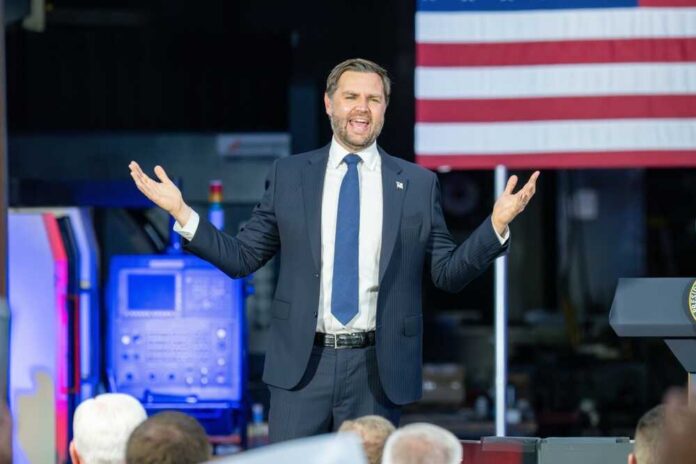
Vice President JD Vance’s public defense of strikes on Iran’s nuclear facilities has created a rift with the very America First base that propelled him to power, raising serious questions about whether political loyalty has trumped the anti-interventionist principles he once championed.
Story Snapshot
- Vance publicly defended Trump’s Iran strikes despite privately expressing skepticism about the military action
- MAGA influencers including Tucker Carlson, Steve Bannon, and Charlie Kirk failed to prevent the bombing campaign they opposed
- The Vice President’s shift from war critic to administration defender threatens his credibility with anti-interventionist conservatives ahead of a potential 2028 presidential run
- Leaked communications reveal Vance pushed for quick strike execution to avoid casualties and leaks, contradicting his public restraint messaging
From War Critic to Conflict Defender
Vance built his national profile as a fierce opponent of endless wars, penning a 2023 op-ed criticizing U.S. interventions in Iraq, Afghanistan, Libya, and Syria. During the 2024 campaign, he warned Americans about the risks of drafts and world wars under non-Trump leadership, positioning himself as a champion of America First restraint. This stance resonated deeply with conservatives exhausted by decades of costly foreign entanglements that drained American blood and treasure while accomplishing little. His pivot to defending strikes on Iran’s nuclear facilities in early March 2026 represents a jarring departure from these foundational principles.
The Vice President attempted to differentiate the Iran operation from previous interventions by emphasizing its limited scope and clear objective of denying Iran nuclear weapons capability. Speaking on Fox News shortly after the strikes, Vance insisted these were not open-ended commitments like Iraq or Afghanistan. However, this framing rings hollow to conservatives who remember similar assurances about previous conflicts that spiraled into protracted occupations. The administration’s inability to provide consistent rationales for the strikes has only deepened skepticism among lawmakers and the conservative base alike.
Internal Divisions and Political Calculations
Leaked communications paint a picture of an administration divided over Iran policy. Sources indicate Vance expressed internal reservations about the strikes during planning stages but ultimately pushed for quick execution to minimize leak risks and potential casualties. This approach reveals the uncomfortable position Vance occupies: balancing personal skepticism with loyalty to President Trump’s final authority on national security matters. His spokesman denied the accuracy of these leaks, but the pattern of internal disagreement followed by public defense has emerged repeatedly, from Yemen Houthi strikes in June 2025 to Venezuela operations.
The political bind Vance faces is particularly acute given the Vice Presidency’s inherent limitations. As constitutional scholars note, the office holds little independent power beyond what the President delegates. Vance cannot publicly oppose Trump’s decisions without triggering a constitutional crisis, yet remaining silent alienates the anti-war faction that views him as their potential standard-bearer for 2028. Conservative influencers like Sohrab Ahmari have openly criticized Vance’s perceived capitulation, while Representative Marjorie Taylor Greene has demanded more vocal opposition. This presents a fundamental problem: defending policies that contradict his stated principles erodes the authenticity conservatives value.
Economic and Strategic Consequences Mount
The Iran strikes have triggered immediate economic fallout, with gas prices spiking as markets react to Middle East instability. Vance addressed these concerns on Fox Business on March 18, 2026, acknowledging the economic pain but defending the action as necessary for national security. This explanation provides little comfort to working Americans already struggling with inflation from years of reckless government spending under the previous administration. The promise of economic relief that helped elect Trump in 2024 now faces headwinds from military action that may prove as costly as it is controversial.
President Trump characterized the strikes as having “completely obliterated” Iran’s nuclear facilities, while Vance offered the more measured assessment that the program was set back “substantially.” This discrepancy in messaging reveals either a lack of coordination or disagreement about the operation’s actual results. For conservatives who demand transparency and accountability from government, these conflicting accounts raise concerns about whether the administration is being forthright about the strikes’ effectiveness and potential for further escalation. The limited objective Vance promised could easily expand if Iran rebuilds or retaliates, trapping America in exactly the kind of commitment he once condemned.
The 2028 Shadow and Conservative Principles
VP scholar Joel Goldstein warns that Vance risks inheriting political fallout from the Iran conflict if it extends into a 2028 presidential campaign. As the presumptive frontrunner for the Republican nomination, Vance must defend his role in an operation that divides the coalition he needs to win. Anti-interventionist conservatives who formed the backbone of Trump’s 2016 victory feel betrayed by what they view as a return to neoconservative adventurism. The failure of Tucker Carlson, Steve Bannon, and Charlie Kirk to prevent the bombing despite vocal opposition demonstrates the restraint faction’s diminished influence within the administration they helped elect.
This situation underscores a broader tension within conservatism between principled opposition to foreign intervention and support for strong executive authority. Vance’s defenders argue the Vice Presidency requires institutional loyalty regardless of personal views, and that targeted strikes with clear objectives align with America First doctrine better than passive acceptance of nuclear threats. Critics counter that true leadership demands vocal dissent when core principles are at stake, and that Vance’s silence during critical decision-making moments represents a failure to use whatever influence the office provides. For conservatives watching closely, this episode will define whether Vance possesses the conviction to resist pressure when it matters most.
Sources:
JD Vance Is Suppressing a GOP Civil War Over Iran. At What Cost?
JD Vance was skeptical of Iran operation, pushed to move quickly once ordered
How Trump and Vance Have Differed on Wars in the Past