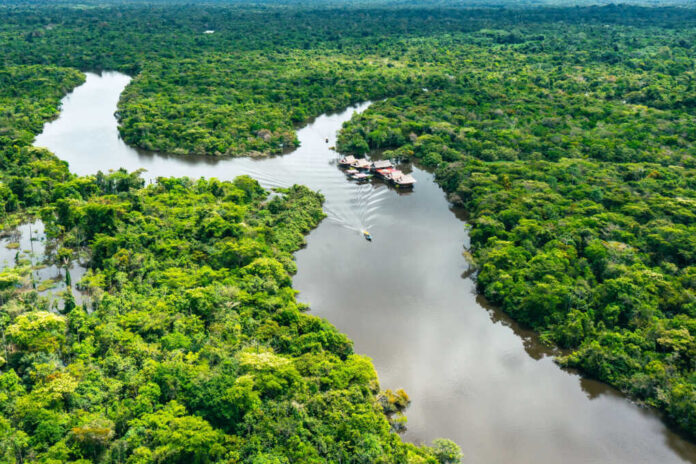
A major new scientific warning suggests rising heat could wipe out the tiny “building blocks” of the Amazon—undercutting pollination, natural cleanup, and food webs that keep ecosystems (and agriculture) functioning.
Quick Take
- A peer-reviewed Nature study assessed heat tolerance in 2,000+ insect species across East Africa and South America.
- Researchers project up to half of Amazon insects could face critical heat stress under continued warming.
- Lowland tropical insects appear less able to “adapt on the fly,” with limits tied to conserved protein stability.
- High-elevation species showed more short-term capacity to adjust than lowland species, widening concerns for rainforest cores.
What the Study Found—and Why the Amazon Looks Uniquely Exposed
Researchers from Julius-Maximilians-Universität Würzburg and the University of Bremen compiled what coverage describes as the largest dataset of its kind, measuring temperature tolerance across elevations and habitats during 2022–2023 fieldwork. The study, later published in Nature, reports that under projected warming, up to half of Amazon insects could reach dangerous heat-stress levels. That matters because insects drive pollination, decomposition, and broader ecosystem stability in the tropics.
Scientists emphasized that the most vulnerable groups are lowland species living closer to their thermal ceiling already. In plain terms, when the baseline environment is already hot and stable, there is less “buffer” before an organism’s biology starts to fail. The reporting highlights a stark contrast: insects from higher elevations showed more ability to increase heat tolerance in the short term, while many lowland species showed limited capacity to do so.
Protein “Hard Limits” Reduce the Odds of Fast, Natural Adaptation
The most consequential detail in the coverage is the proposed mechanism: heat tolerance appears constrained by conserved protein structures. Co-author Marcell Peters is quoted warning that fundamental biological characteristics “cannot be quickly adapted,” and lead author Kim Holzmann says many lowland species largely lack the ability to improve heat tolerance. If protein stability sets a hard ceiling, then policy debates that assume nature will simply adjust—without major tradeoffs—run into a scientific roadblock.
Because the study blends field measurements with genomic analysis, it doesn’t rely only on lab extrapolations. That approach strengthens the inference that the limitation is “built in” for many species rather than a temporary behavioral issue. Even with that strength, the sources still reflect typical scientific uncertainty: the projections depend on future warming trajectories and species-specific thresholds. The findings also focus on measured groups such as moths, flies, and beetles, not every insect in the Amazon.
Why Conservatives Should Care: Food, Forest Stability, and Real-World Costs
The research is not a partisan document, but the implications land squarely in real life. If insect populations crash, pollination and decomposition can falter, affecting crops, forests, and the natural systems that support local communities. Coverage notes potential agricultural losses and social costs for people who rely on intact forests, while also stressing that direct economic estimates were limited in the available reporting. Even without a price tag, the ecological dependence is straightforward and hard to dismiss.
What’s Known, What’s Not, and What to Watch Next
The reporting around this release was consistent across outlets and university statements, with no clear contradictions. That consistency, plus a Nature publication, makes the core claim hard to wave away: many tropical lowland insects may be near their heat limits already. What’s missing is an intervention timeline—no specific mitigation or adaptation program is described in the sources beyond calls for attention to warming risks and biodiversity protection.
Half of Amazon insects could face dangerous heat stress
A sweeping new study of more than 2,000 insect species reveals a troubling reality: many insects may be far less capable of coping with rising temperatures than scientists once hoped. Researchers found that while some…
— The Something Guy 🇿🇦 (@thesomethingguy) March 5, 2026
For Americans exhausted by politicized “expert class” narratives, the key takeaway is to separate measurable biology from ideological slogans. The study’s warning is about physical limits, not fashionable messaging: once critical thresholds are crossed, ecosystems can destabilize quickly. Watch for follow-up research that narrows which Amazon regions face the earliest risk, how quickly insect communities shift, and whether land-management decisions can preserve cooler microhabitats even as broader temperatures rise.
Sources:
Half of Amazon insects could face dangerous heat stress
Climate change pushes tropical insects to their heat limit
Climate change pushes tropical insects to their heat limit
Birds are vanishing from tropical forests. Is another ‘Silent Spring’ coming?