

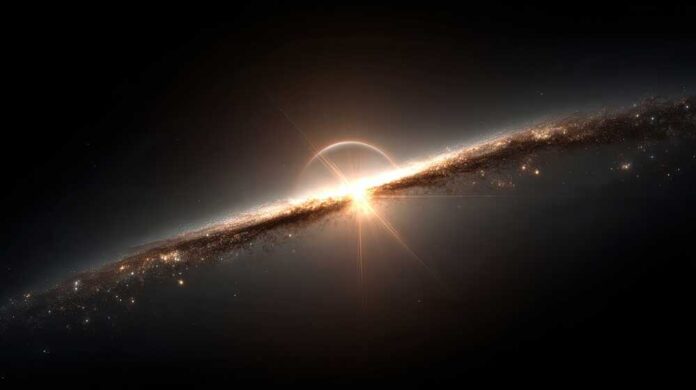
Somewhere in the black heart of the universe, two monstrous black holes locked in a cosmic dance send a jet of plasma arcing through space—just revealed by a telescope so vast it defies imagination.
Story Snapshot
- A virtual telescope larger than Earth captured the mysterious core of the OJ 287 galaxy.
- Researchers observed a curved plasma jet swirling around two merging supermassive black holes.
- The findings expose extreme energy levels and shockwaves inside the jet structure.
- This glimpse into a galactic heart could reshape our understanding of cosmic evolution and black hole mergers.
Earth-Sized Telescope Peers into a Galactic Abyss
Scientists orchestrated a global array of radio telescopes, forming a single virtual instrument that dwarfs our planet. The result: an unprecedented image of the OJ 287 galaxy’s core, a region previously shrouded in cosmic mystery. This accomplishment marks a milestone for radio astronomy, matching and even exceeding the ambition behind projects like the Event Horizon Telescope. The team’s efforts show how collaborative technology can unlock secrets lurking billions of light-years away.
The OJ 287 galaxy, a distant blazar, has long fascinated astronomers for its unpredictable flares and strange brightness patterns. Until now, the precise source of its wild behavior remained speculative. By linking telescopes across continents, researchers synthesized an Earth-sized dish able to resolve the galaxy’s hidden heart. The extraordinary clarity revealed not just a single black hole, but evidence of two supermassive black holes in the midst of a gravitational embrace, their immense energies twisting space and time itself.
A telescope larger than Earth just revealed the hidden heart of a mysterious galaxy – https://t.co/cWB1Awa8Iu
— Ken Gusler (@kgusler) October 14, 2025
Revealing the Curved Plasma Jet
High-resolution images show a curved jet of plasma spiraling outward from the central region of OJ 287. The jet’s shape and motion suggest it is being contorted by the gravity of the merging black holes—a scenario theorized but rarely observed with such clarity. Plasma jets, composed of charged particles moving at near-light speeds, channel colossal energy away from their source. In OJ 287, the jet’s curvature hints at the powerful gravitational tug-of-war shaping its path, confirming predictions from simulations of black hole mergers.
Shockwaves within the plasma jet punctuate the scene, marking regions where matter accelerates and collides at incomprehensible speeds. These shockwaves not only illuminate the jet’s structure but also provide clues about the mechanisms fueling its relentless energy output. Scientists can now probe the physics of these shockwaves, seeking to understand the origins of the galaxy’s erratic flares and the broader impact of such jets on surrounding interstellar material.
Implications for Black Hole Science and Galaxy Evolution
The discovery of two merging supermassive black holes at OJ 287’s core provides a live laboratory for studying gravitational dynamics on a cosmic scale. As the black holes spiral closer, they emit gravitational waves—ripples in spacetime predicted by Einstein and now detectable by sensitive instruments. These waves carry information about the black holes’ masses, spins, and the geometry of their orbits, offering an opportunity to test fundamental physics in extreme environments.
On a grander scale, the process observed in OJ 287 could mirror the fate of many galaxies, including our own, as collisions and mergers shape the universe over billions of years. The energy released during black hole mergers can influence star formation, regulate galactic growth, and even seed new cosmic structures. As astronomers refine their techniques, more hidden galactic hearts may be unveiled, each telling a story of chaos, creation, and the relentless power of gravity.
Sources:
https://www.sciencedaily.com/releases/2025/10/251014014435.htm
https://www.miragenews.com/telescope-larger-than-earth-just-revealed-1550945/