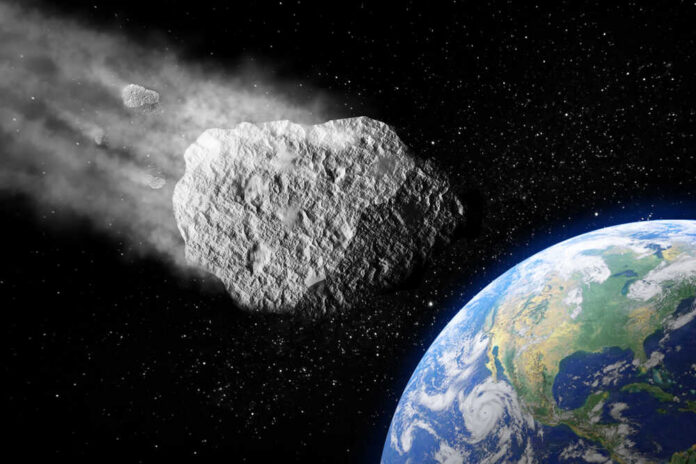
Scientists confirmed a 160-meter asteroid slammed into the North Sea 43 million years ago, unleashing a 330-foot tsunami that reshaped northern European coastlines—a revelation settling a heated 20-year debate and highlighting catastrophic threats our planet faces from space.
Story Snapshot
- Researchers at Heriot-Watt University confirmed the Silverpit Crater resulted from an asteroid impact using shocked quartz crystals and advanced 3D seismic data
- The low-angle impact 80 miles off Yorkshire generated a 1.5-kilometer curtain of rock and water that collapsed, triggering a tsunami exceeding 100 meters
- Discovery overturns 2009 geologist consensus that rejected impact theory in favor of salt tectonics or volcanic activity
- The asteroid struck when the North Sea was shallower, creating one of only 33 known oceanic impact craters worldwide
Two Decades of Scientific Debate Resolved
The Silverpit Crater, discovered in 2002 through seismic surveys, presented geologists with a puzzling three-kilometer-wide formation featuring 20 kilometers of concentric fault rings buried 700 meters beneath the seabed. Initially proposed as an asteroid impact site, the hypothesis faced stiff resistance from scientists who favored alternative explanations including salt dome collapse and volcanic activity. In 2009, geologists formally voted to reject the impact theory, leaving the crater’s origins mired in uncertainty. That rejection stood until researchers at Heriot-Watt University obtained high-resolution 3D seismic data and critical well samples from oil exploration operations, providing the evidence needed to definitively solve the mystery.
Shocking Evidence Proves Catastrophic Impact
Dr. Uisdean Nicholson, a sedimentologist at Heriot-Watt University, led the team that discovered shocked quartz and feldspar crystals in samples retrieved from oil wells near the crater. These mineral signatures serve as unambiguous proof of hypervelocity impact, forming only under extreme pressures that occur when asteroids strike at cosmic speeds. The crystals acted as a “smoking gun,” eliminating geological alternatives that cannot produce such dramatic mineral transformations. Professor Gareth Collins from Imperial College London, who participated in the 2009 debate, acknowledged the impact hypothesis represented the simplest explanation all along, validating what evidence now confirms beyond dispute.
Ancient Tsunami Devastated Proto-European Coasts
Computer models reconstructed the impact sequence revealing the 160-meter asteroid struck at a low angle during the Eocene epoch when water depths ranged between 50 and 300 meters. The collision instantly vaporized rock and seawater, creating a towering curtain of debris reaching 1.5 kilometers skyward before collapsing within minutes. This collapse generated tsunami waves exceeding 100 meters in height that propagated across the ancient North Atlantic, flooding coastal regions and reshaping sediments along what would become northern Europe. While the event caused significant local ecological disruption to marine and nearshore ecosystems, it produced no global mass extinction, distinguishing it from larger impacts like the Chicxulub asteroid that eliminated the dinosaurs.
Rare Oceanic Crater Enhances Planetary Defense
The Silverpit confirmation adds to humanity’s limited catalog of approximately 33 known oceanic impact craters, expanding scientific understanding of asteroid threats that strike water rather than land. This research demonstrates that asteroids around 200 meters in diameter can generate tsunamis far exceeding modern recorded waves, emphasizing risks coastal populations face from future oceanic impacts. The collaboration between academic researchers and the oil industry proved essential, as petroleum exploration provided both the sophisticated seismic imaging technology and physical samples necessary for breakthrough analysis. Scientists continue examining the crater’s deep fractures and shock wave propagation patterns, refining models that predict how similar future events might unfold and inform planetary defense strategies protecting American coastlines and global stability.
Published in September 2025 in Communications Earth & Environment, the peer-reviewed study represents conclusive scientific consensus built on empirical evidence rather than speculation. The discovery underscores how advanced technology and persistent investigation reveal Earth’s violent cosmic history, reminding us that catastrophic asteroid impacts remain ongoing threats requiring vigilance and preparation to protect our nation and civilization from sudden destruction.
Sources:
Evidence of an ancient asteroid impact in the North Sea – EarthSky
Groundbreaking Discovery: 100-Meter Tsunami in the North Sea – Techno-Science
Scientists Find Proof That an Asteroid Hit the North Sea Over 43 Million Years Ago – ScienceSprings
Scientists Find Proof That an Asteroid Hit the North Sea – Phys.org
Ancient Asteroid Impact in North Sea Confirmed – ScienceDaily
Giant Asteroid Struck North Sea Unleashing 330-Feet Tsunami – SciTechDaily