
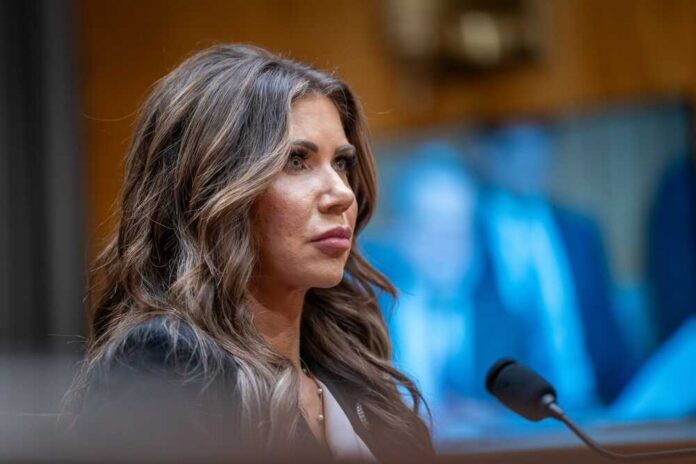
As Washington churns over personnel drama, President Trump is quietly turning Kristi Noem’s DHS exit into a hemispheric offensive against cartels and the failed open-border policies of the past.
Story Snapshot
- Trump removed Kristi Noem as DHS chief but immediately elevated her as special envoy for the new Shield of the Americas security initiative.
- The move shifts Noem from domestic firefights at DHS to leading regional cooperation with 11 Latin American nations against cartels and traffickers.
- Senator Markwayne Mullin will take over DHS on March 31, keeping immigration enforcement and border security on a hard‑line track.
- Shield of the Americas signals a broader America First strategy: push the border fight into the Western Hemisphere instead of absorbing chaos at home.
Trump Turns a Cabinet Shake-Up Into a Regional Security Play
President Trump’s decision to remove Kristi Noem as Homeland Security secretary and immediately install her as special envoy for the newly created Shield of the Americas initiative has sparked headlines focused on palace intrigue, but the underlying strategy points in a very different direction. Instead of sidelining a wounded official, the White House is redeploying her to a role built from the ground up to advance hemispheric security, drug enforcement, and a tougher regional approach after years of Biden‑era drift.
The timeline underscores how deliberate the shift appears. In early March, Trump announced both Noem’s removal from DHS and her appointment to the envoy role, followed almost immediately by a Shield of the Americas summit at Trump National Doral in Florida. That gathering, held March 7 with leaders from eleven Latin American nations, was not thrown together overnight. It reflects months of planning to move border and cartel policy beyond symbolism and into structured, multinational cooperation.
From Contentious DHS Tenure to High-Profile Envoy Role
Kristi Noem did not leave DHS on a quiet note. Her tenure drew criticism over an ad campaign she said had Trump’s approval, internal management clashes, and two heated congressional hearings where even some Republicans pressed her on leadership decisions. Immigration enforcement policy and the sheer scale of deportations became flashpoints. Yet instead of cutting her loose, Trump created a dedicated diplomatic role that keeps her in the inner circle while pulling her out of day‑to‑day departmental turmoil.
For many conservatives frustrated by years of performative border talk and little structural change, this shift matters. DHS remains central to enforcement, but Shield of the Americas recognizes that cartels operate far beyond the Rio Grande. By moving Noem into a job explicitly focused on coordinating with Latin American partners, the administration is betting that squeezing the cartels’ supply chains, finances, and safe havens abroad will do more to protect American communities than any single domestic operation. It also signals a willingness to rethink institutions rather than simply defend existing bureaucracies.
Shield of the Americas: Pushing the Border Fight Southward
The Shield of the Americas framework grows directly out of Trump’s America First security thinking: secure the homeland by reshaping conditions in the broader Western Hemisphere. Instead of treating border chaos as an unavoidable byproduct of globalism, the initiative aims to build a coalition of willing partners focused on cartel crackdowns, drug trafficking routes, and cross‑border criminal networks that profit from weak enforcement and political complacency. The summit’s agenda centers on coordinated action, not speeches about vague “root causes.”
At the Doral summit, Noem publicly thanked Trump for creating the special envoy role and framed Shield of the Americas as a model for what is possible when nations refuse to normalize lawlessness. She highlighted the administration’s record on removals and deportations as a foundation, then pointed to a forthcoming “big agreement” on going after cartels and traffickers. For conservatives, that combination—tough enforcement at home plus organized pressure abroad—answers years of frustration with open‑border rhetoric and soft‑on‑crime diplomacy under prior leadership.
New DHS Leadership and What It Means for Immigration Enforcement
Senator Markwayne Mullin’s scheduled takeover of DHS on March 31 ensures that the department’s leadership will remain firmly aligned with Trump’s immigration and security agenda. The staggered transition allows for continuity in active operations while Noem shifts to her envoy post. For border agents, sheriffs, and communities that bore the brunt of Biden‑era surges, the signal is clear: enforcement is not being dialed back to accommodate diplomatic experiments; instead, diplomacy is being redesigned to support enforcement.
Kristi Noem appears with Trump in new ‘Shield of the Americas’ role – days after he fired her from DHS https://t.co/gV4RKnlH4W
— The Independent (@Independent) March 7, 2026
The notable absences at the summit—particularly from Mexico and Venezuela—also tell a story your average beltway pundit ignores. Nations unwilling to stand shoulder‑to‑shoulder against cartels and traffickers are effectively choosing the status quo that has flooded American streets with fentanyl, empowered violent gangs, and strained border communities. By moving ahead with eleven participating countries, Trump and Noem are drawing a line: cooperation is available, but Washington will not wait on reluctant governments while American families pay the price.
Sources:
Noem thanks Trump for new Shield of the Americas special envoy role after DHS ouster – Fox News