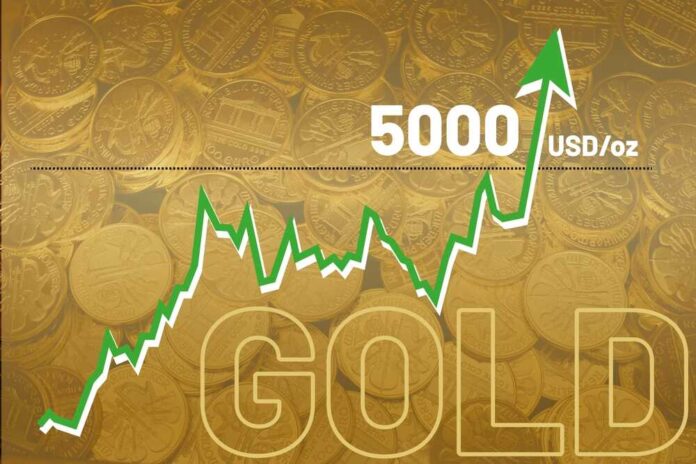
Gold ripping toward $5,600 isn’t just a market headline—it’s a real-time stress test of whether the world believes Washington can keep Iran from going nuclear without stumbling into a wider war.
Story Snapshot
- Gold hit a record near $5,600 on Jan. 29, 2026 as U.S.-Iran tensions spiked after President Trump warned Tehran over its nuclear program.
- Trump’s Truth Social message and the reported movement of a U.S. naval “armada,” led by the USS Abraham Lincoln, drove a surge in safe-haven buying.
- Iran’s foreign minister warned any attack would be met with an immediate response, while leaving the door open to a new deal.
- Oil and silver rallied alongside gold, while markets stayed mixed and the Federal Reserve’s latest decision did not change the risk picture.
Gold’s $5,600 surge tracks escalating U.S.-Iran risk
Gold prices surged to a record near $5,600 per ounce in early Asian trading on Jan. 29, 2026, after reports of rising U.S.-Iran tensions pushed investors into traditional safe havens. The move followed President Donald Trump’s warning to Iran over its nuclear program and came as the U.S. dollar weakened. Oil prices climbed on supply-risk fears, and silver also jumped as traders piled into metals.
Market action lined up with a familiar pattern: when war risk rises, investors often buy assets viewed as insurance against chaos. Analysts cited in the reporting described the move as partly geopolitical and partly about confidence in policy direction. The Federal Reserve’s latest policy announcement was described as uneventful, leaving headlines and troop movements—not interest-rate surprises—as the immediate driver of volatility across commodities and currencies.
Watch: https://youtu.be/onXd_Zp7Fh0?si=JbH0SJp7H3OKwWRp
Trump’s warning and the carrier “armada” sharpen the message to Tehran
Trump’s message on Jan. 28 urged Iran to negotiate and insisted on “NO NUCLEAR WEAPONS,” while warning that a future attack could be “far worse.” Reporting also referenced a U.S. naval buildup described as an “armada,” led by the USS Abraham Lincoln, positioned for operations in Middle East waters. The posture signals leverage: military readiness paired with a demand for a deal that blocks a weapons capability.
Iran’s Foreign Minister Abbas Araghchi answered with a warning of immediate forceful retaliation if attacked, saying Iranian forces had “fingers on the trigger,” while also indicating Iran remained open to a renewed agreement. That combination—threats plus a door left open—suggests both sides are trying to deter the other while keeping diplomacy available. The research does not confirm imminent strikes, but it does confirm heightened readiness and hardened messaging.
Oil and currency moves show how fast global costs can rise
Oil prices rose in tandem with gold, reflecting how quickly Middle East risk can translate into higher energy costs. Reported pricing had U.S. crude (WTI) up roughly 1.6% near $64.24 and Brent up about 1.5% near $69.43. Currency markets also reflected stress, with the dollar weaker against major peers. Those shifts matter to households: higher oil can pressure prices at the pump and ripple into shipping and food costs.
Equities did not share the same clean direction, with mixed performance reported across regions and pockets of sharp weakness in emerging-market trading. That divergence fits a classic risk-off sequence: money rotates into “defensive” assets like gold while growth assets react unevenly. The underlying takeaway for Main Street is straightforward—foreign policy risk does not stay overseas; it can reappear as higher costs and tighter financial conditions at home.
What the rally says about trust, the Fed, and America’s leverage
Some commentary in the research framed gold’s rise as more than a fear trade, casting it as a referendum on confidence in “fiat stewardship” and policy credibility. Other analysts suggested the pressure could be short-lived, with risk premiums fading if tensions cool. Both views can be true at once: a short-term spike can still reveal deeper nerves about government finances, central-bank credibility, and whether global stability is being managed competently.
Updates:
👉 Turkey to offer help resolving US-Iran tension
👉 Gold soars towards $5,600 as Trump rattles sabre over Iran
👉 Kremlin says room for negotiation on Iran 'not exhausted'🔴 Live blog: https://t.co/KxTuZTST8n
— The New Arab (@The_NewArab) January 29, 2026
The reporting also placed the moves in a broader policy backdrop, including attention to the Fed’s direction as Chair Jerome Powell’s exit approaches in May 2026 and market focus on future leadership. At minimum, this episode highlights how fast geopolitics can dominate economic fundamentals. For Americans who want secure borders, affordable energy, and constitutional stability, the practical question is whether Washington can project strength abroad without triggering the kind of prolonged conflict that punishes families through higher prices.
Sources:
Gold soars towards $5,600 as Trump rattles sabre over Iran
Gold hits record near 5600 as Trump ramps up Iran threats