
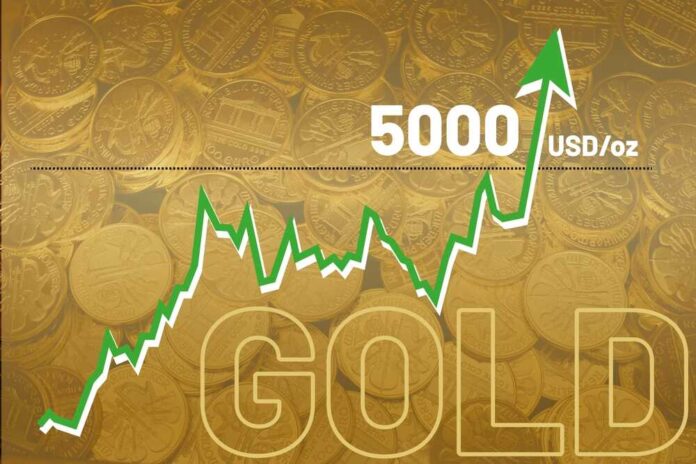
Gold prices soaring past $5,000 per ounce serve as a staggering warning against government bonds, igniting concern among fiscal conservatives.
Story Highlights
- Gold surpasses $5,000 per ounce, driven by Trump’s policies.
- Investor anxiety rises over U.S. Treasury stability.
- Central bank independence is threatened amid global tensions.
- Forecasts suggest potential further gold price increases.
Gold Surges as Investors Seek Safe Haven
On January 25, 2026, gold prices reached a historic $5,058 per ounce, marking a significant shift as investors flock to safe-haven assets. This surge reflects growing unease over President Donald Trump’s policies, including tariff threats and military actions, which have led to market volatility. The increase in gold prices highlights a broader lack of confidence in government bonds, with many questioning the stability of fiat currencies in this tumultuous political climate.
Silver also experienced a notable rise, reaching $107.8 per ounce. The upward trend in precious metals is not merely a reaction to inflation or interest rate changes but stems from the geopolitical unpredictability introduced by the current administration. Trump’s aggressive foreign policy stance, particularly in Venezuela and threats against Canada, has led to increased demand for assets perceived as stable, such as gold and silver.
Watch: https://www.youtube.com/watch?v=4ldg5dt3Jms
Impact on Government Bonds
The unprecedented rise in gold prices serves as a stark warning to government bond markets. With gold acting as a barometer for investor anxiety, concerns about U.S. Treasury stability are surfacing. The fear of fiscal mismanagement and policy unpredictability under Trump’s leadership is prompting investors to reconsider their reliance on traditional government securities. Analysts from major banks such as Goldman Sachs and Bank of America forecast even higher gold prices, suggesting continued market instability.
The response from global central banks, who are major buyers of gold, further underscores the declining confidence in fiat currencies. These institutions are increasingly turning to precious metals as a hedge against potential economic disruptions. This shift indicates a significant change in the financial landscape, where metals are gaining preference over bonds as the go-to safe-haven asset.
Broader Economic and Political Implications
The rise in gold prices reflects broader economic and political implications, including a weaker U.S. dollar and persistent inflation. The ongoing tariff threats and geopolitical tensions have strained relationships with global allies, contributing to a sense of instability. The Federal Reserve’s credibility is also under threat, as its independence appears compromised by political pressures, such as the criminal probe into Fed Chair Jerome Powell.
In the long-term, if these trends persist, the market may continue to see a flight from bonds and stocks to precious metals. This would not only impact investors but also exporters facing tariff risks and retirees whose purchasing power is eroded. Although the rally has created opportunities for miners and bullion firms, the broader economic consequences could lead to heightened global anxiety and potential trade war revivals.
Sources:
Gold tops $5,000 as concerns over Trump upending global relations drive historic rally
Gold now costs more than $5,000 an ounce: Here’s how it got to this milestone price
Forget $5,000, Bank of America sees gold price hitting $6,000/oz spring 2026