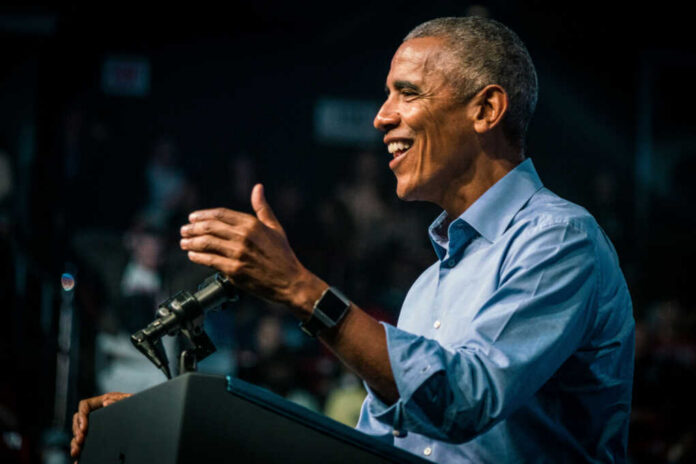
Barack Obama is using the opening of his presidential center for a high-profile, prime-time interview with one of late night’s most openly political hosts—right as that host’s show winds down.
Quick Take
- Stephen Colbert is set to interview Barack Obama on May 5, 2026, airing from the Obama Presidential Center in Chicago.
- The interview is billed as Obama’s first televised sit-down from the center, which is scheduled to officially open June 19, 2026.
- The segment lands during the final weeks of “The Late Show,” which is slated to end May 21 after CBS/Paramount canceled it amid reports of major annual losses.
- Colbert’s long-running ties to Democratic politics are part of the backlash, including his role hosting a major 2024 fundraiser involving Obama.
Why the Obama–Colbert booking is drawing heat
Stephen Colbert will interview former President Barack Obama on May 5, 2026, with the episode airing from the Obama Presidential Center in Chicago. The appearance is being promoted as Obama’s first televised interview from the newly opening complex, which is scheduled to officially open on June 19, 2026. For many conservatives, the immediate question is less “why Colbert?” than why a taxpayer-adjacent civic institution is being introduced through a late-night political brand.
From a media strategy standpoint, the selection makes sense: late-night TV still offers soft-focus questions and friendly framing. But the political optics are unavoidable because Colbert is not viewed as a neutral entertainer. He has become a reliable voice for Democratic narratives, and critics argue that this kind of platforming blurs the line between cultural programming and partisan messaging. The research provided shows that conservative commentary has already framed the booking as further evidence that entertainment and politics now operate as one ecosystem.
The timing: a farewell tour for “The Late Show”
The interview is also landing at a unique moment for Colbert. It is set during the final weeks of “The Late Show,” which ends on May 21 after CBS and Paramount canceled the program. Reported annual losses exceeding $40 million have been cited in coverage of the cancellation. That context matters because it turns the Obama sit-down into a kind of capstone event—an episode designed to generate attention and legitimacy during a highly scrutinized exit.
For viewers already frustrated with elite institutions, the cancellation backdrop can cut two ways. Some will see a failing show leaning harder into politics to rally its base; others will see a network using a former president to create a headline and draw viewers. Either way, the event reinforces a broader 2020s trend: legacy media chasing polarizing, partisan-adjacent content because it still produces engagement even when profitability and trust decline.
Colbert and Obama have a long on-air history
The planned interview is not a one-off relationship. Colbert and Obama have a documented history of televised appearances together, including three on “The Colbert Report” and two prior interviews on “The Late Show,” in 2016 and 2020. That familiarity makes the May 5 sit-down easier to book and easier to manage. It also feeds skepticism among conservatives who doubt the interview will be adversarial on issues like inflation, border enforcement, or energy policy.
The research also notes Colbert’s direct involvement in Democratic politics, including hosting a 2024 fundraiser reported at $26 million involving Joe Biden, Hillary Clinton, and Barack Obama. That fact is central to why critics label the interview less as journalism and more as friendly promotion. A fair reading is that the fundraiser does not prove coordination around the presidential center’s messaging, but it does explain why the booking strikes many Americans as insider politics wearing a comedy-show costume.
What this signals about politics, culture, and public trust
The dispute over this interview is bigger than two famous names. Conservatives often argue that elite cultural institutions—from universities to media—tilt left and then insist they are “nonpartisan,” fueling distrust. Liberals, meanwhile, tend to view Republican criticism of media as a pretext to discredit unfavorable coverage. The facts in the research don’t resolve that clash, but they do show why suspicion persists: a former president is debuting a major civic project through a host with a well-known partisan record.
OF COURSE: Democrat Propagandist Stephen Colbert to Interview Obama at Opening of His Presidential Center
READ: https://t.co/iRJWc7iZbP pic.twitter.com/AmJfI6fJ2J
— The Gateway Pundit (@gatewaypundit) April 25, 2026
In 2026, with Republicans controlling Congress and Donald Trump back in the White House, Democrats have incentives to keep cultural megaphones loud even when electoral power is limited. At the same time, Americans of all stripes who believe the “deep state” and elite networks protect their own will see another example of interconnected influence—politics, money, and media reinforcing one another. Limited public details about the interview’s format, topics, and conditions leave key transparency questions unanswered.
Sources:
Obama chooses supporter Stephen Colbert for debut interview at controversial presidential center
Obama Sticks It to Trump With Huge Favor to Stephen Colbert
Stephen Colbert to Interview Barack Obama During Final Weeks of ‘The Late Show’