
As American forces pound Iran’s military sites and Tehran fires back at our Gulf bases, President Trump’s push to keep the Strait of Hormuz open has turned into a full‑scale test of U.S. strength, resolve, and limits.
Story Snapshot
- U.S. strikes aim to crush Iran’s ability to attack civilian shipping and enforce a renewed naval blockade.
- Iran is answering by hitting U.S. bases in Bahrain, Kuwait, Qatar, Jordan, and Oman, plus closing the Strait of Hormuz.
- The Trump administration says it is defending global energy flows and stopping Iran from using oil and terror as weapons.
- Experts warn Iran’s missile and drone network is bruised but still dangerous, meaning this fight could drag on.
U.S. Strikes Aim to Protect Shipping and Reassert Control
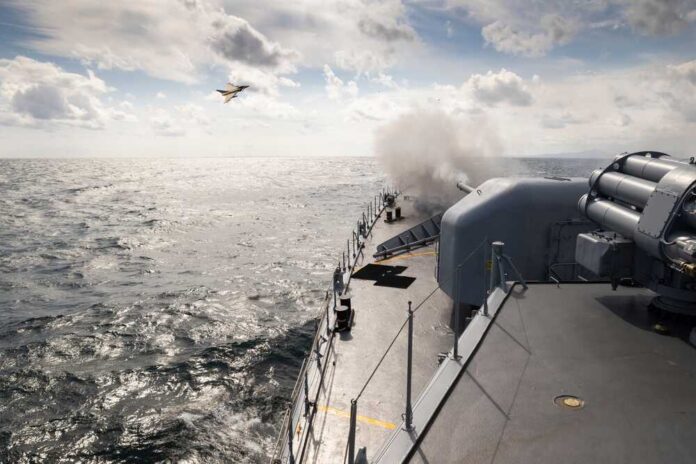
The United States military is hitting Iran hard along its southern coast, focusing on sites tied directly to attacks on commercial ships in the Strait of Hormuz. Central Command says recent waves of strikes have targeted air defense systems, coastal radar, anti‑ship missile launchers, drone storage areas, mine‑laying boats, and fast attack craft used to harass tankers. Officials frame these actions as “retaliatory” and “defensive,” responding to Iranian drone and missile attacks on tankers and cargo ships that were simply trying to move oil and goods through a vital international waterway.
To increase pressure, the Trump administration has reinstated a blockade on vessels “to and from Iranian ports and coastal areas,” tightening the squeeze on Iran’s economy and its ability to export oil. Central Command says the goal is to “degrade Iranian capabilities” that threaten freedom of navigation, not to punish the Iranian people. But the scale is large: U.S. statements and media reports describe strikes on roughly 80 targets in one night and about 300 over three nights, including missile and drone sites, naval depots, ammunition storage, and communications nodes. This fits a wider campaign that began with Operation Epic Fury in February, when U.S. and Israeli forces hit hundreds of Iranian military targets in a single day to break its strike capacity and block nuclear ambitions.
Iran Hits U.S. Gulf Allies and Shuts the Strait
Iran is not rolling over. Tehran’s leaders call the U.S. actions “aggression” and say they are answering with their own strikes on U.S. forces and partners across the Gulf. Iranian state media and the Islamic Revolutionary Guard Corps claim missile and drone attacks on American bases and facilities in Bahrain, Kuwait, Qatar, Jordan, and Oman, showing they can still hit regional targets even after heavy U.S. bombing. Iran also says U.S. strikes have injured more than 260 people and damaged civilian infrastructure, though those casualty numbers come from Iranian officials and have not been confirmed by independent groups.
Iran has gone a step further by declaring the Strait of Hormuz closed “until the end of U.S. interference” and firing on commercial vessels it says are using “unapproved” routes. Its forces have claimed responsibility for attacks on several tankers, including a Panamanian‑flagged ship and a Cyprus‑flagged container vessel, saying these were warnings to ships ignoring Iranian rules. Iranian negotiators insist the strait will only reopen “with Iranian arrangements, not American threats,” arguing they have the right to control traffic off their shores. However, international shipping bodies and many governments treat the strait as an international passage where no single country can lawfully charge tolls or shut it at will, and some Gulf states have publicly blamed Iran for the tanker incidents.
Strategic Stakes: Oil, Power, and Trump’s Political Promise
The Strait of Hormuz carries about one‑fifth of the world’s traded oil and natural gas, so this clash hits energy prices, family budgets, and broader global stability. Since the crisis began, oil has spiked after each tanker attack or closure threat, feeding higher fuel and food costs at home that many Trump supporters already resent after years of inflation and green‑agenda pressure. Trump argues that decisive action now prevents Iran from turning the world’s fuel lifeline into a permanent hostage situation, and he has even floated charging a 20 percent protection fee on ships using U.S. naval escorts, a plan some of his own advisers question under international law.
Analysts say these latest strikes show both American power and its limits. U.S. bombs and missiles can destroy radar sites, launchers, and boats, but Iran’s dispersed missile and drone program gives it room to absorb losses and keep firing. Experts note that despite repeated U.S. waves hitting 80 or more sites at a time, Iran still launches enough missiles and drones to threaten bases and shipping and to close parts of the strait when it chooses. This pattern of ceasefire, violation, retaliation, and new deal has repeated several times since spring 2026, with each flare‑up lasting a few days before cooling, but never fully ending the risk.
What It Means for Conservatives at Home
For many conservative Americans, this showdown is about more than distant shipping lanes. It touches core beliefs about strong borders, reliable energy, and a federal government that should defend citizens rather than chase “woke” climate schemes or bow to global elites. Trump’s team stresses that keeping Hormuz open protects U.S. drivers from foreign price shocks, supports domestic production by stabilizing markets, and sends a message that America will not let a radical regime weaponize oil or terror. At the same time, some critics warn about “mission creep,” noting the conflict has stretched far beyond early expectations and raising concerns about long‑term deployments, costs, and the risk of dragging America into another endless Middle East war.
US, Iran trade fresh strikes as Hormuz conflict escalates
The United States struck Iran and Tehran hit back at US allies in the Gulf on Thursday, as the foes battled over the vital Strait of Hormuz in the renewed Middle East war …read more pic.twitter.com/aPsglhbCiy
— OGTV Abeokuta (@OgunTV) July 16, 2026
The key tension for patriots is clear. Many support crushing Iran’s ability to hit our ships and bases and applaud Trump’s refusal to let Tehran gain nuclear weapons or strangle the world’s fuel supply. Yet they also demand that any operation stay focused, constitutional, and tied to clear American interests, not globalist dreams or permanent policing of every foreign waterway. As strikes and counter‑strikes continue, the test for this administration will be delivering real safety for U.S. troops, shippers, and families while avoiding a drawn‑out quagmire, protecting our energy security, and keeping faith with the promises that put Trump back in the White House.
Sources:
youtube.com, bbc.com, nytimes.com, washingtonpost.com, cnbc.com, reuters.com, apnews.com, aljazeera.com, jpost.com, cbsnews.com, cnn.com, axios.com, wsj.com