

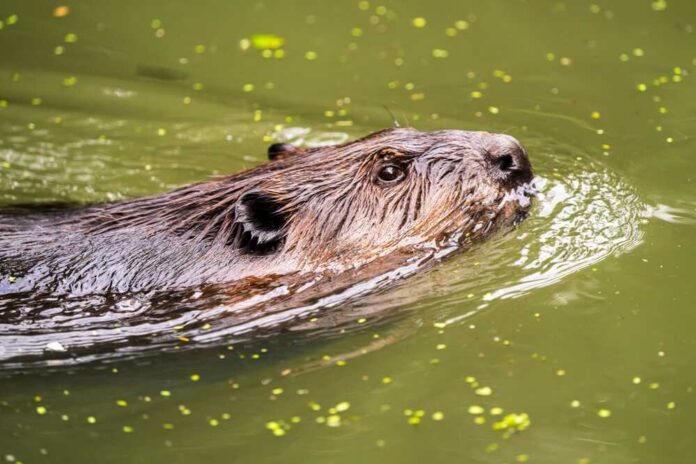
Beavers emerge as nature’s free carbon capture machines, storing up to 10 times more carbon than untouched streams—offering a practical alternative to bloated government climate schemes.
Story Highlights
- Swiss study shows beaver wetlands store 1,194 tonnes of carbon over 13 years, equivalent to 10.1 tonnes CO₂ per hectare annually.
- Beaver activity turns streams into net carbon sinks at 98.3 tonnes per year, with negligible methane emissions.
- Cost-free ecosystem engineering supports rewilding without taxpayer-funded interventions.
- U.S. precedents confirm beavers boost carbon storage in meadows, informing practical land management.
Beaver Transformation in Swiss Stream Corridor
University of Birmingham-led researchers analyzed a northern Switzerland stream where beavers began activity around 2010-2013. Over 13 years, dams slowed water flow, trapped sediments, and expanded wetlands. Sediments accumulated 14 times more inorganic carbon and 8 times more organic carbon than nearby forest soils. The site now functions as a persistent net carbon sink of 98.3 ± 33.4 tonnes per year. This first comprehensive European carbon budget highlights beavers’ role without relying on expensive human interventions.
Mechanisms Driving Carbon Storage
Beavers engineer landscapes by building dams that retain organic matter and sediments. Riparian forests contribute about 50% of long-term carbon through deadwood storage. The study combined hydrology data, chemistry analysis, sediment sampling, greenhouse gas monitoring, and modeling. Negligible methane emissions stand below 0.1%, despite summer CO₂ releases from exposed sediments. Annual net sequestration reaches rates 10 times higher than unbeaverized systems, demonstrating reliable, passive carbon dynamics.
Expert Insights from Lead Researchers
Dr. Joshua Larsen of University of Birmingham stated beavers turn streams into powerful carbon sinks, creating opportunities for nature-based solutions across Europe. Dr. Lukas Hallberg, corresponding author, noted the site’s transformation within a decade underscores beaver-led restoration potential. Dr. Annegret Larsen from Wageningen University called beavers powerful agents of carbon capture that reshape waterways and build wetland habitats. These academics advocate rewilding informed by data, not mandates.
Scalability and Broader Implications
Researchers project scaling beaver activity to Swiss floodplains could offset 1.2-1.8% of national emissions at zero cost. U.S. studies from UC Davis show similar enhancements in mountain meadows, storing significant greenhouse gases. Long-term storage persists for decades if dams remain intact, though short-term summer emissions occur. Swiss communities gain flood mitigation and biodiversity benefits, while landowners face potential wetland expansion. This aligns with practical stewardship over globalist overreach.
Practical Lessons for American Landowners
Beaver reintroduction, once halted by overhunting, now recolonizes Europe via rewilding since the 20th century. In America, under President Trump’s focus on efficient resource management, these findings offer common-sense tools for private land carbon enhancement. Farmers and ranchers can leverage beavers for flood control and soil retention without federal subsidies. Limited data notes dam failure risks, but overall evidence supports targeted encouragement of these ecosystem engineers on suitable properties.
Sources:
EurekAlert: Beavers can convert stream corridors to persistent carbon sinks
University of Birmingham: Beavers can turn riverbeds into powerful carbon sinks, new research shows
Wageningen University: Beavers can turn riverbeds into powerful carbon sinks
Martinez Beavers: Beavers and Carbon Sinks
UC Davis: Beavers, Meadows, and Climate Change