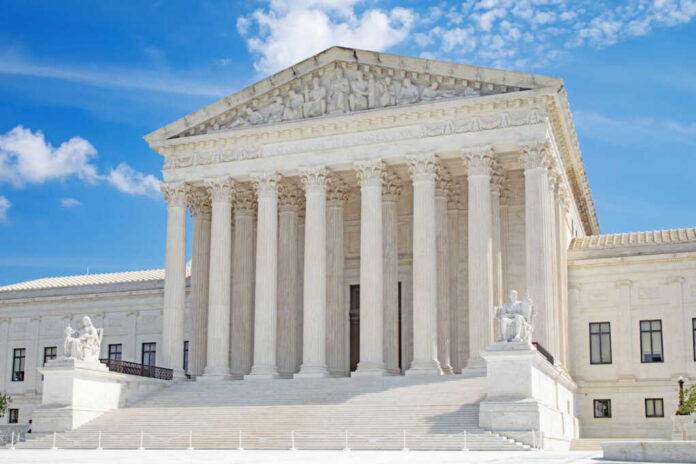
The Supreme Court showdown over birthright citizenship could redefine who counts as an American at birth—and whether the Constitution allows a president to curb what many see as “anchor-baby” incentives.
Story Highlights
- The Justice Department confirms an executive order narrowing birthright citizenship and directing agencies to deny related documents [9].
- Challengers invoke the Fourteenth Amendment’s Citizenship Clause and precedent like Wong Kim Ark to oppose the order [7][10].
- Reports describe judicial skepticism toward the administration’s focus on “domicile” as the key constitutional test [1].
- Lower courts have issued blocks, setting up a final Supreme Court decision with sweeping national impact [2][4].
What the Executive Order Actually Does
The Justice Department’s Supreme Court brief confirms that Executive Order No. 14,160 treats children born in the United States to “temporarily present aliens and illegal aliens” as not automatic citizens if born more than 30 days after the order took effect. The filing states that federal agencies are directed not to issue or accept citizenship documents for those children, establishing concrete implementation rather than symbolic rhetoric [9]. That admission frames the dispute: a real, operational policy now squarely before the justices.
The administration defends the policy by interpreting the constitutional phrase “subject to the jurisdiction thereof” to hinge on whether parents are “domiciled” here. According to coverage of arguments, the government contends that in the Constitution “reside” effectively means domicile, drawing a sharper line between temporary presence and settled allegiance [1]. That framing aims to align citizenship with enduring connections to the country and to address concerns about illegal immigration and short-term entry for birth tourism.
What the Constitution and Precedent Say
The Fourteenth Amendment states that all persons born or naturalized in the United States, and subject to its jurisdiction, are citizens. Government manuals that summarize Supreme Court decisions reproduce that text and anchor the baseline understanding used by federal officers [7]. The core precedent is the 1898 decision in United States v. Wong Kim Ark, widely summarized as affirming citizenship for children born in the United States to resident alien parents under the common-law rule of jus soli—citizenship by birth on the soil [10].
Challengers point to Wong Kim Ark’s language that includes children “of resident aliens” and references to those domiciled in the United States, arguing that the Amendment’s protection has long covered more than citizens’ children alone [10]. They add that the government cannot trim constitutional citizenship by executive directive. However, today’s categories—such as undocumented status or very short-term presence—were not addressed head-on in Wong Kim Ark, which gives the administration room to argue that the modern question remains open within the constitutional text [10][1].
The Litigation Posture and What Comes Next
American Civil Liberties Union materials describe a nationwide class action on behalf of children who would be denied citizenship and report that federal courts have repeatedly blocked implementation of the order [2][4]. Those blocks and appeals positioned the dispute for Supreme Court review, creating a single decision point with national consequences. Commentary signals that several justices pressed the government’s domicile theory with skepticism, foreshadowing a close reading of history, text, and the meaning of “jurisdiction” [1].
The Supreme Court will soon issue rulings on birthright citizenship, gun rights and more. Here are the major cases. https://t.co/USuyqfD6c4
— CBS Philadelphia (@CBSPhiladelphia) May 20, 2026
The stakes extend beyond passports and birth certificates. If the Court accepts the domicile test, agencies would continue rejecting citizenship documents for children born to parents here unlawfully or only briefly. If the Court rejects it, birthright citizenship remains as traditionally practiced under Wong Kim Ark’s understanding. Because the record provided does not include final opinions or complete filings from all sides, some details remain limited; the Court’s ruling will supply the definitive reading [2][9][10].
Why It Matters to Sovereignty, Law, and Common Sense
Conservative readers see a basic choice: Should citizenship track genuine allegiance and lawful presence, or should any short stay on U.S. soil suffice? The administration’s position aims to tighten the link between citizenship and commitment to the nation, reflecting concerns about illegal immigration, strained public resources, and fairness to lawful immigrants. Opponents counter with text and precedent to say the Constitution already settled the rule. The Court’s answer will shape immigration incentives and the meaning of American citizenship for decades [1][9][10].
Sources:
[1] Web – Why the Supreme Court’s birthright-citizenship decision may depend …
[2] Web – Supreme Court Arguments Wrap in Landmark Challenge to Trump …
[4] Web – Live Coverage: Birthright Citizenship SCOTUS Oral Arguments – ACLU
[7] Web – 8 FAM 102.3 SUPREME COURT DECISIONS – Foreign Affairs Manual
[9] Web – [PDF] Trump v. Barbara – In the Supreme Court of the United States
[10] Web – United States v. Wong Kim Ark – The National Constitution Center