

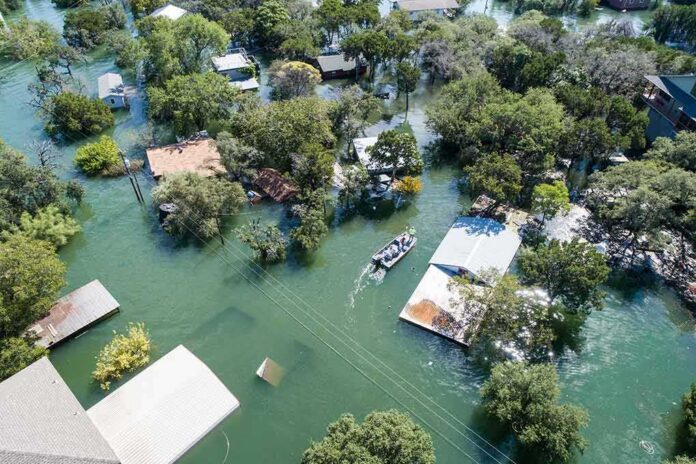
Floodwaters in Pagosa Springs, Colorado, tore a house from its foundation and sent it crashing into a bridge as the San Juan River hit nearly its highest level in recorded history.
Story Snapshot
- A local resident described watching a house float down the river in pieces during the November flood.
- Separate reports confirm a mobile home was swept away and struck a bridge in the same disaster.
- The San Juan River reached 16.81 feet, just a foot below the historic 1911 record.
- Homes were submerged, roads washed out, and bridges damaged across Pagosa Springs.
Eyewitness Describes House Breaking Apart in River
Pagosa Springs resident Henry Maes told a local news crew he watched the disaster unfold in real time. “People are hurting around here, you missed it about a half hour ago a house was floating down the river and it was already in pieces,” Maes said, according to a report published November 3, 2026. His account came as crews scrambled to reach stranded families across the mountain town.
A wire-service report backed up the dramatic scene independently. “An entire home was lifted from its foundation and floated down the river before crashing into a pedestrian bridge,” the account stated, describing damage that matched what residents on the ground were reporting. A separate report also documented a mobile home swept away before striking a bridge, adding another layer of confirmation to the chaos.
River Nears Historic Record as Town Takes a Beating
The National Weather Service recorded the San Juan River cresting at 16.81 feet, landing it about one foot below the historic 1911 flood level. That is not a normal rainstorm. That is the kind of water surge that rips mobile homes off their blocks and turns pedestrian bridges into battering targets for entire houses.
Beyond the floating structure, Pagosa Springs took a beating across the board. Homes sat submerged in floodwater, roads washed out and eroded under the pressure, and bridges across the area sustained serious damage, according to local coverage. Families found themselves cut off from the outside world as the water refused to recede quickly, leaving entire neighborhoods isolated.
Families Displaced as Colorado Counties Declare Emergencies
This was not an isolated incident in one small town. A dozen Colorado counties declared states of emergency as rivers surged to record levels, with thousands of homes also affected across the border in New Mexico. Southwestern Colorado flooding this round hit even harder than last year’s disaster, destroying homes and leaving residents stranded without a clear way out.
For families who had already rebuilt once, the second wave of flooding meant starting over again. Evacuation orders went out repeatedly as water levels kept climbing, and many residents described losing not just property but any sense of stability heading into winter. Local officials focused resources on reaching stranded households rather than cataloging every structure lost downstream.
Natural Disasters Expose Gaps in Local Infrastructure
Conservatives have long argued that rural and mountain communities get overlooked when it comes to infrastructure investment, and Pagosa Springs is a case study in what happens when aging roads and bridges meet extreme weather. Washed-out roads trapped families in their own neighborhoods, showing how fragile basic infrastructure can be when disaster strikes without warning.
🌊🏠 WHOLE HOUSE SWEPT AWAY IN PAGOSA SPRINGS, COLORADO FLOODING
📍 PAGOSA SPRINGS, COLORADO | NOVEMBER 2, 2026
RETURN OF ISIS | BREAKING WEATHER NEWS
🎥 Video Credit: Surajit 🫶🏾
💜 Support the movement here: https://t.co/AuozkoPMaz
Even $1 is helpful.
🌊 A HOME LOST TO THE… pic.twitter.com/bahEgSBjgE— Return of Isis (@RobinWa89528130) November 3, 2026
Local residents like Maes are the ones left to pick up the pieces, both literally and figuratively, while federal and state emergency crews work to restore basic services. The flooding stands as a reminder that natural disasters do not wait for bureaucratic response times, and communities depend on fast, local action when the water starts rising fast.
Sources:
kdvr.com, kob.com, archuletacounty.gov, kiowacountypress.net