

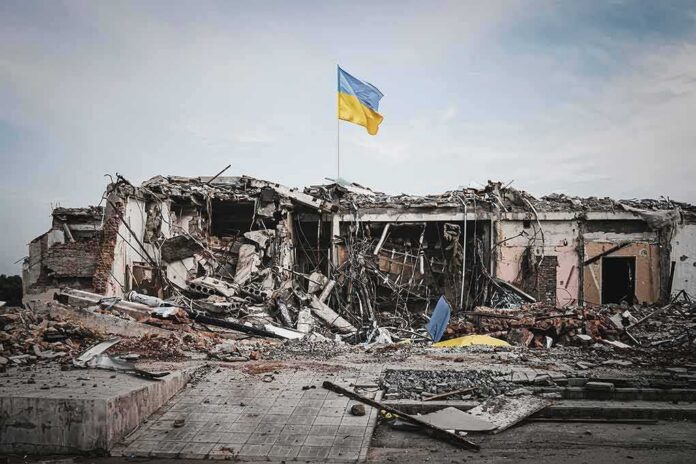
Fifty-three civilians were killed when Russia bombed a Ukrainian aid site and then struck its shelter, officials say.
Story Highlights
- Officials report 53 dead after Russia bombed an aid-distribution site in Komyshuvakha.
- Rescuers worked five days under threat of repeat strikes to recover victims.
- Ukraine says bombs hit the aid center first, then the shelter where people fled.
- United Nations monitors say powerful aerial bombs in cities drive heavy civilian losses.
Deadly Strike On Aid Site In Zaporizhzhia
Ukrainian regional leaders said on Friday that the death toll from Russia’s bombing of an aid-distribution point in Komyshuvakha, a community in the Zaporizhzhia region, has risen to 53. Acting governor Mykhailo Semikin delivered the update after days of search and recovery. Reporters from Reuters documented the growing toll across the week as crews pulled victims from the rubble and identified remains. The figure marks one of the war’s deadliest single attacks on civilians this year.
Local authorities said the site served families in need, handing out food and supplies. Ukrainian officials reported that people tried to reach safety in a shelter after the first bombs hit. They said more bombs then struck the shelter itself, which trapped many inside the damaged structure. The account aligns with other early reports from the region. Officials warned that the number of confirmed dead rose as responders reached collapsed areas and identified bodies over several days.
Rescue Work Under Threat And Rising Casualties
Emergency teams searched the ruins for five straight days, while facing the risk of more strikes, according to officials cited by international media. Earlier this week, crews even found a survivor three days after the blast sequence, underscoring how chaotic the scene was. The toll moved from the forties to fifty-three as teams cleared debris and verified identities. This pattern is common after large building collapses, where many victims are buried and hard to reach fast.
Before this latest update, reporters counted at least forty-three dead as of Thursday. By Friday, leaders said the total reached fifty-three after more victims were found and identified. That steady climb shows both the force of the attack and the care needed to confirm each person. Ukrainian authorities stressed that the site was set up to help civilians. International outlets described it as both an aid center and a shelter serving local families during the war.
Aid Centers Are Protected Civilian Sites
Humanitarian sites like schools used for aid are protected under the laws of war. The International Committee of the Red Cross explains that parties must distinguish civilians and civilian objects from military targets at all times. Attacks must never be aimed at people seeking aid or shelter. That rule exists to protect life and keep relief flowing to those who need it most. Striking such places breaks core principles that guard civilians in conflict.
The United Nations has tracked heavy harm to civilians in Ukraine from explosive weapons used in towns and cities. In one recent period, hundreds were killed and thousands injured, with most losses tied to wide-area blast effects. Monitors warn that aerial bombs and missiles in urban areas cause mass casualties and wreck critical buildings. That grim record fits what local leaders reported in Komyshuvakha after the strike on the aid point and the shelter.
Why This Matters For Americans
Americans value clear moral lines in war, support for civilians, and strong borders against aggression. Attacks on aid centers cross those lines and shock the conscience. President Trump has said the United States stands for peace through strength. This tragedy reminds us why strength, missile defense, and strict limits on targets matter. It also shows why America should lead with resolve, back humanitarian corridors, and press for accountability when civilians are hit on purpose or with reckless force.
Russian Strike Turns Humanitarian Hub Into Mass Grave—The death toll from Russia’s bombing of an aid distribution point in Komyshuvakha has risen to 53, acting Zaporizhzhia regional governor Mykhailo Semikin said on November 6, as search and rescue operations entered their fifth… pic.twitter.com/ui9Biw8SnR
— JP Lindsley | Journalist (@JPLindsley) November 6, 2026
For families in Ukraine, an aid site is a lifeline. For readers here at home, it is a lesson. When bombs fall on people lined up for food, it proves that evil does not respect rules. It also proves that deterrence, not naïve talks, protects the innocent. The United States can help by pushing for investigations, supporting rapid aid delivery, and keeping pressure on those who target civilians. Doing less invites more attacks on the vulnerable.
Sources:
zmina.info, reuters.com, dw.com, transcripts.un.org, ukraine.ohchr.org