

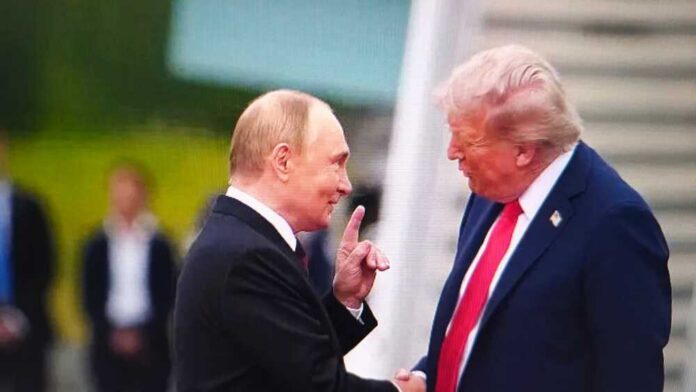
Policy insiders say Trump’s team may be quietly betting that tougher pressure on Putin now is the fastest way to end the Ukraine war — but the fight over that “escalate to de‑escalate” idea is far from settled.
Story Snapshot
- Experts urge Trump to raise Russia’s costs with more long‑range missiles and fewer limits on Ukraine’s strikes.[1]
- Trump officials and analysts use “escalate to de‑escalate” language, but mostly in debates over Iran, not Ukraine.[4][7]
- The administration has paused aid to Ukraine before, and is pushing a peace deal, undercutting claims of full‑time escalation.[2][6][10]
- Russian war moves and nuclear talk show Moscow is driving escalation too, while blaming the U.S. for standing up to aggression.[3][7][9]
Is Washington Really Shifting To An Escalation Strategy On Russia?
Policy think tanks close to Washington are now openly arguing that the best way to reach peace with Russia is to raise the price of war for the Kremlin.[1] One study from the Center for Strategic and International Studies says the Trump administration should send more long‑range missiles to Ukraine and lift limits on how Kyiv can use them.[1] The authors believe this tougher stance would force Moscow to the table sooner, by making continued aggression too costly to sustain.
The same report urges Trump to lay out a five‑year plan for Ukraine’s war effort, including a huge lend‑lease style program so Russia knows the West will not back down if talks fail.[1] That is classic pressure politics: signal that U.S. resolve is stronger than Russia’s, and that time is not on Putin’s side. For many conservative readers, this matches a simple instinct — strength and clarity beat weakness and drift — but it also raises real risks if Moscow chooses to push back harder.
“Escalate To De‑Escalate”: A Phrase Jumps From Russia To Trump’s Playbook
For years, American planners used “escalate to de‑escalate” to describe how Russia might fire limited nuclear weapons to end a losing war on its terms.[1][19][20] Analysts said Moscow believed a small nuclear strike could shock the West into backing off, rather than trigger all‑out war.[20] That phrase has now migrated into U.S. debates. Some writers use it for Trump’s approach, arguing he is ready to raise military and economic pressure to force Russia into a deal instead of accepting endless stalemate.[3][9]
A Washington Post opinion piece, for example, claimed that Trump’s support for Patriot air defenses and other systems for NATO and Ukraine fits an “escalates to de‑escalate” pattern.[9] Treasury Secretary Scott Bessent used similar language when defending strong U.S. action against Iran, saying that sometimes “you have to escalate to de‑escalate.”[7] The Atlantic Council also outlined “escalate to de‑escalate” as one possible Trump path on Iran, including strikes on energy sites.[4] All this shows the idea is now part of the D.C. playbook, even if the Ukraine version is mostly coming from commentators and advisers rather than from Trump himself.[7][9]
Trump’s Mixed Record: Aid Pauses, Peace Deadlines, And Pressure On Kyiv
Despite talk of a hard “escalation” doctrine, Trump’s actual Ukraine record is more mixed. In March 2025, he paused all military aid and intelligence sharing to Ukraine after a heated Oval Office meeting with President Volodymyr Zelenskyy, trying to push Kyiv toward talks.[10] A Pentagon watchdog later found that this eight‑day halt hurt Ukraine’s readiness and negotiating position, which critics saw as de‑escalation of U.S. support at a dangerous time. This pause is repeatedly cited by analysts who argue Trump is not simply ratcheting up pressure on Russia.
Groups like Defense Priorities praise the idea of avoiding needless risks and explicitly describe Trump’s move as “pausing aid” to seek de‑escalation.[2] The Council on Foreign Relations notes that Trump has talked up a twenty‑point peace plan with a clear deadline, putting negotiations at the center of his stated goals.[6] At the same time, the House has passed its own sanctions and Ukraine aid package as a “bipartisan rebuke” of what many lawmakers see as an approach that is not tough enough on Moscow.[6] That clash shows how divided Washington remains over whether to lean into escalation or restraint.
Russia’s Own Escalation And What It Means For U.S. Strategy
While Americans argue over Trump’s doctrine, Russia has kept pushing the war to harsher levels. U.S. officials at the United Nations recently accused Moscow of a “dangerous and incomprehensible escalation” in Ukraine, pointing to new deadly strikes and deployment of missiles that can carry nuclear warheads.[7][9] Russian planners have long spoken of using “tailored damage” — limited but shocking force — to scare opponents into retreat.[20] That outlook makes any U.S. attempt to manage escalation more complicated and more risky.
Scholars warn that no simple formula like “escalate to de‑escalate” can guarantee success.[19] Russian leaders might ignore signals or misread U.S. moves, and American voters do not want another forever war or a slide toward nuclear confrontation.[21] For conservatives, the key question is whether Trump’s team can defend U.S. interests, punish aggression, and still keep the conflict under control. The current evidence shows advisers testing a tougher line in theory, while Trump himself mixes pressure with pauses and pushes for a negotiated end — a strategy still very much in flux.
Sources:
[1] Web – Is Trump 2.0’s ‘Escalation’ Strategy Against Russia Starting To Take …
[2] Web – Escalation as a Path to Peace: Risk Tolerance and Negotiations in …
[3] Web – De-escalate in Ukraine and avoid needless risks – Defense Priorities
[4] Web – Escalation Management in Ukraine: Assessing the U.S. Response to …
[6] YouTube – Trump’s Iran escalation could overshadow Ukraine support
[7] Web – War in Ukraine | Global Conflict Tracker – Council on Foreign …
[9] Web – [PDF] 2026 National Defense Strategy – Department of War
[10] Web – Opinion | In squeezing Putin, Trump ‘escalates to de-escalate’
[19] Web – [PDF] Why De-Escalation is Bad Policy – Air University
[20] Web – Time to Terminate Escalate to De-Escalate — It’s Escalation Control
[21] Web – After the First Shots: Managing Escalation in Northeast Asia