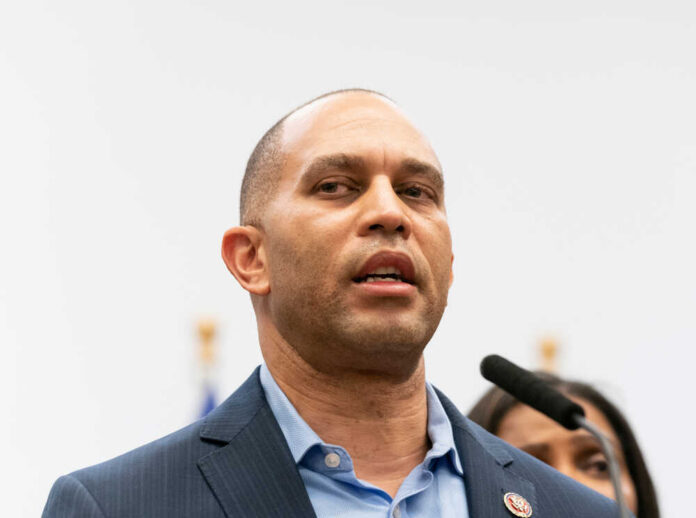
Hakeem Jeffries just signaled that if Democrats claw their way back into power, they may try to re-engineer America’s courts after losing key election-law fights.
Quick Take
- House Minority Leader Hakeem Jeffries said “massive” or “total” judicial reform should be “on the table” if Democrats regain unified control in Washington.
- Jeffries linked the push to recent court defeats involving redistricting and voting-law disputes, including a Supreme Court decision tied to Louisiana maps and a Virginia Supreme Court ruling.
- No legislation has been filed yet; the comments function mainly as a midterm-election message and warning shot about what Democrats want to do later.
- Critics argue the rhetoric pressures an independent judiciary, while supporters frame it as a response to “structural” barriers to their policy goals.
Jeffries’ message: courts are the next battlefield
Hakeem Jeffries, the top Democrat in the House, made the comments during a May 11 appearance on MSNBC’s MS Now with Ali Velshi, arguing Democrats should pursue nationwide judicial changes “state by state” and at the federal level if they retake Congress and the White House. Jeffries described “structural problems” and said “everything” should be considered, tying the idea to election-law and redistricting disputes that have recently gone against Democrats.
Jeffries’ office later posted a transcript of his interview, which conservatives and Republicans quickly circulated as evidence Democrats are preparing a broad institutional campaign against courts that don’t deliver preferred outcomes. For voters already frustrated with a government that seems to serve insiders first, the episode underscores a growing pattern: when one side loses in court, it increasingly treats the judiciary as another political branch to be reshaped rather than a co-equal check to be respected.
What sparked the remarks: redistricting losses and voting-law fights
The immediate backdrop is a string of high-stakes rulings in the post-2020 census redistricting cycle. Jeffries pointed to disputes including a U.S. Supreme Court decision involving Louisiana and a Virginia Supreme Court ruling that overturned a Democratic redistricting plan. While coverage varies in how it summarizes the technical details, the political impact is clearer: the decisions limited or rejected map-drawing approaches that Democrats argued were necessary for fairness and representation.
Jeffries also connected “judicial reform” to broader Democratic priorities that have repeatedly stalled in Congress or faced court scrutiny. That includes renewed talk of passing the John Robert Lewis Voting Rights Advancement Act and revisiting campaign-finance rules shaped by Citizens United. Those policy goals matter because they show “judicial reform” isn’t just about courtroom ethics or efficiency; it’s wrapped into a larger effort to change the rules of elections and political power, especially as both parties look ahead to 2026 and 2028.
“Total judicial reform” is still vague—and that uncertainty is the point
Jeffries did not lay out a specific legislative package, and as of mid-May no formal plan has been introduced. That leaves “total” or “massive” reform open to interpretation, ranging from relatively narrow changes—like ethics enforcement and transparency—to far more consequential moves like changing court structures or pushing reforms across state systems. The lack of detail makes it harder for voters to judge intentions, while still energizing partisan audiences who want action.
On the right, the comments are already being used as a political warning: if Democrats regain power, they may look for ways to neutralize judicial roadblocks that constrained them during years of divided government. On the left, allies cast the courts as a barrier to voting-rights goals and other priorities. The shared reality is that Americans are watching another institution become a proxy for raw power—exactly the dynamic that fuels “deep state” suspicion across the spectrum.
Institutional trust takes another hit as both sides escalate
Legal professionals have warned that attacking the legitimacy of justices, or implying the courts must be “reformed” after unpopular rulings, can weaken public confidence in the rule of law. The American College of Trial Lawyers issued a statement condemning Jeffries’ earlier rhetoric about the Supreme Court, arguing that extreme language undermines institutional credibility. That concern resonates beyond party lines: if courts are treated as prizes to be captured, the incentive becomes retaliation, not restraint.
Politically, the timing fits the 2026 midterm cycle, when Democrats need a unifying message and Republicans want to highlight contrasts on constitutional governance. With President Trump in a second term and Republicans holding Congress, Democrats can’t implement major changes now—so messaging becomes a way to define the next election as a referendum on institutions. For voters focused on limited government and stable constitutional checks, the key question is whether “reform” means accountability—or a future attempt to change outcomes by changing the referees.
Hakeem Jeffries Says 'Total Judicial Reform' Is on the Table If Dems Regain Power. What Does That Mean?https://t.co/CtEOrn5IAB
Like my writing? Check out my first book: Gaslight, How the Democratic Party Lost Its Mind to Radical Leftism and Abuses Voters in the Process,… pic.twitter.com/gVpWd45mvD
— Amy Curtis (@RantyAmyCurtis) May 12, 2026
For now, the concrete takeaway is simple: Jeffries put a marker down that Democrats see court-centered power as part of their path back, even though the specifics remain undefined. If Democrats later propose legislation, the details will determine whether this is a narrow push for ethics and procedure or a sweeping redesign that risks turning courts into openly political weapons. Either way, the remarks add to a public mood that Washington’s factions prioritize control over competence—and that ordinary citizens pay the price.
Sources:
Hakeem Jeffries Says ‘Total Judicial Reform’ Is on the Table If Dems Regain Power
Jeffries threatens judicial reform post voting rights ruling
Press Release: Hakeem Jeffries Emphasizes Unity in Defense of Democracy During MS NOW Interview
Addressing structural racism in public policy with Rep. Hakeem Jeffries
ACTL denounces remarks by House Minority Leader Hakeem Jeffries targeting Supreme Court justices