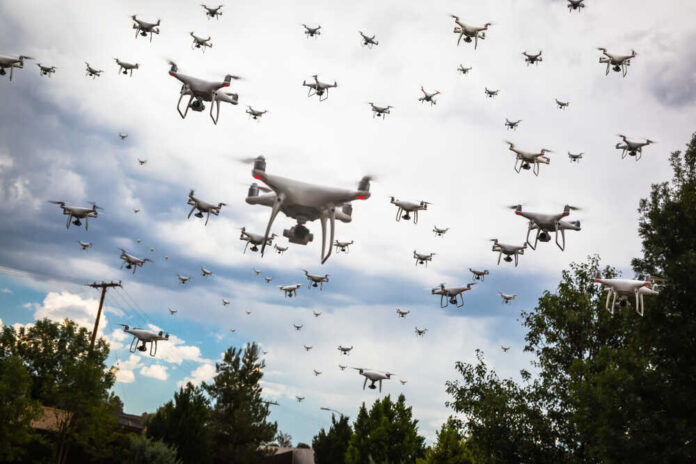
Ukraine’s unprecedented 300-drone assault on Moscow exposed critical vulnerabilities in Russian air defenses, forcing the complete shutdown of the capital’s aviation hub.
Story Highlights
- Nearly 300 Ukrainian drones targeted Russia overnight, with 32 specifically aimed at Moscow, forcing closure of all four capital airports
- Russian air defenses intercepted 287 drones in what officials called one of the largest attacks since the war began
- Passengers endured 12+ hour delays while Armenian Prime Minister’s flight was diverted to St. Petersburg
- The attack represents a dramatic escalation in Ukraine’s deep-strike capabilities against Russian infrastructure
Massive Drone Swarm Overwhelms Russian Defenses
Russian Defense Ministry officials confirmed intercepting 287 Ukrainian drones during the overnight assault of December 10-11, 2025. The coordinated strike targeted multiple regions across Russia, with Moscow bearing the brunt of 32 individual drone attacks. This represents the largest single drone operation Ukraine has conducted since Russia’s full-scale invasion began in February 2022, demonstrating Kyiv’s expanding capacity to project force deep into Russian territory despite ongoing resource constraints.
Moscow Mayor Sergei Sobyanin reported the capital faced its most intensive drone bombardment to date. Russian air defense systems worked throughout the early morning hours to neutralize the incoming threats. The scale of the attack forced authorities to implement emergency protocols across the Moscow region, highlighting Ukraine’s ability to penetrate Russian airspace with increasing frequency and sophistication.
Watch: https://www.youtube.com/watch?v=2eKrvLjqHzo
Moscow Aviation Hub Paralyzed by Security Threat
All four Moscow airports suspended operations during the drone attack, creating widespread disruption for thousands of travelers. Vnukovo Airport passengers, including families with children, endured delays exceeding 12 hours as authorities maintained flight restrictions. The Association of Tour Operators of Russia reported over 60,000 passengers affected by aviation disruptions in 2025, with this single incident contributing significantly to that total.
Armenian Prime Minister Nikol Pashinyan’s official flight exemplified the chaos, requiring diversion to St. Petersburg before he could continue to Moscow later that day. The incident underscores how Ukraine’s drone warfare strategy now directly impacts international diplomatic travel and civilian aviation safety. Russian aviation authority Rosaviatsia coordinated the emergency response, gradually reopening airspace once the immediate threat subsided.
Escalating Pattern Threatens Regional Stability
This attack continues Ukraine’s aggressive 2025 drone campaign that has already caused 217 Russian airport closures between January and May alone. The frequency represents a dramatic increase from 58 closures in 2023 and 91 in 2024, with peaks occurring around significant Russian holidays like Victory Day. Ukrainian forces have leveraged advanced “kamikaze” drone technology to compensate for manpower shortages on traditional battlefields.
Ukrainian drones over Russia trigger airspace shutdowns, flight delays
Full news: https://t.co/YqwZdTIhJZ#ukraine #russia #airspaceshutdown pic.twitter.com/8j88C43yda— Ujyaalonepal.com/ उज्यालाे नेपाल डट कम (@UjyaaloN) December 11, 2025
The broader implications extend beyond immediate tactical victories, as these operations strain Russian air defense resources and civilian infrastructure. Simultaneously, Russia launched 151 drones and 3 missiles targeting Ukrainian energy facilities, continuing the mutual escalation that has defined the conflict’s latest phase. This tit-for-tat strategy raises concerns about further spillover effects on regional security and civilian populations.
Sources:
Ukrainian drones over Russia trigger airspace shutdowns, flight delays
Violations of non-combatant airspace during the Russo-Ukrainian war
Kyiv Post Report on Moscow Drone Attack