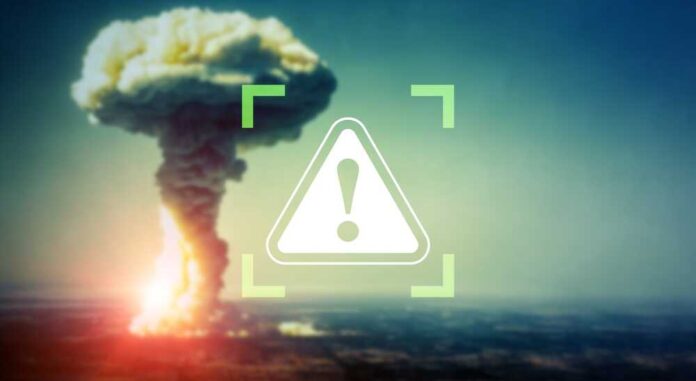
Putin has ordered immediate nuclear weapons test preparations at Russia’s Arctic facility, responding directly to Trump’s threat to resume U.S. nuclear testing.
Story Snapshot
- Putin convened Russia’s Security Council on November 5, ordering nuclear test preparations at Novaya Zemlya after Trump’s November 3 statement
- Russia threatens to match any U.S. nuclear testing, breaking decades-old international moratorium agreements
- Moscow showcased advanced nuclear weapons including Burevestnik cruise missiles and Poseidon underwater drones
- The escalation represents a dangerous shift from proxy conflict to direct nuclear brinkmanship between superpowers
Trump’s Nuclear Warning Triggers Russian Response
President Trump’s November 3 statement about resuming U.S. nuclear testing prompted an immediate and forceful Russian reaction. Trump accused Russia and China of conducting similar activities, signaling America’s readiness to abandon the testing moratorium that has held since the early 1990s. Within 48 hours, Putin convened Russia’s Security Council and issued direct orders to prepare nuclear testing capabilities at the Novaya Zemlya Arctic site, demonstrating how quickly diplomatic tensions can escalate into military preparations.
Putin’s directive explicitly stated that if the United States or any nuclear power breaks the testing moratorium, Russia would follow suit immediately. Russian ministries and defense agencies received orders to gather intelligence and draft comprehensive proposals for test preparations. The Kremlin emphasized that Russia has adhered to international treaties but will respond proportionally to any American nuclear testing resumption, marking a significant shift in global nuclear stability.
Ukraine-Russia war latest: Putin orders nuclear weapons test preparations after Trump threat in new escalationhttps://t.co/DLhDZhZIpi
— The Independent (@Independent) November 5, 2025
Russia Displays Advanced Nuclear Arsenal
Moscow used the escalation as an opportunity to showcase its next-generation nuclear-capable weapons systems. Russian officials highlighted the Burevestnik nuclear-powered cruise missile and the Poseidon underwater nuclear drone, both designed to circumvent traditional missile defense systems. These weapons represent Russia’s technological advancement in nuclear delivery systems, demonstrating capabilities that extend beyond conventional intercontinental ballistic missiles and potentially altering strategic calculations for American defense planners.
Watch; Putin Orders Nuclear Test Prep, Showcases Burevestnik & Poseidon Superweapons
The Novaya Zemlya test site holds historical significance as the location of the Soviet Union’s most powerful nuclear tests, including the 1961 Tsar Bomba explosion. Russian officials confirmed the facility remains operationally ready for rapid nuclear test initiation, with infrastructure and personnel capable of conducting various types of nuclear detonations. This readiness suggests Russia has maintained testing capabilities despite the decades-long moratorium, positioning Moscow to respond quickly to any American testing resumption.
Arms Control Architecture Faces Collapse
The nuclear testing threats accelerate the breakdown of arms control agreements that have provided stability since the Cold War. Previous treaty collapses include the Intermediate-Range Nuclear Forces Treaty in 2019 and the Open Skies Treaty in 2020, while Russia suspended participation in New START in 2023. The potential end of the nuclear testing moratorium would eliminate another crucial pillar of strategic stability between nuclear powers.
American officials, including senior defense leaders and congressional representatives, have expressed varying levels of support for resuming nuclear testing. Some suggest limited underground tests, while others back broader testing resumption to maintain technological superiority over adversaries. This divergence in American positions creates uncertainty about actual U.S. intentions, potentially complicating diplomatic efforts to de-escalate the current crisis while emboldening Russian preparations for their own testing programs.
Sources:
Kremlin Official Statement on Nuclear Test Preparations