

President Trump’s second-term promise to end foreign entanglements faces new tests as Russia’s tank losses in Ukraine underscore the quagmire of endless wars draining American resources through NATO aid.
Story Snapshot
- Russia lost over 1,200 T-72 tanks in Ukraine, depleted faster than replacements, signaling unsustainable warfare.
- Modern U.S.-supplied Javelins and Ukrainian drones exploit Cold War-era design flaws in mass assaults.
- By early 2025, T-72s vanished from front lines, forcing Russia to dig into obsolete reserves.
- Total Russian tank losses exceed 4,000, outpacing production amid ongoing Pokrovsk battles.
T-72 Losses Expose Russian Vulnerabilities
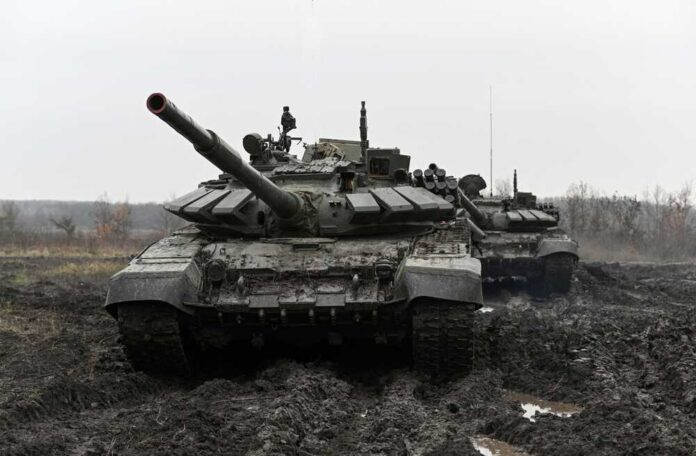
Russia suffered at least 1,200 T-72 tank destructions in Ukraine by late 2024, with hundreds more lost since. Ukrainian forces used Javelin missiles to strike the tank’s thin turret roof, a known weakness from its 1970s Soviet design. FPV drones further decimated units in frontal assaults around Donbass and Pokrovsk. These losses compelled Russia to reactivate stored T-72s at rates exceeding production capacity, highlighting tactical failures in overwhelming force doctrines.
Shift from Frontline to Reserves
By early 2025, T-72s grew rare at front lines, reassigned to rear artillery roles. OSINT analyst Richard Vereker noted T-72 arrivals dwindled to near zero by March 2025, as losses shifted to T-80s and T-62s. Oryx confirmed over 4,030 total main battle tank losses by June 1, 2025. Russia concentrated 11,000 troops near Pokrovsk in October 2025, yet advances remained slow against Ukrainian defenses bolstered by NATO weapons.
Historical precedents amplified T-72 shortcomings. Early 2022 invasions saw 183 T-72 losses within Russia’s 940-unit fleet, a 33.8% rate. Conflicts in Syria and Georgia 2008 exposed top-attack susceptibilities. Oryx visually verified 440 T-72s by 2022-2024, rising beyond 1,200. This attrition eroded Russian assault capabilities, pressuring Putin amid unconfirmed official tallies.
Implications for U.S. Policy and Global Stability
Early losses cost Russia $219.6 million for 183 T-72s alone, totaling $616.75 million in tanks. Crew casualties mounted in wrecked hulks, sapping morale and logistics. Long-term, fleet exhaustion strains Soviet-era stocks exported worldwide. The war’s drone dominance boosts Javelin demand, marking a shift from mass armor to precision strikes. For America First advocates, sustained NATO aid recalls past regime-change pitfalls, fueling calls to avoid escalation.
In 2026, as President Trump steers clear of new conflicts, these developments validate frustrations with globalist entanglements. High energy costs from sanctions and proxy funding hit families hardest. Conservative voters demand focus on border security, inflation curbs, and constitutional safeguards over foreign quagmires. Russia’s struggles offer leverage for peace, aligning with promises to prioritize U.S. sovereignty.
Sources:
1,200 Destroyed: Russia’s T-72 Tank Is Getting Smashed to Bits in the Ukraine War
4000 Destroyed: Russia’s Tanks Are Suffering in Ukraine
Historical Armor Losses, Shifting Tactics and Strategic Paralysis