
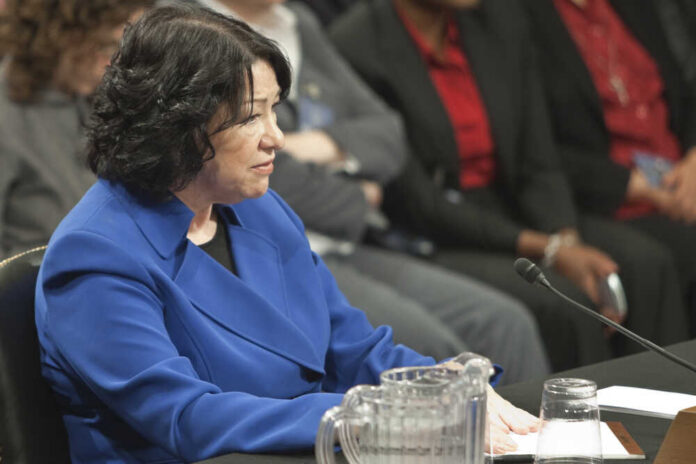
Supreme Court Justice Sonia Sotomayor unleashed a scathing 20-page dissent accusing her conservative colleagues of enabling unconstitutional racial profiling by ICE agents, marking one of the most personal rebukes in recent Court history.
Story Snapshot
- Sotomayor condemned the conservative majority for overturning lower court restrictions on ICE raids targeting Latino workers in Los Angeles
- The dissent accused Justice Kavanaugh of downplaying violent seizures involving firearms and physical force as mere “brief inquiries”
- The unsigned emergency order allows raids based on appearance, accent, and low-wage employment, stripping constitutional protections according to liberal justices
- The ruling highlights growing tensions within the Supreme Court over immigration enforcement and the controversial shadow docket process
Court Greenlights ICE Enforcement Over Constitutional Concerns
The Supreme Court issued an unsigned emergency order overturning a federal district court’s injunction that had restricted ICE raid authority in California. The conservative majority’s decision allows immigration agents to resume operations targeting individuals based on factors including ethnicity, accent, and employment in low-wage sectors. Justice Brett Kavanaugh wrote a concurrence defending the ruling, arguing that ethnicity constitutes a relevant factor when combined with other indicators. The order provides no detailed explanation for vacating the lower court’s restrictions, following the controversial shadow docket pattern of rapid, opaque rulings.
Dissent Exposes Stark Reality of Immigration Raids
Justice Sotomayor, joined by Justices Elena Kagan and Ketanji Brown Jackson, described the ICE operations as violent seizures involving firearms and physical force directed at individuals who “look Latino.” Her dissent rejected Kavanaugh’s characterization of raids as brief, orderly encounters, calling it a “fantasy” disconnected from documented realities. Sotomayor accused the majority of misusing the emergency docket to strip constitutional freedoms without proper deliberation. She emphasized personal knowledge of her colleagues’ positions, making the rejection of their reasoning particularly pointed. This approach represents an unusually direct challenge to fellow justices’ credibility on matters of civil liberties.
Shadow Docket Deepens Institutional Divisions
The emergency docket, often called the shadow docket, has become a flashpoint for criticism as the conservative majority uses it for rapid rulings favoring executive immigration actions without full briefing or oral arguments. Legal commentators have characterized the practice as eroding transparency and public trust in the Court’s decision-making process. The lack of explanation in unsigned orders leaves lower courts and affected communities uncertain about constitutional boundaries. Meanwhile, Justice Amy Coney Barrett publicly denied the existence of a constitutional crisis during a book promotion, a statement critics labeled “appalling” and disrespectful to liberal justices documenting institutional concerns. This disconnect between the conservative majority’s reassurances and the liberal minority’s alarm signals deepening fractures within the nation’s highest court.
Real-World Impact on Latino Communities
The ruling enables resumed ICE operations in the Los Angeles area, directly affecting Latino workers and their families who face heightened risks of detention based on appearance and employment characteristics. Short-term implications include increased fear within low-wage sectors and potential family separations. Long-term consequences may establish precedent for expanded executive power in immigration enforcement with minimal judicial oversight. The decision weakens lower court authority to check federal agencies on constitutional grounds, particularly regarding Fourth Amendment protections against unreasonable searches and seizures. Immigration advocacy groups have mobilized in response, though the conservative majority’s 6-3 advantage suggests limited legal recourse for challenging similar future actions through the emergency docket process.
The stark language and personal nature of Sotomayor’s dissent reflects broader frustrations about a Court majority that critics argue prioritizes government power over individual rights. For Americans across the political spectrum already distrustful of institutions perceived as serving elite interests rather than constitutional principles, this episode reinforces concerns that even the Supreme Court has become another venue where ordinary citizens lose while those in power consolidate control. Whether one views immigration enforcement as necessary law and order or unconstitutional overreach, the lack of transparency and the dismissal of documented violence in favor of sanitized descriptions suggests a judiciary increasingly disconnected from the realities facing communities on the ground.
Sources:
SCOTUS Justice Sonia Sotomayor Shreds Colleagues in Blistering Dissent
U.S. Sotomayor on Conservative Colleague Gorsuch: He’s Such a Lovely Person