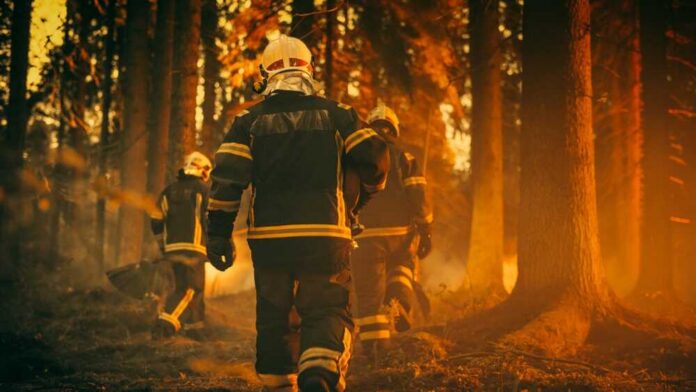
As dense Canadian wildfire smoke once again forces millions of Americans indoors, even the World Cup final near New York is now at the mercy of the wind.
Story Snapshot
- Hundreds of Canadian wildfires are pushing hazardous smoke across the U.S., choking cities from Detroit to New York.
- Air quality has hit “hazardous” levels in key Midwestern cities, with global trackers ranking them among the most polluted on earth.
- New Jersey and New York officials are warning people to stay inside or wear masks just days before the World Cup final near MetLife Stadium.
- Scientists say this kind of cross‑border smoke is now a repeating pattern, not a rare fluke, reshaping North American air quality.
Wildfire Smoke Slams Millions as Cities Top Global Pollution Charts
Dense smoke from hundreds of wildfires burning across Canada has once again poured into the United States, driving air quality to dangerous levels for millions of people across the Midwest, Great Lakes, and Northeast. Detroit and Chicago recorded air quality index readings in the “hazardous” range, with monitoring site IQAir listing them as among the most polluted cities in the world. Parts of Michigan, Minnesota, and Wisconsin have stayed in the worst bands of the index for days, showing how long this smoke can linger.
Canadian officials report well over 800 active fires across the country, with many out of control in northern Ontario and other forest regions feeding this vast smoke plume. That smoke band is clearly visible on satellite images stretching from the Upper Midwest through southern Ontario, New England, and down into the New York City area. Environment agencies on both sides of the border have issued alerts urging people to limit outdoor time and avoid hard exercise when the air turns “very unhealthy” or “hazardous.”
Health Warnings and Everyday Disruption for American Families
State and local health officials warn that fine particles in wildfire smoke, known as PM2.5, can pass deep into the lungs and into the bloodstream, raising the risk of heart and lung problems. The United States Environmental Protection Agency’s public health guide links short‑term smoke exposure to inflamed airways, worse asthma, chest pain, and even early death in vulnerable groups. Hospitals and clinics in past smoke events have reported more visits for breathing issues and heart trouble, especially among older adults and people with existing disease.
For families, the impact is immediate and practical. Officials across the affected states advise keeping windows closed, using good air filters, and moving exercise and kids’ play indoors when the index hits unhealthy levels. Studies show that when smoke drives people indoors and cuts outdoor activity, it can even change how respiratory diseases spread in communities. Many Americans now keep air quality apps on their phones, right alongside weather and traffic, because smoke days are becoming a regular part of life instead of a rare event.
World Cup Final Faces Smoke Concerns but Likely Clears in Time
Smoke from the Canadian fires has reached the New York–New Jersey region just as Argentina and Spain prepare for Sunday’s World Cup final at MetLife Stadium. On Thursday, air in New Jersey was rated “unhealthy for sensitive groups” by several tracking platforms, and Spain still trained outdoors despite earlier “hazardous” readings in northern New Jersey. New York Governor Kathy Hochul said the smoke created unhealthy conditions across the state and urged residents to stay indoors when possible.
𝐂𝐀𝐍𝐀𝐃𝐈𝐀𝐍 𝐖𝐈𝐋𝐃𝐅𝐈𝐑𝐄 𝐒𝐌𝐎𝐊𝐄 𝐂𝐇𝐎𝐊𝐄𝐒 𝟐𝟎 𝐒𝐓𝐀𝐓𝐄𝐒, 𝐌𝐈𝐍𝐍𝐄𝐀𝐏𝐎𝐋𝐈𝐒 𝐀𝐈𝐑 𝐐𝐔𝐀𝐋𝐈𝐓𝐘 𝐇𝐈𝐓𝐒 𝐇𝐀𝐙𝐀𝐑𝐃𝐎𝐔𝐒 𝟒𝟔𝟎
Smoke from wildfires burning across the Arrowhead region, the Boundary Waters Canoe Area Wilderness, and southern Canada… pic.twitter.com/VqLAoqsQ8R
— M.A. Rothman (@MichaelARothman) July 17, 2026
World Cup organizers and local health departments say they are monitoring conditions closely but note that there is no fixed air‑quality line that automatically cancels a FIFA match. Meteorologists expect a cold front and rain to move through the area Sunday morning, pushing much of the smoke away and dropping humidity before the afternoon kickoff. That forecast suggests the final itself should go ahead with much cleaner air, even if fans and players had to adjust training schedules and outdoor plans in the days leading up to the game.
From Rare Haze to a New Normal of Cross‑Border Smoke
Researchers studying air-monitor data across about 600 stations in the continental United States have found that wildfire smoke now accounts for a large share of days with unhealthy pollution, especially since 2020. One recent analysis shows that surface smoke was present on roughly 14 percent of all days from May to September between 2018 and 2023, with 2023 hitting record levels mainly because of Canadian fires. Another long‑term review finds that North America has entered a “smokier skies” era, with wildfire seasons reversing decades of progress on cleaner air.
Scientists say that smoke from Canada’s big burn years is not just a local problem; plumes have crossed the Atlantic to reach Europe and even parts of Asia, proving how far these particles can travel. Climate and fire experts warn that, under high‑warming scenarios, annual deaths linked to smoke PM2.5 in the United States could rise more than 70 percent by mid‑century. For American communities that already feel hammered by high energy costs, inflation, and crime, this growing haze is one more reminder that government planning must stay focused on protecting public health, critical events, and everyday life without drifting into heavy‑handed overreach.
Sources:
insiderpaper.com, bbc.com, npr.org, reuters.com, nytimes.com, pbs.org, washingtonpost.com, science.nasa.gov, cnn.com, usatoday.com, youtube.com, cbc.ca, nicb.org, pmc.ncbi.nlm.nih.gov, repository.library.noaa.gov, pubs.acs.org, pnas.org, preventionweb.net