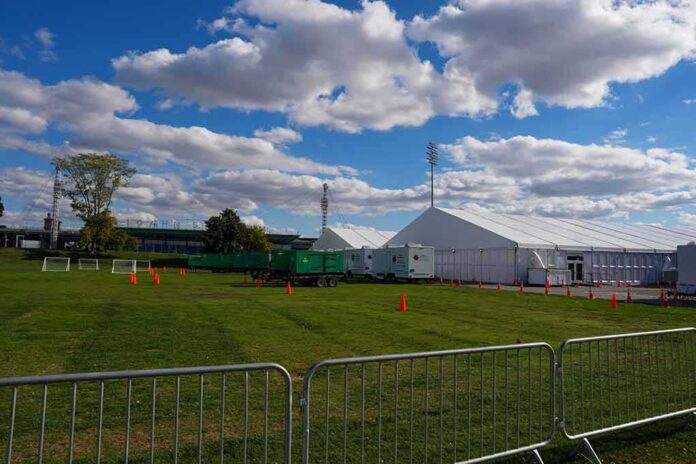
What happened at the Bite of Seattle was not a random burst of violence in a vacuum; it was a crowded-festival shooting in which police quickly concluded that multiple guns were involved, bystanders were struck in the crossfire, and a juvenile suspect was detained while investigators continued to look for others.
Key Points
- Three people were killed and four others were wounded in the shooting near the Seattle Center Armory, including a 2-year-old boy who remained hospitalized.
- Seattle police said their working theory was that two people exchanged gunfire in the festival area, with bystanders caught in the middle.
- A 15-year-old was detained in connection with the case, and police said they recovered two firearms from the scene.
- The early record was still provisional: officials used investigative language, and later reporting suggested the number of shooters may have been more complicated than the first public briefings implied.
The Official Picture: A Crowd, Crossfire, and a Fast-Evolving Investigation
The core facts are stark and, by this point, not meaningfully disputed: gunfire erupted during the Bite of Seattle food festival at Seattle Center, three people died, four others were injured, and one of the wounded was a toddler. Seattle police said one suspect was detained and another remained at large, while Assistant Police Chief Tyrone Davis told reporters there was “no outstanding threat to the community.”
That immediate public-safety message matters because it frames the incident the way police understood it in real time. The initial explanation was not that officers had already untangled every shot and every participant; it was that they believed the shooting involved an exchange of fire, not a single shooter methodically targeting a crowd. In the first updates, officials said investigators believed two people were shooting at each other near the Seattle Center Armory and that bystanders were caught in the crossfire.
That distinction is consequential. A festival shooting can arise from very different dynamics: a deliberate attack on a crowd, a dispute that spills into a public space, or a chaotic multi-person gunfight in which innocent people are hit because there is no meaningful separation between shooters and spectators. Here, the police account pointed toward the third category. The public record also says officers recovered two guns from the scene, which is consistent with, though not by itself proof of, more than one armed participant.
Why the Crossfire Theory Took Hold So Quickly
The Seattle case followed a pattern that is familiar in active-shooting investigations: the first theory to reach the public is often the one assembled fastest from fragmentary evidence. Officers are trying to secure the scene, preserve life, identify suspects, and reassure the public before forensic work is complete. In this instance, officials repeatedly used qualifying language — “we believe” and “investigating” — which is the language of an unfolding case, not a finished one.
Still, the early account had several anchors. Police said a juvenile was detained, that a second suspect was being sought, and that the incident involved gunfire between groups in a crowded festival area. Reporting also identified the dead as Carlos Israel Sanchez Villalba, Ashley Whitehead, and Junior Cee Niko Semo, with later accounts describing Sanchez Villalba and Whitehead as innocent bystanders. The 2-year-old boy, meanwhile, was reported in stable condition after being hospitalized.
That combination — a detained juvenile, a second suspect sought, two recovered firearms, and multiple civilian victims — made the crossfire framework plausible from the outset. It also explains why early coverage emphasized confusion about the shooters while remaining confident about the human toll. Police were not speaking about an ordinary assault scene; they were describing a fast-moving public shooting in which the difference between participant and bystander had to be reconstructed after the fact.
Where the Early Narrative Became Less Certain
The one thing the early record does not fully settle is the exact number of shooters and how they were related to one another. That uncertainty is not a contradiction so much as a reminder that the first hour of a homicide investigation is not the same as the final case file. Some reports said one suspect was in custody and another was still being sought; later reporting introduced the possibility of a third shooter and noted that a juvenile-court filing said police believed at least three shooters were involved.
That later wrinkle matters because it shows how quickly an early police theory can harden into a public narrative before the underlying forensic work is complete. But the broader point remains stable: the shooting was not treated by investigators as a clean, one-gun event. The official posture was that there had been an exchange of gunfire in a crowded public place, and that the inquiry was still sorting out the role of each participant.
In other words, the uncertainty is about mechanics, not about whether the incident was catastrophic. Three people were dead, four were wounded, and the scene was serious enough that police spent days chasing down suspects, witnesses, and the chain of events that produced the shooting. The public should read the early inconsistency as a feature of an active investigation, not as evidence that the basic event never happened as described.
On Tuesday, Seattle Mayor Katie Wilson delivered updates on the investigation into Sunday's deadly mass shooting at the Bite of Seattle. https://t.co/o6YXDwFaTa
— FOX 13 Seattle (@fox13seattle) July 29, 2026
What the Case Shows About Mass-Shooting Investigations
Cases like this expose the difference between what the public wants immediately and what investigators can responsibly say immediately. The public wants a clean label: mass shooting, targeted attack, gang dispute, accidental spillover, or crossfire. Police usually cannot offer that level of certainty at first, especially when the scene is crowded, the witnesses are scattered, video is partial, and juvenile records may be sealed or heavily redacted. That is why the first official account often contains a mix of firm facts and provisional theory.
The Seattle shooting also shows how venue context shapes interpretation. A festival at Seattle Center is, by design, dense, noisy, and mobile; once shots are fired, ordinary crowd movement can obscure who stood where, who drew first, and which victim was struck by which round. In that environment, the difference between “shooter,” “suspect,” and “bystander” can be harder to establish than the public assumes. The first police description of bystanders in crossfire was therefore not a flourish — it was the best working explanation available from the scene.
For readers trying to understand the case, the right frame is simple: the official account supports a multi-actor shooting in a crowded festival setting, with innocent people caught in the gunfire and a juvenile detention at the center of the investigation. The unresolved details are real, but they do not change the essential shape of the story. The tragedy was immediate; the forensics, as always, came later.
Sources:
nypost.com, cnn.com, komonews.com, time.com, youtube.com, seattletimes.com