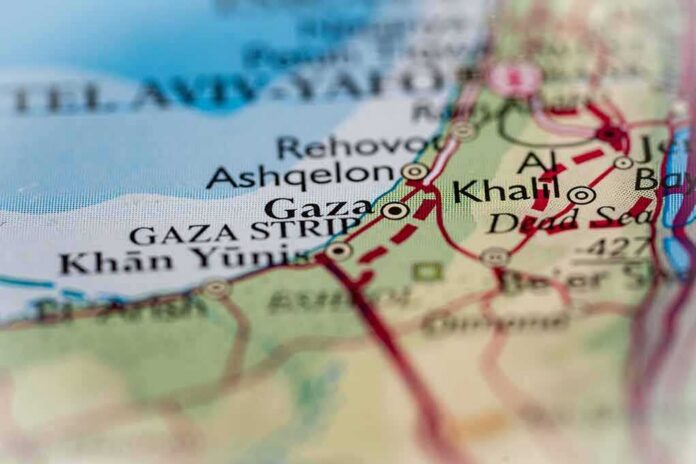
The real story in Gaza is not simply that Donald Trump declared a disarmament deal; it is that the announcement immediately collided with the region’s oldest problem: sequencing. Disarmament, withdrawal, aid, and governance are being treated as one package, yet each side is still trying to make the other move first.
Intro Header
- Trump announced a framework he said would bring Hamas’s weapons out of play and trigger an Israeli pullback from Gaza.
- Gazans reacted with caution, not celebration; the memory of failed ceasefires still shapes how new announcements are received.
- Hamas’s own public posture is conditional, not unconditional: it has tied any weapons-related steps to Israeli withdrawal, a halt in hostilities, and humanitarian relief.
- The dispute is not only political but operational, because “disarmament” means different things to different actors.
What Trump Announced, and Why It Matters
Trump’s announcement matters because it attempted to compress the hardest phase of Gaza diplomacy into a single headline: a “historic agreement” for the complete disarmament of Hamas, carried out in phases alongside an Israeli withdrawal. That is not a trivial rhetorical flourish. In Gaza, the difference between a ceasefire framework and a real settlement is usually found in the implementation language—who moves first, who verifies compliance, what happens to weapons, and whether withdrawal is linked to security guarantees or delayed until after them.
Reporting around the announcement described a staged formula rather than an immediate surrender. The plan, as summarized in contemporaneous coverage, envisages weapons being handed over in phases and Israeli forces withdrawing sector by sector as a new security architecture takes shape. That architecture is supposed to include a transitional or technocratic Palestinian administration and an international stabilization force. In other words, the proposal is less a ceasefire than a managed transition from militia rule to externally supervised demilitarization.
Why Gaza’s Reaction Was Skeptical Rather Than Euphoric
Inside Gaza, the dominant tone was caution. Displaced Palestinians told reporters they were not convinced by the announcement, and many explicitly linked their doubt to past agreements that failed to stop the fighting or restore movement and return for civilians. That skepticism is not cynicism for its own sake; it is accumulated memory. When a population has watched repeated promises collapse before aid arrives or reconstruction begins, a new deal is judged less by its language than by whether the artillery actually falls silent.
Some Palestinians did express relief that disarmament was being discussed at all, especially after nearly three years of devastation. But even that more hopeful reaction was paired with a familiar question: why did it take so long, and how much of Gaza will be left by the time any implementation begins. That is the political psychology of ruin. The more shattered the landscape becomes, the less room there is for abstractions about process, and the more every delay is read as proof that the deal was performative rather than operative.
The Core Dispute Is About Sequencing, Not Just Substance
The sharpest disagreement is over whether Hamas has actually agreed to disarm, or only signaled that it might do so after Israel fulfills the first phase of the deal. CNN reported that a senior Hamas official described the arrangement as contingent on Israel halting military action, ceasing targeted killings, pulling back troops to the “Yellow Line,” and allowing a major influx of aid. Reuters reported the same basic principle: implementation would depend on Israel first meeting its commitments. That is not a minor footnote. It means Hamas is presenting disarmament as reciprocal leverage, not as an opening concession.
Israeli officials, by contrast, are defining disarmament in maximalist terms. BBC reporting said Israeli officials want genuine demilitarization—meaning the removal of weapons from Gaza altogether—while Hamas has spoken of weapons being stored under a Palestinian technocratic body or handed over in stages. Those are not identical concepts. One is total military removal from the territory; the other is custody transfer under a new authority. The disagreement is therefore partly semantic, but only partly. In practice, the choice of definition determines whether the plan is read as surrender, restructuring, or a temporary holding pattern.
Hamas’s Leverage Logic Explains the Resistance to an Immediate Surrender
Hamas has long treated its weapons as its main source of leverage, which is why disarmament is never just a technical issue for the group; it is an existential one. The European Council on Foreign Relations notes that Hamas has historically tied relinquishing weapons to the end of a broader political process, including a wider settlement rather than a standalone handover. That history helps explain why public Hamas statements have emphasized reciprocity and political guarantees instead of unconditional compliance. A movement that believes its arms are its only bargaining chip will not give them up before it believes the other side is locked in.
This is also why some of the language coming out of Palestinian sources sounds tactical rather than final. BBC reporting said Hamas had dismissed one disarmament proposal and told mediators it would not proceed to second-phase talks until Israel completed first-phase obligations. That does not rule out eventual disarmament, but it does show the group is trying to anchor any weapons transfer to Israeli behavior. In a process built on distrust, each side is trying to create a veto over the other’s escape route.
World Daily Brief — August 1, 2026
1. Gaza: Hamas confirms disarmament deal — with a major condition attached
Hamas confirmed Friday that it has agreed to the disarmament roadmap President Trump announced Thursday, with senior official Bassem Naim saying on social media the… pic.twitter.com/LeYxjhiggE
— ForeignAnalysis (@FAnalysis247) August 1, 2026
Why This Announcement Immediately Produced Competing Narratives
This dispute was always likely to generate contradictory interpretations because the language of phased peace is inherently elastic. One camp can say a breakthrough has been achieved; the other can say nothing real has changed until the first truck of aid rolls, the first withdrawal begins, and the first weapons are surrendered. That is exactly what happened here. Trump presented the plan as a milestone, while reporting from Gaza, from Hamas-linked interlocutors, and from Israeli officials emphasized conditions, skepticism, and unresolved mechanisms.
The public record, taken as a whole, supports a narrower conclusion than the most enthusiastic read: there is a serious framework on the table, and it has generated at least some conditional acceptance, but the central obligations remain contested and implementation is not secured. Hamas’s position is not a clean yes; Israel’s position is not a clean yes; and the mechanics of verification are not yet settled. That is why Gaza’s reaction was cautious. People there understand that in this conflict, the announcement is the easy part. The hard part is forcing armed actors, external patrons, and rival authorities to obey the same timetable at the same time.
What Happens Next Will Be Decided by Enforcement, Not Optics
If the deal advances, the decisive questions will be operational rather than rhetorical: who inventories weapons, who certifies destruction or storage, who commands the international force, who authorizes Israeli withdrawal, and what triggers a rollback if either side claims the other has violated the bargain. Reuters and BBC reporting make clear that both sides are already conditioning movement on the other’s compliance. That is the architecture of a fragile settlement. It can still work, but only if each side believes there is more to gain from controlled implementation than from returning to war.
For Gaza, the significance is brutally concrete. A real phased deal could open the door to reduced bombardment, aid delivery, and eventually reconstruction. A fake one, or one that collapses in the first sequencing dispute, would deepen the sense that diplomacy is merely another theater of the war. The region has seen enough paper victories to know the difference between a roadmap and a route.
Sources:
youtube.com, aljazeera.com, bbc.com, thenationalnews.com, facebook.com, jpost.com, ecfr.eu, longwarjournal.org, english.aawsat.com