

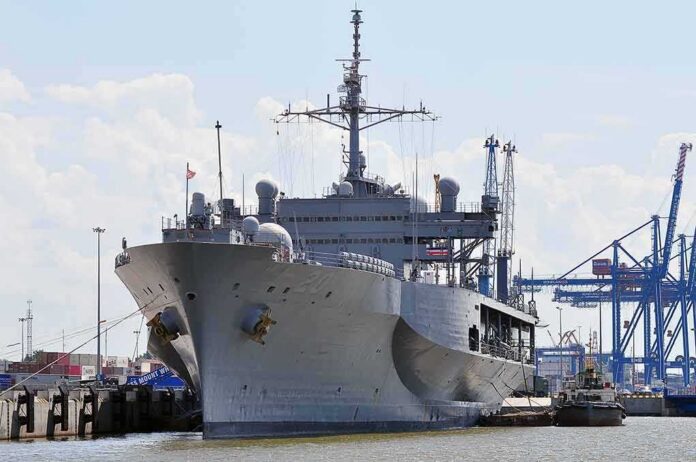
Watchdog findings show America’s Navy yard shortfalls are stalling new warships while China surges ahead in scale.
Story Highlights
- Government auditors report chronic U.S. shipbuilding delays, overruns, and weak planning.
- The Navy’s industrial base has not shown the capacity to meet long-term fleet goals.
- Key programs, like the Constellation-class frigate, face years-long delays and higher costs.
- China fields the largest maritime fighting force, but commercial capacity is not the same as warship output.
GAO warns the Navy lacks the industrial capacity to meet its plans
Government Accountability Office reviewers reported that the Navy’s private shipbuilding base has not demonstrated the capacity needed to reach planned fleet growth. The report stated the Navy would need to deliver 383 ships over 30 years to hit its force goals. The current industrial base has not shown it can scale production to that level. Auditors urged the Department of Defense to adopt a clear industrial-base strategy with metrics and visibility across investments.
Auditors also said the Navy nearly doubled its shipbuilding budget over two decades without getting the fleet growth it planned. Cost growth, delivery delays, and performance problems persisted across major programs. A senior Government Accountability Office official told Congress the system put programs and shipyards in a “perpetual state of triage,” where ships cost billions more and arrive years late. That pattern is a structural problem, not a short-term funding gap, according to the findings.
Delays and overruns strain readiness and waste taxpayer dollars
From 2019 through 2023, Navy delivery records fell far short of plans for key submarines and destroyers. The Navy delivered four of 11 Virginia-class submarines and seven of 15 Arleigh Burke-class destroyers in that span. Across the portfolio, 37 of 45 ships under construction were delayed from five months to more than three years. Those delays reduce presence at sea and drive higher lifecycle costs for the taxpayer.
One program shows how shaky designs lead to schedule and cost risk. Construction of the lead Constellation-class frigate began before design work finished. Government Accountability Office assessments projected at least a three-year delay. Reporting put the revised delivery in 2029 and the estimated price more than $200 million over the original $1.3 billion figure. Building before the design is stable invites rework, delays, and overruns that ripple across the yard.
China’s scale is real, but warship complexity narrows the gap
The Congressional Research Service reported that China now operates the world’s largest maritime fighting force, with 234 fighting ships to the United States Navy’s 219 when support ships are excluded. Analysts also note China’s large commercial shipbuilding capacity. But the often-cited 230-to-1 figure measures gross commercial tonnage, not the ability to build complex, combat-system-equipped warships. That means raw commercial output does not equal instant naval power parity in every class.
This distinction matters for submarines, carriers, and integrated combat systems. Those platforms demand advanced design stability, secure supply chains, and specialized labor. Government Accountability Office findings show America’s hurdle is not only money. The Navy needs complete designs at the start, stable plans, healthy suppliers, trained workers, and a coordinated industrial strategy. Without those basics, higher budgets alone will not produce more ready ships on time.
What must change now to rebuild American sea power
Auditors called for a strategic approach to private-yard investments, with clear metrics and better visibility across programs and repairs. Leaders must send stable, credible demand signals so suppliers can staff, train, and invest. Programs should lock designs before cutting steel, use proven design practices, and sequence work to avoid churn. Yards need workforce pipelines and modern tooling to raise throughput without sacrificing quality or safety.
📈 BCA’s #ChartoftheWeek!
Naval rearmament has become a durable budget priority as it is at the heart of geopolitical competition. GeoMacro analyst Jose Yanes notes:
⚓ China has a larger fleet and ~232x US shipbuilding capacity
🧊 Russia has ~5x the US icebreaker fleet
🏗️… pic.twitter.com/EaD0QeR3H7— BCA Research (@bcaresearch) October 10, 2026
Congress and the administration can align on oversight that ties funding to real delivery gains. That means linking dollars to schedule performance, design maturity, and supplier health. Taxpayers deserve ships that arrive close to plan and work as promised. Patriots expect a Navy that deters threats, protects trade, and keeps peace by strength. Closing the gap will take discipline, not slogans. The fix is doable if we set clear goals, enforce them, and stop paying for delay.
Sources:
files.gao.gov, gao.gov, legistorm.com, stripes.com