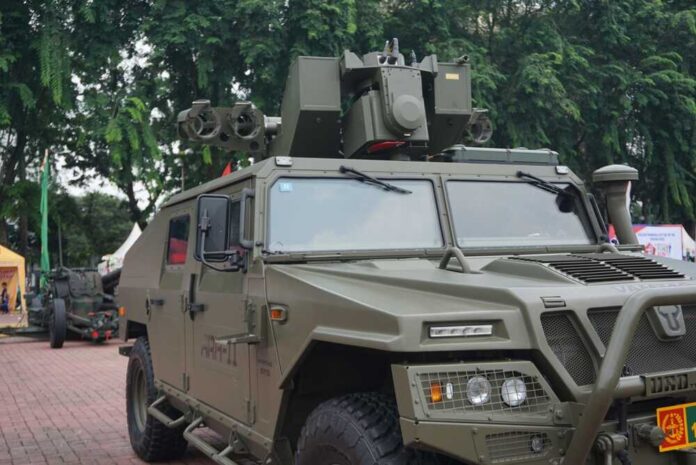
The U.S. Marine Corps’ latest advancement poses a significant leap in defense technology, turning light vehicles into formidable drone-killers.
Story Highlights
- Joint Light Tactical Vehicles (JLTVs) equipped with MADIS to combat drones.
- Development stems from lessons in modern warfare, especially from the Russia-Ukraine conflict.
- Marine Air Defense Integrated System (MADIS) now in full-rate production.
- Integration of kinetic and non-kinetic effectors for comprehensive defense.
Advanced Defense Technology Enhances Marine Capabilities
The U.S. Marine Corps has introduced a revolutionary air defense system by mounting advanced weaponry on Joint Light Tactical Vehicles (JLTVs). This innovation, known as the Marine Air Defense Integrated System (MADIS), enables these vehicles to detect, track, and neutralize unmanned aerial systems (UAS) and low-flying manned aircraft effectively. This leap from prototypes to full-rate production marks a significant enhancement in mobile expeditionary forces’ defense against aerial threats, underscoring a strategic shift from experimental to combat-ready capabilities.
MADIS operates on mobile JLTVs in two-vehicle teams, integrating kinetic options like the XM914 30mm cannon and Stinger missiles with non-kinetic measures such as electronic warfare and the Epirus Leonidas high-power microwave system. This dual approach contrasts with the U.S. Army’s heavier M-LIDS on M-ATVs, showcasing the Marines’ preference for mobility in littoral and expeditionary operations.
Strategic Development and Background
The development of MADIS has been driven by over a decade of efforts to counter small UAS threats, accelerated by insights from the Russia-Ukraine war. Drones have become primary tools in modern warfare, causing significant casualties and necessitating advancements in defense systems. The Marine Corps’ adoption of MADIS, alongside systems like the Epirus Leonidas, reflects a strategic response to these evolving threats, emphasizing lightweight, easy-to-operate systems that can be deployed rapidly by any Marine.
New tech will soon be turning Marine light vehicles into roaming drone- and aircraft-killers https://t.co/juCvK5vBUj
— Jazz Drummer (@jazzdrummer420) December 17, 2025
Live-fire validations conducted at locations such as Twentynine Palms and Hawaii confirm MADIS’s ability to engage multiple threats while on the move or stationary, offering a dynamic defense solution for maneuver units. This capability is crucial as drones increasingly reshape battlefield dynamics, demanding adaptable and responsive defense mechanisms.
Implications and Industry Impact
The deployment of MADIS offers immediate protection for deploying Marine Expeditionary Units (MEUs) against drones and helicopters, enhancing their maneuverability without compromising security. In the long term, MADIS is poised to reshape Marine air defense doctrine towards a more mobile, integrated approach, scalable to counter evolving drone swarms. This advancement not only increases the survivability of Marine units but also pressures adversaries by deterring UAS operations.
Economically, the scalable, low-cost production of systems like MADIS boosts the defense industry, encouraging the growth of the counter-UAS market. Politically, it signals the U.S.’s commitment to adapting to drone warfare, urging allies to follow suit. Socially, such innovations promise reduced troop casualties in drone-heavy conflicts, fostering a more secure operational environment for American forces.
Watch: https://www.youtube.com/watch?v=i0E0kDY30ng
Sources:
Interesting Engineering: US Marines Validate Drone Killer
The Watch Journal: Marine Corps to Field New Handheld Counter-Drone Systems
GovTech: U.S. Marines Test New Anti-Drone System in Hawaii
AOL: New Tech Turning Marine Light Vehicles into Roaming Drone Killers