President Trump signed a sweeping executive order to verify who gets a mail-in ballot — and a federal judge just gave it the green light to move forward, dealing Democrats a stinging defeat.
Story Highlights
- Trump signed an executive order on March 31 directing federal agencies to build verified citizen voter lists for every state and restricting mail-in ballot delivery to approved voters only.
- The U.S. Postal Service (USPS) must send mail ballots only to voters on state-approved lists and has already published a proposed rule in the Federal Register to comply.
- A federal judge rejected Democrats’ attempt to immediately block the order, ruling they filed too soon because no harm had yet occurred.
- Over two dozen states and multiple voting groups have filed lawsuits, arguing the order oversteps presidential authority and could exclude legitimate voters.
What Trump’s Order Actually Does
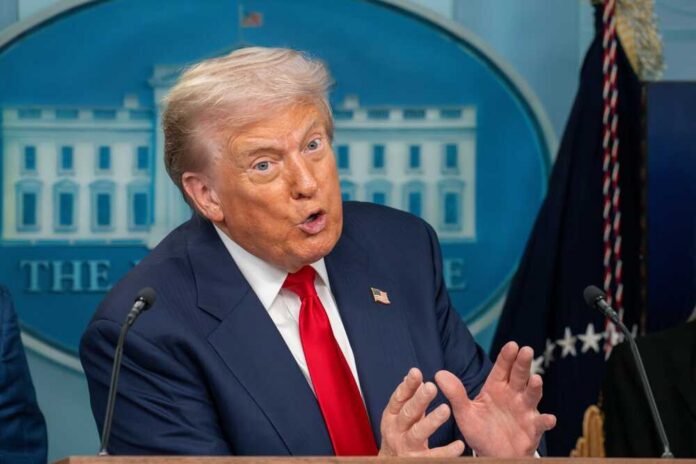
Trump signed Executive Order 14399, titled “Ensuring Citizenship Verification and Integrity in Federal Elections,” on March 31. [1] The order directs the Department of Homeland Security (DHS), working with the Social Security Administration, to compile a list of verified U.S. citizens eligible to vote in each state. [3] The USPS must then send mail-in ballots only to voters on those state-approved lists. [2] States that don’t comply risk losing federal funding, and Attorney General Pam Bondi is authorized to investigate and possibly prosecute officials who give ballots to ineligible voters. [8]
Trump described his goal plainly after signing the order. “It’s about voter integrity,” he said. “We want to have honest voting in our country because if you don’t have honest voting, you can’t have really a nation.” [7] The order also requires barcoded ballot envelopes, state-submitted participation lists, and centralized USPS tracking of all mail-in ballots. [1] States must keep election records for five years. [13]
Judge Blocks the Block — Democrats Lose Round One
U.S. District Judge Carl Nichols rejected a request from Senate Minority Leader Chuck Schumer and other Democrats to immediately halt the order. [13] Nichols ruled that the lawsuit was filed too early. The government had not yet created any citizenship lists, and the USPS had not yet enacted new rules. “Since the Executive Order does not compel Plaintiffs to take any action, and no agency has yet acted under the Order in a manner that could harm Plaintiffs, they have not experienced any actual harm at this time,” Nichols wrote. [13] The judge left the door open for future challenges as the order is put into practice. [12]
The USPS has since published a proposed rule in the Federal Register to comply with the order. [11] Notably, that proposed rule would not apply to primary elections or ballots for overseas voters. [11] The postal workers’ union has raised objections to mail carriers playing a role in deciding who receives a ballot. [11] Courts in Boston also heard arguments from a coalition of two dozen states and voting rights groups seeking to block the order. [11]
Legal Fights Ahead — And What’s at Stake
Multiple lawsuits are now working through the courts. The American Civil Liberties Union and the League of Women Voters argue the order is unconstitutional. [14] They say the Constitution gives states and Congress — not the president — the power to set election rules. [14] Critics also warn that federal databases from DHS and the Social Security Administration contain errors and outdated information that could wrongly exclude legitimate voters, including newly naturalized citizens, military families, and students. [17]
Those are real concerns worth watching. But conservatives have a fair point too: the left spent years fighting any effort to verify who is casting a ballot, and a judge has already said there is no proven harm yet. [13] The order targets a genuine weak point — mail-in voting has always been harder to audit than in-person voting, and requiring verified lists before a ballot goes out is a reasonable safeguard. The legal battles ahead will determine whether the order survives intact, gets trimmed by courts, or is struck down entirely. Either way, the fight over who controls election rules — Washington or the states — is far from over. [6]
Sources:
[1] YouTube – Trump Drops BOMBSHELL That Just BLEW UP the Democrats CORRUPTION!!!
[2] Web – Trump signs executive order setting rules for mail-in voting and …
[3] Web – Trump signs absentee/mail-in voting executive order
[6] Web – Explainer: Executive Order on Mail-in Ballot Rules and Federal …
[7] Web – Trump’s Order Restricting Mail-In Voting Rebuked by States
[8] YouTube – Trump signs executive order to crack down on mail-in voting
[11] Web – Trump’s executive order on mail voting is set to face legal challenges
[12] Web – Federal court hears arguments over efforts to halt Trump’s mail-in …
[13] Web – US judge rejects immediate block on Trump’s mail-in voting executive …
[14] Web – Judge allows Trump to implement mail-in voting executive order
[17] Web – The Actual Danger of Trump’s Phony Vote-by-Mail Executive Order