A deadly ICE traffic stop with no video and a scrambled camera rollout is now testing whether Washington can protect both our agents and the truth.
Story Snapshot
- ICE now has a written body camera directive requiring activation during enforcement operations, including traffic stops.
- DHS received $20 million to buy more than 5,000 cameras, yet only about half of agents have them today.
- Houston and Maine ICE shootings happened with no body camera footage, fueling protests and media attacks.
- Border czar Tom Homan says body cameras “are the way to go,” arguing they mostly protect law enforcement.
New ICE Camera Rules After Deadly Traffic Stops
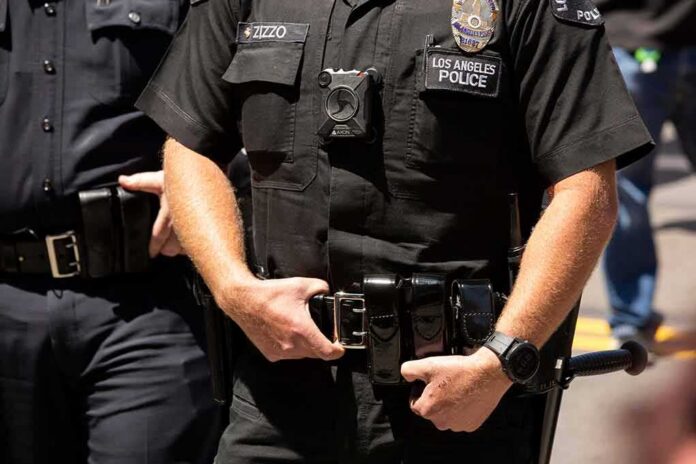
After recent fatal encounters in Texas and Maine, Immigration and Customs Enforcement leaders ordered that vehicle stops be recorded by at least one body camera on each arrest team. Tom Homan, serving as President Trump’s border czar, explained that ICE now requires officers to use body-worn cameras during traffic operations whenever possible. The Department of Homeland Security has said that every ICE arrest team will have at least one officer equipped going forward, tying cameras directly to vehicle stop enforcement. This focus on car encounters matters because the Houston shooting began with a traffic stop in an unmarked vehicle, and without body cameras, there is no officer video to confirm key moments.
ICE did not start from scratch with these new traffic rules. The agency had already adopted Directive 19010.3, a formal body camera policy that took effect in February 2025. That directive tells officers to turn cameras on at the beginning of enforcement activities and turn them off once the activity ends. Covered actions include arrests, searches, warrant service, brief investigative detentions, and interactions with the public during enforcement operations. Officers who do not activate cameras must put a written explanation into case records, creating a paper trail when video is missing. In theory, this written policy gives conservatives a clear standard for accountability while still letting officers do their jobs.
Funding, Delays, and What DHS Says Is a ‘Top Priority’
Congress backed the camera push with federal dollars. Fiscal year 2026 funding set aside $20 million for Department of Homeland Security to buy, deploy, and run body cameras for agents and officers. A Homeland Security source said the plan is to purchase more than 5,000 devices with that money. DHS also announced that body cameras had already gone out to more than half of ICE field offices, with the rest scheduled to get them within about two months. Agency spokespeople call getting cameras on every ICE officer a “top priority,” while also blaming earlier government shutdowns for slowing distribution and leaving some teams uncovered during recent operations.
Despite the strong language, rollouts have lagged. ICE itself has admitted it still does not have enough equipment for every law enforcement officer. As of mid-2026, DHS has said only about half of ICE agents and officers actually have body-worn cameras in hand, even with the funding in place. Internal privacy documents show ICE is still implementing the body camera program “nationwide, by geographic areas of responsibility,” rather than flipping a switch all at once. That step-by-step approach makes sense from a logistics view, but it also means some high-risk units are working without video protection at the exact moment media and activists are searching for reasons to attack federal enforcement.
How the Policy Works — and Where Loopholes Worry Critics
ICE’s written directive does more than say “wear a camera.” It spells out that law enforcement officers must record as soon as possible at the start of enforcement, and keep recording until a supervisor or team leader says the scene is secure. If an officer fails to activate, they must explain the reason in a statement or an after-action summary. The directive also lists examples of covered activity, such as at-large arrests, serving warrants, search operations, removal orders, and responses to violent disturbances at ICE facilities. These rules aim to capture the most intense moments of federal immigration enforcement, where questions about force and legality most often arise.
Critics point to exceptions that they say could be abused. ICE policy allows officers to skip activation when recording is not feasible due to operational security concerns or when it could compromise sensitive investigative techniques. There are also limits on recording in places like courtrooms or certain healthcare settings. Separate analysis notes that the policy does not clearly cover vehicle pursuits or transport, and it bars recording inside detention facilities. Those carve-outs worry civil-liberties advocates, who argue they make it too easy for controversial incidents to happen off camera. For conservatives, the key question is whether these exceptions protect legitimate undercover work or open the door to second-guessing every time an officer chooses not to record.
Houston Shooting, Media Attacks, and Homan’s Defense of Agents
The Houston case shows how gaps in the rollout can feed a political storm. Multiple outlets have confirmed that the ICE agents involved in the July 7 shooting of Lorenzo Salgado Araujo were not issued body cameras, so there is no official video of the encounter. Local reporting describes unmarked federal vehicles pursuing a white van, followed by shots fired, but so far no body camera footage, surveillance video, or other clear recording has publicly confirmed or disproved ICE’s account. That absence has fueled protests on Houston streets and raised demands for independent investigations, with activists saying they do not trust internal reviews by the Federal Bureau of Investigation or Department of Homeland Security.
ICE Agents Need Body Cameras
Universal body cameras would bring the truth to light and prove innocence more often than guilt.
ByJason JohnsonJuly 17, 2026Immigration and Customs Enforcement’s decision to deploy body cameras after two controversial shootings is welcome—and,…
— bronxboy1 (@bronxboy1) July 19, 2026
Mainstream outlets have seized on the lack of cameras as proof of secrecy rather than a technology gap. Coverage from networks like CNN, the Associated Press, and the Houston Chronicle highlights “uncertainty” and “outrage” and repeats the question, “Why aren’t agents wearing body cams?” Some stories stress that Congress gave DHS $20 million for cameras, yet Houston agents still had none. Others frame the new rules as damage control “put in place following two fatal shootings,” instead of a thoughtful policy to protect both citizens and officers. This framing matters because it shapes public opinion about ICE and, by extension, the Trump administration’s broader effort to restore lawful immigration enforcement.
Tom Homan has pushed back by leaning into the accountability tool the left claims to want. In interviews, he has said, “I think body cameras are the way to go,” and argued that they mostly protect law enforcement officers by showing when agents act in self-defense. Homan has also explained that the ICE director instructed that, whenever possible, at least one officer on a team should wear a camera. His stance lines up with conservative values of truth, due process, and support for frontline personnel. If cameras are used correctly, they can clear agents from false accusations, expose real misconduct when it happens, and keep both sides honest during intense encounters — all without surrendering control of federal policy to activist narratives.
Sources:
cbsnews.com, cnn.com, chron.com, usatoday.com, immpolicytracking.org, apnews.com, wbaltv.com, youtube.com, facebook.com, abc7ny.com