
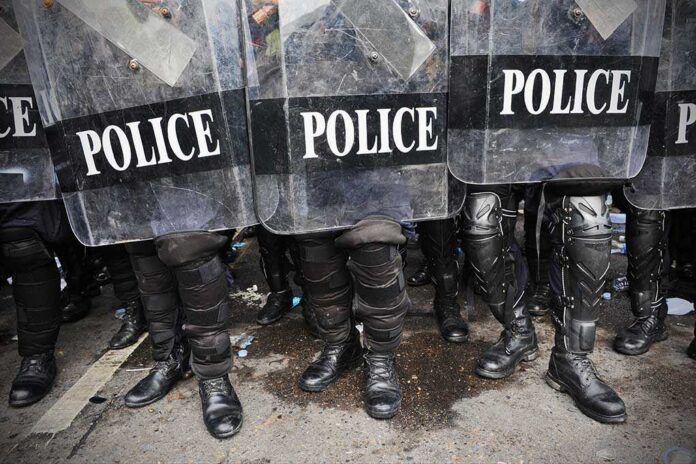
Protesters angry over President Trump’s visit tried to march on the ASEAN summit site in Manila and clashed with police who blocked the route.
Story Snapshot
- Activists attempted to leave a designated protest park and head toward the summit venue.
- Police formed barricades and used force to stop the march amid a large security presence.
- Reports describe arrests and minor injuries; exact counts differ across outlets.
- Organizers opposed Trump’s visit and burned effigies while chanting against U.S. policy.
March Route Standoff Near Summit Venue
Manila police blocked activists who tried to march from Liwasang Bonifacio toward the Philippine International Convention Center during the ASEAN leaders’ meetings. Reporters on the ground described barricades that stopped the crowd from leaving the park area and reaching major roads that lead to the venue. The confrontation unfolded as the summit schedule drew public attention and traffic closures. Coverage confirms the clash and the attempted route toward the summit site as the key flashpoint that day.
Journalists and rights groups reported arrests and injuries tied to the effort to break through police lines. Counts vary by outlet and source, with some citing seven arrests and others saying nine. Several reports described minor injuries linked to the pushing between riot police and protesters. Those same reports did not provide a final official tally for this specific standoff. The variation reflects fast-moving events and split locations citywide, but all accounts agree that arrests occurred during the barricade clash.
Protest Message: ‘Ban Trump’ And Burned Effigies
Protest organizers said the march targeted President Trump’s visit and his policies on trade, security, and foreign affairs. Demonstrators burned effigies, chanted “ban Trump,” and called him a “fascist imperialist leader.” Organizers claimed thousands joined from labor, student, Indigenous, Muslim, and LGBT groups. Their message centered on national dignity and anger at foreign pressure. The multi-group turnout and the anti-Trump theme were consistent across several reports from Manila streets during the summit period.
Earlier and nearby rallies in the same period saw stronger crowd-control tactics. Photo and video reporting documented water cannon use as protesters tried to move toward the United States embassy, and local coverage mentioned truncheons and a sonic alarm in separate confrontations. Those scenes fed the sense of a tense citywide operation around the summit. They also show how images from one site can blend with another in public memory when events happen across several days and blocks.
Permits, Freedom Parks, And Police Limits
Police told reporters that rallies could proceed inside Liwasang Bonifacio, a designated freedom park, but not as a march toward the summit venue without a permit. Philippine law requires a written permit for assemblies in public places but exempts freedom parks. That split often sparks conflict when organizers try to leave the park and enter main roads. The legal framework puts city leaders and officers in charge of route limits when they claim public safety or security concerns.
The country’s high court has also stressed that peaceful assembly is a core right. Court rulings have warned officials against changing rally permits or venues without strong, clear reasons tied to real danger. That precedent sits beside the permit rules and pushes authorities to justify restrictions with evidence, not convenience. The tension between legal protections and on-the-ground security plans often comes to a head during major summits with global guests and tight timelines.
Security Scale And Conflicting Numbers
Summit organizers deployed a large security force across Manila, with thousands of personnel assigned to protect venues, routes, and motorcades. That scale framed the protest standoff as a public-order issue first, even as the demonstrators aimed to send a political message about U.S. policy and sovereignty. The mix of zones, checkpoints, and rolling road closures made movement tricky. It also increased the odds that short clashes could flare when marchers hit hardened lines and tried to push through.
🇵🇭 Philippines
PROTESTS GREET THE ASEAN SUMMIT.Demonstrators face police in Manila as Southeast Asian leaders arrive. They cite the cost of basic goods and a US-led AI supply plan known as Pax Silica.
Al Jazeera reports from the streets.Will leaders hear them? pic.twitter.com/R2SCF9Gn5r
— Silent Politics◾️ (@silentpolitics1) November 15, 2026
Newsrooms reported injuries in the dozens for the broader protest period, yet only a handful tied to the specific summit-venue march. Some outlets carried organizer claims about a person beaten and taken by police instead of to a hospital, but those details were not backed by official records in the coverage provided. What remains undisputed is simpler: protesters tried to move on the summit site, police blocked the route, and arrests followed during the struggle over the street.
Sources:
youtube.com, dw.com, rappler.com, dzrh.com.ph, mindanews.com, newsinfo.inquirer.net, gmanetwork.com