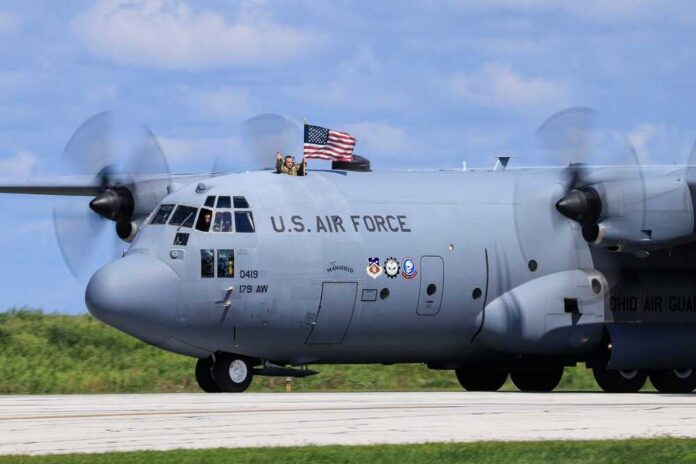
The U.S. Air Force is transforming ordinary cargo planes into formidable missile launchers, a groundbreaking move that will multiply America’s strike capability without the billion-dollar price tag of new bombers.
Story Snapshot
- Air Force’s Dragon Cart system turns C-130 and C-17 cargo aircraft into cruise missile platforms, launching up to 45 missiles per plane by 2027
- $355 million budgeted for initial 1,000 low-cost missiles in FY2027, with $12.6 billion allocated for 28,000 missiles long-term
- No aircraft modifications required—palletized system uses standard airdrop technology, making it exportable to 63 allied nations operating C-130s
- Program deploys advanced weapons including JASSM-ER with 575-mile range and LRASM anti-ship missiles via simple pallet drops
Converting Cargo Haulers Into Strike Assets
The Air Force Research Lab’s experimental Rapid Dragon program officially transitions to operational Dragon Cart in 2027, converting logistics aircraft into standoff bombers. A C-130 Hercules can deploy 12 cruise missiles while a massive C-17 Globemaster carries up to 45 missiles on palletized systems. The weapons launch via parachute-extracted pallets during standard cargo airdrops, requiring zero modifications to the aircraft themselves. This ingenious approach leverages existing airdrop technology dating back to WWII, modernized for precision-guided cruise missiles capable of striking targets over 575 miles away.
Cost-Effective Deterrence Against China
Dragon Cart addresses a critical capability gap as the Air Force faces bomber shortages amid rising Indo-Pacific tensions. Rather than spending billions on new stealth bombers, the service repurposes its existing cargo fleet to saturate adversary defenses with overwhelming missile strikes. The FY2027 budget requests $355 million for 1,000 affordable Family of Advanced Multirole Munitions, with long-term plans for 28,000 missiles totaling $12.6 billion. This strategy aligns with fiscal conservatism—maximizing defense capability while respecting taxpayer dollars. Lockheed Martin designed weapon-agnostic pallets accommodating JASSM-ER, LRASM anti-ship missiles, and future JASSM-XR with 1,000-mile range, providing flexibility against hardened targets or naval threats.
Expanding Allied Strike Power
The Dragon Cart system’s export potential reshapes global power dynamics, offering 63 C-130-operating allied nations instant standoff strike capabilities without expensive platform purchases. This force multiplication strengthens deterrence against adversaries like China and Russia by distributing lethal firepower across coalition partners. Defense industry experts praise the no-modification design for scalability, noting it transforms logistics squadrons into multi-role strike assets overnight. The program complements Agile Combat Employment doctrine, enabling rapid force projection from austere bases across the Pacific theater where traditional bombers face limited access.
Testing Validates Operational Readiness
Years of rigorous testing since December 2021 demonstrated the concept’s viability, beginning with MC-130J trials at Hurlburt Field and progressing through vertical launches of JASSM and LRASM surrogates. Lockheed Martin’s Dragon Cart pallets proved aircraft-agnostic across cargo platforms, validated through 2025 with multiple weapon types. Production scaling begins in 2026 with initial low-rate procurement of 1,000 missiles, ramping to full-scale saturation capacity. The Air Force frames this as affordable deterrence—a common-sense approach maximizing existing assets rather than chasing gold-plated solutions that drain budgets while delivering minimal additional capability against peer adversaries.
Sources:
Air Force’s Rapid Dragon, which turns cargo aircraft into missile launchers, is finally going live
Air Force to Field Cruise Missiles on Cargo Plane Pallets in 2027
U.S. Air Force Plans $12.6 Billion Buy of 28,000 Low-Cost Cruise Missiles
USAF Seeks Affordable Missiles Launch from Cargo Aircraft