Iranian forces exchanged fire with an unnamed “enemy” on a strategic island in the Strait of Hormuz, triggering U.S. military strikes that exposed the fragility of a ceasefire between Washington and Tehran—raising urgent questions about whether Americans are being kept in the dark about escalating Middle East tensions.
Story Snapshot
- Iranian state media reported forces engaged “the enemy” on Qeshm Island on May 7, 2026, prompting U.S. Central Command to conduct what it called “self-defense” strikes on Iranian facilities
- President Trump asserted the ceasefire between the U.S. and Iran “remains in place” despite the exchange of fire, while Iran accused Washington of violating the fragile truce
- The clash occurred as U.S. Navy vessels transited the Strait of Hormuz, a critical chokepoint handling roughly 20% of global oil trade, sending energy prices up 2-3% amid renewed security fears
- No casualties or major damage were reported, but the incident underscores persistent tensions in a region where decades of U.S.-Iran confrontations have repeatedly threatened broader conflict
Conflicting Narratives Emerge from Strait Incident
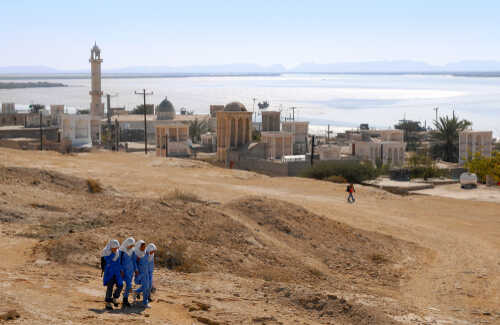
Iranian state media outlets Fars and Tasnim reported armed forces exchanged fire with “the enemy” on Qeshm Island, home to approximately 150,000 residents and a vital water desalination plant in the Persian Gulf. The vague terminology—typical of Iranian government messaging—left the adversary unidentified, though U.S. Central Command later confirmed conducting strikes on Iranian facilities during a U.S. Navy transit through the Strait of Hormuz. Additional reports described loud noises and defensive fire in western Tehran, along with explosions near the port city of Bandar Abbas, heightening alarm across the region.
CENTCOM stated its forces responded to Iranian attacks involving missiles, drones, and small boats targeting U.S. naval vessels as they moved from the Strait of Hormuz into the Gulf of Oman. The command emphasized it “does not seek escalation” and characterized the strikes as necessary self-defense measures. Iran’s Islamic Revolutionary Guard Corps Navy countered by accusing the United States of violating the ceasefire and striking Iranian tankers and vessels near Qeshm without provocation. President Trump later told reporters the ceasefire remained intact, a claim that struck many observers as difficult to reconcile with the day’s events.
Strategic Chokepoint Reignites Energy Security Concerns
The Strait of Hormuz has served as a geopolitical flashpoint since the 1979 Iranian Revolution, with its narrow 21-mile width funneling a fifth of the world’s oil supply through contested waters. Historical precedents—including the 1980s “Tanker War” during the Iran-Iraq conflict and the U.S. Navy’s 1988 Operation Praying Mantis that sank Iranian vessels—underscore the strait’s volatile nature. More recently, Iran seized a British tanker in 2019, and U.S. forces intercepted Iranian drones multiple times between 2024 and 2025, illustrating the ongoing cat-and-mouse dynamic.
Qeshm Island holds strategic importance for Iran’s naval operations and serves as a suspected hub for arms smuggling, making it a natural target for asymmetric warfare tactics that Tehran has refined over decades. The island’s desalination infrastructure supplies water to a region chronically short of fresh resources, adding civilian vulnerability to military calculations. Maritime analysts warned of a potential “Tanker War 2.0,” though they noted America’s technological superiority limits Iran’s capacity for sustained aggression. Oil prices spiked 2-3% intraday as traders absorbed the news, and insurance premiums for tankers in the Gulf reportedly climbed 5-10%, reflecting heightened risk assessments.
Ceasefire Credibility Questioned Amid Escalation
The timing of the incident places immense pressure on an already fragile U.S.-Iran ceasefire negotiated after escalations in 2025 involving Iranian proxy attacks on American assets and U.S. retaliatory strikes on Islamic Revolutionary Guard Corps-linked sites. Iran’s state media reported the country had not made decisions on a potential peace deal with Washington, signaling Tehran’s reluctance to finalize any agreement despite public claims of seeking stability. Experts such as Jon Alterman of the Center for Strategic and International Studies suggested Iran’s vague “enemy” rhetoric masks efforts by the IRGC to probe U.S. resolve and test the boundaries of the ceasefire.
The exchange raises uncomfortable questions about transparency from both governments. Americans frustrated with decades of Middle East entanglements—and the financial and human costs they entail—deserve clarity on whether their leaders are managing tensions or sleepwalking into another protracted conflict. President Trump’s assertion that the ceasefire holds, despite acknowledging U.S. strikes, strains credibility and fuels suspicions that the public is receiving a sanitized version of events. This pattern of contradictory messaging from elites in Washington and Tehran alike feeds a growing sense that ordinary citizens on all sides are pawns in a dangerous game driven more by bureaucratic inertia and institutional self-preservation than genuine national interest.
Broader Implications for Regional Stability
Short-term consequences include heightened alert levels for commercial shipping and potential disruptions to Qeshm’s desalination operations, which could impact the island’s 150,000 residents if infrastructure sustained unreported damage. Longer-term risks involve the collapse of ceasefire talks and the possibility of a broader Gulf conflict drawing in Iranian proxies such as Hezbollah and the Houthis, the latter of which have already disrupted Red Sea shipping in recent years. Regional allies including Saudi Arabia and the United Arab Emirates implicitly support U.S. freedom-of-navigation operations, yet fear being dragged into open warfare.
Economically, delays in Strait of Hormuz transit could add 50 cents to one dollar per barrel to global oil prices, compounding inflationary pressures that continue to strain households across America and Europe. Iran’s economy, already weakened by international sanctions, faces further deterioration, potentially emboldening hardliners in Tehran who view confrontation as preferable to concessions. Politically, the incident provides ammunition to critics of Trump’s Iran strategy, with some arguing the administration projects weakness while others claim it risks reckless escalation. The episode underscores a harsh reality: the Strait of Hormuz remains a tinderbox where miscalculation by either side could ignite consequences far beyond the Persian Gulf’s contested waters.
Sources:
Iran says no decisions have been made on potential peace deal with US – WPTV
Iranian media report exchange of fire with US forces near island in Strait of Hormuz – Euronews