
When gunfire erupts in a crowded commercial corridor in broad daylight, the real story is not only the tragedy of the victims but how a modern city’s entire emergency, media, and civic infrastructure strains to make sense of chaos in real time—and how much uncertainty inevitably remains after the first, stark facts are clear.
At a Glance
- Three people were killed and at least two others injured in a mass shooting at or around an In-N-Out Burger in Twin Falls, Idaho.
- Police classified the event as an active shooter incident, locked down a major commercial district, and later confirmed the suspected shooter is among the dead.
- Early casualty figures and suspect status shifted as agencies reconciled 911 calls, witness video, and hospital counts—a typical pattern in breaking-violence reporting.
- Despite clear confirmation of deaths and injuries, key questions about motive, precise sequence of shots, and individual roles remain under active investigation.
The Core Facts: What Happened in Twin Falls
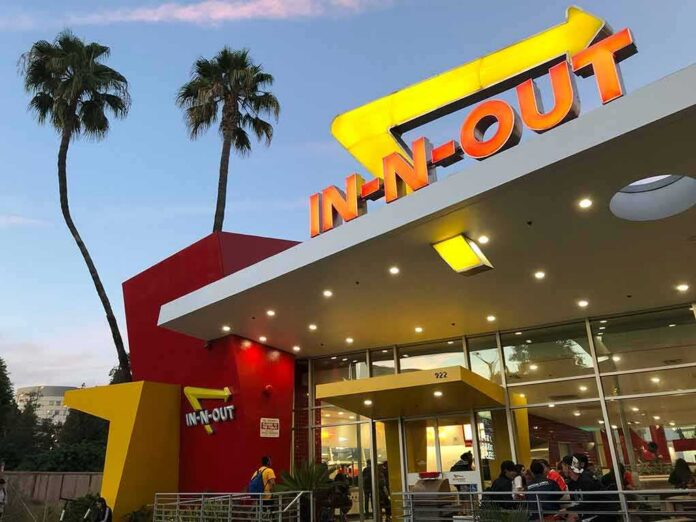
By any reasonable evidentiary standard, the shooting at the Twin Falls In-N-Out Burger was a mass-casualty event. Multiple major outlets and city officials converge on the same core picture: three people were killed and at least two more wounded when a gunman opened fire in and around the restaurant and neighboring businesses in the city’s busy north-side commercial district. A Twin Falls city spokesperson told national media it was an “active shooter incident” centered on the In-N-Out and nearby shops, confirming three fatalities and at least two injured transported for treatment.
Police received 911 calls shortly before 2:30 p.m. local time reporting an armed assailant at the restaurant. Dispatchers described being overwhelmed by reports of people down in the parking area and drive-through. Videos posted to social media and later carried by news organizations show crowds fleeing across asphalt, crouching behind vehicles, and a man holding a long gun—variously described as an AK- or AR-style rifle—firing at a parked sedan and a Tesla near the storefront.
Emergency Response and Active Shooter Protocol
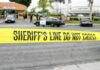
Once officers treated the calls as an active shooter, Twin Falls’ emergency apparatus moved quickly into a familiar pattern. Police closed surrounding roads, including the Perrine Bridge across the Snake River Canyon—a critical regional artery—both to quarantine the threat and to keep civilians from flooding into a still-fluid scene. Businesses in the shopping area went into lockdown; some, like Ross across the parking lot, became ad hoc shelters as customers rushed inside and employees pulled people away from glass and exterior doors.
Multiple agencies converged: Twin Falls Police, Idaho State Police, county sheriff’s deputies, and fire and paramedic crews established a perimeter, triaged the wounded, and began a search for any additional suspects. School buses were brought in to evacuate people safely from cordoned lots, a detail that underscores the scale of the response and the number of civilians caught in the immediate vicinity.
As is now standard in large, uncertain incidents, federal partners were alerted early. The FBI deployed agents to assist, though all available accounts stress that local law enforcement retained primary investigative control while federal teams focused on evidence handling and advisory support. Within hours, state and local officials were issuing coordinated public messages: avoid the area, respect road closures, and allow first responders to work.
Casualty Counts and the Shooter’s Status
One of the best documented aspects of the Twin Falls shooting is the eventual casualty count—but that number took time to stabilize. Initial alerts mentioned “multiple” victims without specifying fatalities. A county commissioner relayed preliminary information that five people were hurt, while early wire reports spoke of several injured and no confirmed deaths. As officers and medical staff reconciled what they were seeing on scene with hospital intake, officials moved to a more precise toll: three dead and at least two injured.
Later, outlets such as the Wall Street Journal reported three fatalities and at least five wounded, reflecting hospital statements that more injured individuals had presented for care or been identified after the first press updates. That discrepancy—two injuries in some reports, five in others—is exactly the sort of fluid detail that tends to evolve in the first day of a major incident as people with less serious wounds self-transport or delayed symptoms emerge.
The shooter’s status followed a similar trajectory. In the earliest televised segment, a Twin Falls spokesperson told NBC there was no active search underway, but it was unclear whether the suspect was among the deceased, which implied investigators believed the threat had ended but were still confirming identities. Other outlets, drawing on a city public information officer and neighboring chiefs, later stated explicitly that authorities believe there was one shooter, dead from a self-inflicted gunshot. AP-style reporting and regional papers echoed that conclusion: the shooter is among the dead, and there is no ongoing danger to the public.
Inside and Around the Restaurant: What Witnesses Saw
The most vivid accounts of the Twin Falls shooting come from eyewitnesses whose video and testimony were later carried by local television. One driver, stopped at a light on Blue Lakes Boulevard, described a young male shooter with glasses and dark hair, pale and focused, firing a semi-automatic rifle into a car just feet away.[Dz1 transcript; KTVB] He watched the vehicle speed off and then saw the gunman turn the weapon on other targets: cars in the drive-through lane and even through the restaurant window as employees scrambled.
That witness reported that a man in the In-N-Out drive-through returned fire with a handgun, a detail that illustrates how quickly an armed civilian can become part of the tactical equation—sometimes distracting or pinning down a shooter, sometimes adding another moving firearm to an already confused scene.[Dz1 transcript] He told reporters the shooter fired “a couple of magazines,” sending rounds toward vehicles and the building before running toward the nearby visitor center while still shooting.
Another eyewitness account, paired with video released by the Associated Press, shows people sprinting away from the restaurant as shots ring out; observers can be heard identifying the weapon (“He got an AK”) as the shooter fires at a parked Tesla. A Ross employee said no shots were fired inside their store, but they heard gunfire and saw people streaming into the building for cover.
These narrative details—magazine reloads, defensive fire from a bystander, a wounded worker dragged from harm—play an important role in reconstructing the mechanics of the event. Yet they remain subordinate, evidentiary-wise, to the confirmed outcomes: who died, how many were injured, and where ballistic evidence ultimately places the shooter at each stage.
Location, Sequence, and the Problem of Early Specifics
Curiously, one of the points about the Twin Falls shooting that remains less settled in the public record is where, exactly, the first shots were fired. Some outlets, drawing on CBS reporting that cited the city’s public information coordinator, say the shooting began inside the In-N-Out restaurant shortly before 2:30 p.m. Others describe it more generally as occurring “in the area of” the restaurant and surrounding businesses, a phrasing that matches video showing the gunman in the parking lot, near cars and exterior windows.
The distinction matters for granular forensic reconstruction—inside first, then outside, or the reverse—but it does not alter the established reality that customers and staff in and around the restaurant came under fire. From an evidentiary perspective, that ambiguity is unsurprising. In the first hours, officials are typically working from dispatcher notes, fragmentary witness statements, and whatever clips have surfaced online. Only later, with full scene access and a methodical review of surveillance footage and ballistic trajectories, can investigators fix the exact origin point of the attack.
This is a good example of how to read breaking-violence coverage intelligently. Where different outlets disagree, they tend to do so at the level of detail—inside versus outside, two injured versus five—not on the existence or seriousness of the event itself. In Twin Falls, every credible source acknowledges multiple fatalities, multiple injuries, and an armed assailant who is now dead. The unresolved elements sit on top of that shared foundation.
Patterns in Mass-Violence Reporting and Public Trust
The Twin Falls shooting slots into a well-studied pattern in how mass-violence events enter the public record. Criminologists and media scholars have long noted that initial casualty counts and suspect descriptions are the least reliable facts in the first 24 hours: agencies are still locating victims, hospitals are triaging, and witnesses are frightened and often mistaken about what they saw. In this case, AP and regional outlets reported five hurt before fatalities were formally confirmed; later, police and city spokespeople settled on three dead with either two or “at least five” wounded, depending on when the statement was made.
Overlaying that official channel is the now-routine flood of social media content. In Twin Falls, multiple videos showed the shooter and fleeing crowds; some images were reportedly AI-enhanced or low-resolution, raising questions about authenticity even as they shaped public perception.[iCkEdMeL transcript] Local livestreamers monitored police scanners, speculated about motives, and repeated unverified claims about casualty numbers and suspects, sometimes contradicting later verified information.
This dual-track information environment—formal briefings and informal streams—creates both benefits and risks. On the one hand, real-time footage helps confirm that a serious event is indeed occurring, counters rumors that nothing happened, and can later aid investigators. On the other, it amplifies speculation about motives, gang ties, or disgruntled employees long before detectives have a coherent narrative. The Twin Falls case is emblematic: authorities ultimately affirmed deaths and injuries, but have not publicly pinned down motive or detailed the shooter’s movements, leaving a vacuum that commentary eagerly fills.
Unanswered Questions: Motive, Victims, and Forensics
Despite the clear confirmation that lives were lost and others wounded, significant investigative work remains before the Twin Falls shooting can be fully understood. Police have not released the names of the deceased, pending notification of next of kin and completion of autopsies. The shooter’s identity, beyond being male and deceased, has not been publicly detailed, nor have any prior contacts with law enforcement or indications of ideological or personal motive.
Coroner and medical examiner findings will ultimately determine cause and manner of death for each victim; in mass shootings, those reports are crucial for distinguishing direct gunshot fatalities from complications during transport or treatment. Hospital records from St. Luke’s Magic Valley Medical Center will clarify how many injured individuals were treated, how their conditions evolved, and whether some early “hurt” counts reflected minor injuries or shock rather than gunfire wounds.
On the forensic side, crime scene technicians will map cartridge cases, bullet strikes, and blood patterns to reconstruct the shooter’s path—from first discharge to final self-inflicted shot—and to confirm or refute conflicting witness memories about who was targeted first. Video from the restaurant, adjacent businesses, and parking-lot cameras, synchronized with 911 timestamps and radio traffic, will eventually give investigators a precise timeline where the public record now has only a rough outline.
Why Incidents Like Twin Falls Resonate Beyond One City
For residents of Twin Falls, the In-N-Out shooting is a local trauma: a new restaurant, a familiar shopping area, a summer afternoon turned into a scene of death and panic. For everyone else, it is another entry in a national ledger that has grown disturbingly long. What makes this case instructive is not only its sorrow but how it illustrates the mechanics of modern mass-violence response and reporting—what we learn quickly, what stays uncertain, and how to read early accounts without either gullibility or reflexive cynicism.
The evidence supports a clear, sober bottom line. There was an active shooter at or around the In-N-Out Burger on Blue Lakes Boulevard; three people did not survive; several others were injured; the suspected gunman is dead and the immediate threat has passed. Around those facts, investigative detail will accrete over months, not hours. The challenge—for citizens, journalists, and policymakers alike—is to hold both truths at once: the weight of what is already known, and the humility that comes with recognizing how much about a single violent afternoon still needs to be carefully, patiently understood.
"In-N-Out Burger President Lynsi Snyder releases statement on deadly mass shooting which left 3 dead and 7 injured in Twin Falls, Idaho" https://t.co/xj0wHeqC5t
— Miss Mary (@DivintyMary) August 2, 2026
Sources:
feedpress.me, independent.co.uk, youtube.com, ksl.com, gbnews.com, facebook.com, apnews.com, abc7.com, x.com