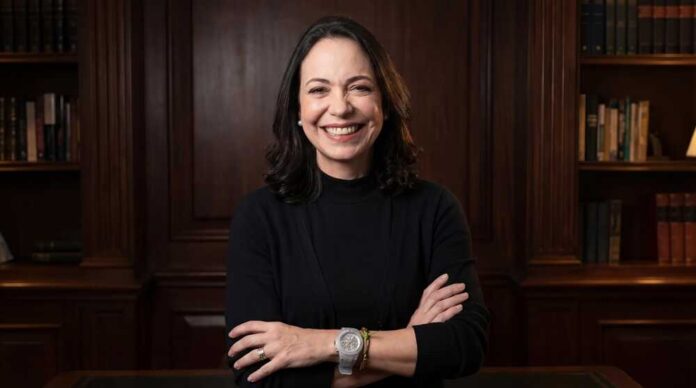
A historic shift looms as Venezuela, Cuba, and Nicaragua edge towards freedom, threatening authoritarian strongholds.
Story Highlights
- Machado’s vision parallels the fall of the Berlin Wall, promising a democratic wave in the Americas.
- The Trump administration backs the Venezuelan democratic transition, challenging authoritarian regimes.
- The geopolitical landscape of the Western Hemisphere hangs in the balance with potential regime changes.
- Venezuela’s massive oil reserves remain a strategic interest for the U.S., impacting global energy markets.
Machado’s Vision for Democratic Transformation
María Corina Machado, Venezuelan opposition leader and 2025 Nobel Peace Prize recipient, has asserted that the authoritarian regimes of Venezuela, Cuba, and Nicaragua are on the brink of collapse. Drawing comparisons to the fall of the Berlin Wall, Machado envisions a sweeping democratic transformation across the region. Her statements come after discussions with President Trump, indicating a strong U.S. commitment to support these nations in achieving democratic governance.
The Trump administration has shifted U.S. policy to actively support Venezuelan opposition leader Edmundo González, recognized as Venezuela’s rightful president by Secretary of State Marco Rubio. This stance reinforces U.S. strategic interests in the region, aiming to dismantle the Maduro regime’s oppressive structures, promote political freedom, and stabilize the hemisphere.
Watch: https://www.youtube.com/shorts/FeXxtRwANO8
Implications for the Western Hemisphere
The potential democratic transition in Venezuela could significantly alter the geopolitical dynamics of the Western Hemisphere. With Venezuela holding the world’s largest proven oil reserves, the stakes are high for both regional stability and global energy markets. The collapse of authoritarian regimes in these nations would reduce the influence of China and Russia, who have historically aligned with these socialist governments, thereby enhancing U.S. security and hemispheric partnerships.
Machado’s strategic vision emphasizes popular sovereignty and institutional transformation beyond mere regime change. Her focus on long-term democratic institution-building highlights the need for sustained U.S. collaboration and investment to ensure a successful transition.
Challenges and Future Prospects
Despite the momentum, the path to democracy remains fraught with challenges. The timeline for transition is uncertain, and the dismantling of oppressive regimes requires intricate political maneuvering. The Trump administration’s support is crucial, but long-term success hinges on robust institutional frameworks and the release of political prisoners as a demonstration of genuine transition commitment.
The successful transition of these nations could trigger a broader hemispheric realignment, pressuring Cuba and Nicaragua towards similar democratic reforms. The impact on regional security, migration patterns, and economic structures could reshape Latin America and the Caribbean, offering new opportunities for economic growth and stability.
Sources:
Trump’s Meeting with Venezuela’s Nobel Laureate Machado Offers U.S. an Opportunity
Maria Corina Machado Press Conference
US Holds Phone Call with González, Labels Him Rightful President of Venezuela
Nobel Peace Prize Awarded to María Corina Machado from Venezuela