

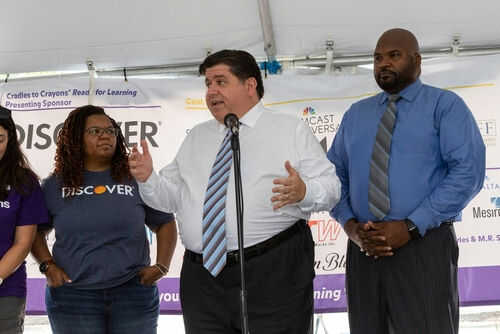
A bloody Chicago weekend has reopened the fight between President Trump and Governor JB Pritzker, and the question is simple: how many more families have to pay the price before leaders accept real help?
Story Snapshot
- Trump blasted Pritzker after another violent Chicago weekend, saying he could make the city safe in “one month.”
- Recent holidays have seen dozens shot and multiple killed, keeping Chicago near the top in homicides nationwide.
- Pritzker still rejects National Guard support, calling it unnecessary and even “un-American,” despite years of deadly crime.
- Crime stats show some declines, but many neighborhoods remain dangerous and residents say they do not feel safe.
Trump’s Warning After Another Bloody Chicago Weekend
After yet another weekend of shootings in Chicago, President Donald Trump again called out Illinois Governor JB Pritzker for failing to keep residents safe. Reports from past holiday weekends tell a grim story: at least 35 people shot over Labor Day with four killed, and another weekend with six killed and more than twenty wounded in shootings across the city.[10] In a Truth Social post, Trump called Pritzker “weak and pathetic” and warned that if the governor would not act, the federal government would.[11]
Trump’s message has been steady for months: Democrat leaders in Illinois and Chicago talk about progress, but people keep dying in the streets.[10] He has argued that federal law enforcement and, if needed, National Guard units could quickly help restore order, just as he claims success cracking down on crime in Washington, District of Columbia.[9] The White House has even prepared plans to send as many as a thousand Guard troops to Chicago, citing the city’s long run at or near the top of national homicide lists.[10]
Pritzker Says ‘No Emergency’ As Families Live With Fear
Governor Pritzker insists there is no crisis that justifies federal troops on Chicago streets. In an interview while touring “revitalized” South Side blocks, he told the Associated Press he wants to “show off that there’s no emergency happening in Chicago” and that the city does not need or want the National Guard.[3] He has repeatedly called Trump’s approach “unconstitutional” and “un-American,” framing it as a political stunt aimed at a blue city in a blue state.[12]
Pritzker and Chicago’s Democrat leadership point to recent declines in some crime metrics to support their stance. City data and independent reviews show that Chicago’s overall crime rate in mid‑2025 was lower than it was before the pandemic, and that violent crime in 2025 fell to about a decade low as arrests rose across most neighborhoods.[1][7] Mayor Brandon Johnson has touted more than a 30 percent drop in homicides and even larger percentage drops in robberies and shootings over the past year.[4][12]
Numbers vs. Reality: Chicago Still a Homicide Hot Spot
Even with those declines, Chicago remains one of the deadliest big cities in America. A Chicago Tribune review found 573 homicides in 2024, and other reporting notes that Chicago has led the nation in total homicides for more than a decade.[2] A separate Council on Criminal Justice study showed that while homicides have fallen from the 2021 peak, Chicago’s murder rate is still higher than its 2013–2015 and 2019 levels.[22] In short, the “improvement” still leaves hundreds of families planning funerals each year.
NEW: President Trump on Truth Social: “Lots of Killing going on in Chicago. 22 people shot, at least 4 Dead. Why isn’t Governor Pritzker calling me for help. I could make Chicago a safe City in ONE MONTH, in ONE YEAR, it would be one of the safest!!! D.C. went from one of the… pic.twitter.com/enRVl2qcU4
— RedWave Press (@RedWavePress) June 21, 2026
That gap between data trends and daily life is exactly what many residents are angry about. Local voices say crime statistics “don’t mean much if folks still can’t ride the train or bike through their neighborhood without fear.”[5] Research on Chicago’s crime pattern shows that violence is heavily concentrated in long‑neglected West and South Side communities, where homicides jumped more than 50 percent from 2019 to 2020 and never returned to earlier lows.[21] For families in those areas, debates over percentages feel like political games played over their grief.
Trump’s Pitch: Federal Back‑Up, Fast Results, Local Control
Trump’s promise to “make Chicago a safe city in one month” is clearly ambitious, but it reflects a law‑and‑order vision many conservatives share: back the police, enforce the law, and stop making excuses. In Washington, his administration highlighted what it called “remarkable success” using a combined surge of federal agents and troops to push down violent crime.[9] He now argues that the same model—tight coordination between local officers, federal agents, and if needed the National Guard—could be used in Chicago to stabilize the worst hot spots quickly.[4][7]
At the same time, serious conservative voices know that crime has deep roots, from broken families to failing schools to drug gangs dug into specific blocks. Academic studies show that party labels alone do not explain city crime; factors like poverty, neighborhood design, and local culture matter a lot.[18][19][23] That means any federal surge would have to respect the Constitution, support—not replace—local officers, and be tied to clear goals: secure streets, safe transit, and real consequences for violent offenders, not endless catch‑and‑release.
What This Fight Means For Everyday Americans
For readers who live far from Chicago, this clash still matters. It highlights a broader divide between leaders who see crime as a talking point and leaders who treat it as a moral emergency. While national groups argue over how to read statistics, one in five major‑city residents reports being directly touched by serious crime or heavy‑handed policing.[24][25] Middle‑class families are changing how they commute, where they work, and whether they even visit once‑great cities because they simply do not feel safe.[21]
Conservatives watching this know that secure streets are the base of every other freedom we enjoy. Without safety, the rights of law‑abiding citizens—especially the right to defend their families, run a business, go to church, or ride a train at night—shrink to words on paper. Chicago’s struggle is a warning: when leaders care more about protecting their image than protecting their people, violence fills the gap. Trump is daring Pritzker to choose—pride in blue‑state politics or peace for his own citizens.
Sources:
[1] Web – NEW: Trump Blasts JB Pritzker After Weekend of Violence in Chicago – …
[2] Web – Crime in Chicago: What You Need to Know
[3] Web – How officials are talking about Chicago and Illinois crime data
[4] Web – Guard not needed in Chicago, Pritzker tells AP during tour of city to …
[5] Web – Gov. Pritzker gets HUMILIATED as he brags about his record on …
[7] Web – Crime Statistics – Chicago Police Department
[9] Web – Crimes – 2001 to Present – Chicago Data Portal
[10] Web – bretbaier presses Illinois Gov. JB Pritzker on why Chicago has the …
[11] Web – Trump slams JB Pritzker on Chicago crime after at least 6 people …
[12] Web – Trump Blasts Illinois Governor Over Violent Weekend in Chicago – …
[18] Web – Amid backlash, Pritzker calls for leaders — especially Trump
[19] Web – The partisanship of mayors has no detectable effect on police … – …
[21] Web – The Truth Behind Crime Statistics: Avoiding Distortions and …
[22] Web – The geography of crime in four U.S. cities: Perceptions and reality
[23] Web – Crime Trends in U.S. Cities: Year-End 2024 Update
[24] Web – Exploring the complex association between urban form and crime
[25] Web – One in Five: Disparities in Crime and Policing – The Sentencing …