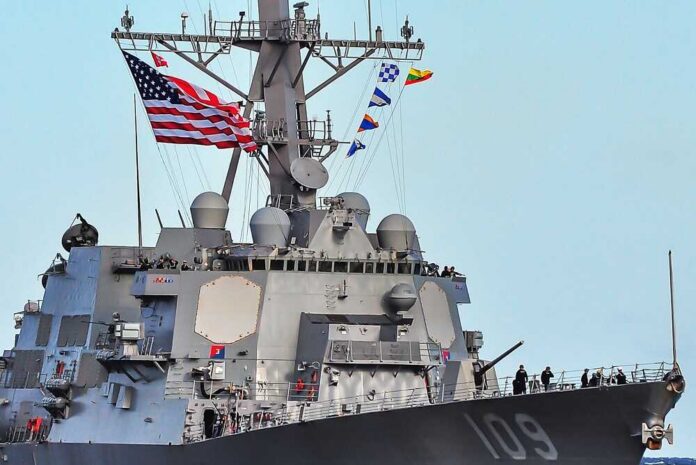
A quiet White House idea to sell “VIP passes” for U.S. Navy tanker escorts through Hormuz is testing how far Washington should go in turning national defense into a billable service.
Story Snapshot
- Trump has authorized U.S. Navy escorts and federal risk insurance to keep oil flowing through Hormuz.
- Officials have discussed a paid, “VIP pass” fast lane for tankers that want expedited, escorted passage.
- Military leaders and Energy Secretary Christopher Wright say large-scale escorts cannot start yet.
- Conservatives must weigh using U.S. power to defend free trade without growing a permanent escort bureaucracy.
What the Trump Team Has Put on the Table
President Donald Trump has made one thing crystal clear: the United States will not let Iran choke off the energy lifeline that runs through the Strait of Hormuz. In March, he ordered the United States Navy to be ready to escort tankers “as soon as possible” if needed and told the United States International Development Finance Corporation to provide political risk insurance and guarantees for all maritime trade, especially energy cargoes, in the Gulf at a reasonable price.[3] That move put Washington’s financial and military weight behind global shipping without raiding the Strategic Petroleum Reserve.[3] It is a classic Trump approach: use American strength to calm markets, push back against hostile regimes, and avoid surrendering energy leverage to globalist institutions.
Since then, aides have worked to turn that pledge into something shippers can actually use. Reports say the White House has discussed plans for U.S. naval escorts with partner navies and is already in the “preparatory phase” of a larger operation.[5] The idea is to clear mines, hit Iranian launch sites that threaten ships, and then run convoy-style escorts with staging areas at each end of the narrow waterway.[5] This would echo past missions like the 1980s tanker convoys, but on a modern battlefield with missiles, drones, and mines. For many conservatives, that sounds like a necessary use of hard power to protect free trade and keep gas prices from exploding at home.
The Controversial “VIP Pass” and Who Pays the Bill
Now a new detail is drawing fire and questions: a possible paid “VIP pass” for tankers. According to a report based on people familiar with talks, Trump administration officials floated to industry the idea of letting shipowners pay a fee for expedited passage through Hormuz, possibly escorted by U.S. naval ships.[1] One source described it as putting a “VIP pass” on your ship, with a fee tied to faster clearance and maybe a military escort.[1] The same reporting says the administration already put about $20 billion of political insurance on the table earlier this year, but few companies took the offer because they feared Iran’s missiles and drones more than they liked cheaper coverage.[1] That raises a core question for our side: when does smart cost-sharing cross into turning the U.S. military into a pay-per-use security service for global shippers?
Conservatives have long argued that America should not be the world’s free security guard while other countries and giant corporations ride for free. Trump’s team is trying to solve that by blending escorts with government-backed insurance so costs are shared and risk is priced in.[2][3] In theory, a fee-based fast lane could make foreign companies help cover the burden carried by American taxpayers. But it also risks something else we hate: a new semi-permanent Washington “service” that can grow, add layers of rules, and turn U.S. warships into traffic cops for hire. If energy multinationals get comfortable paying for escorts, they may push to keep that option forever, even when the crisis passes, creating yet another way for government to grow in size and reach.
Readiness Gaps, Free Markets, and What Comes Next
The other hard reality is readiness. Even as Trump promises escorts when needed, his own Energy Secretary Christopher Wright has said the Navy is “simply not ready” to launch wide escort operations right now, with assets focused on knocking down Iran’s offensive weapons and factories.[6] Treasury Secretary Scott Bessent has said operations will start “as soon as it is militarily possible,” making clear the plan is real but not yet fully in place.[6] Analysts describe a two-step process: first reduce Iran’s ability to kill ships, then begin convoy escorts with air cover, mine clearing, and quick reaction forces.[5] In short, the administration is trying to walk a tightrope between strong deterrence and not overpromising what commanders can safely deliver.
For conservative readers, the stakes are bigger than one narrow waterway. If Iran can scare shipping out of Hormuz, gas prices at home jump, inflation gets worse, and middle-class families pay the price for weakness. At the same time, turning U.S. escorts into a standing, fee-based business model could open the door to more global commitments, more mission creep, and more chances for our troops to be drawn into endless patrols that do not clearly serve core American interests. The Trump White House is betting that limited, conditional escorts plus backed insurance can restore order without a wider war. Our job as citizens is to watch two things closely: that the mission stays tightly focused on defending freedom of navigation, and that any “VIP pass” idea does not become a new pipeline for permanent government expansion or backdoor taxes on energy that families will feel at the pump.
Sources:
[1] Web – Trump Administration Mulls Charging Fees for Naval Escort Through …
[2] Web – ‘VIP pass’: Trump administration mulling how to coax more oil tankers …
[3] Web – Trump administration has vowed to escort oil tankers through Strait of …
[5] Web – Trump administration has vowed to escort oil tankers through Strait …
[6] Web – ‘Free flow of energy’: Donald Trump orders US Navy to escort …