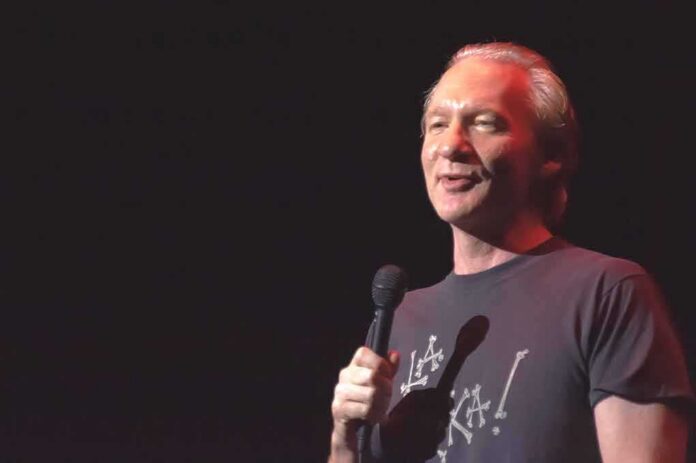
Bill Maher, no friend of religion in general, stopped a guest cold rather than let a false claim about the Quran and the Bible slide by unchallenged.
Quick Take
- Bill Maher interrupted comedian Max Amini on his “Club Random” podcast after Amini claimed the Quran and Bible are “basically the same book.”
- Maher told Amini flatly, “It’s not really accurate,” and refused to let the comparison stand uncorrected.
- The same episode covered Iran, regime change, and Amini’s comments about people fighting the United States and Israel.
- Amini later faced online backlash for calling those fighters a different “species” with “no sense of morals.”
Maher Draws A Hard Line On Religious Claims
The August 17 episode of “Club Random with Bill Maher” featured Iranian-American comedian Max Amini in a wide-ranging talk about faith, family, and Iran. Amini argued that if people just took the good parts of each holy book, religions would look nearly identical. Maher cut him off immediately.
“I gotta stop you there, man,” Maher said. “It’s not really accurate, because the Quran and the Bible are not like the same book, just in a different language. They’re just not.” He said it plainly, without hedging, and moved the conversation forward.
A Host Known For Blunt Talk On Islam
Maher has a long history of picking fights over Islam, dating back to his famous 2014 clash with Ben Affleck on “Real Time.” Maher revealed on the same Amini episode that he and Affleck still have not patched things up over that disagreement more than a decade later. That history matters here, because it shows Maher’s pushback on Amini was not a one-off stunt. It fits a pattern of a host who says religions are not interchangeable, no matter how uncomfortable that makes his liberal peers.
For years, conservatives have watched mainstream hosts avoid tough questions about Islam to dodge accusations of bigotry. Maher, an atheist who mocks Christianity just as often, does not play that game. When a guest tried to soften real differences between faiths, he said so on the spot. That kind of honesty, even from an unlikely source, is worth noting for readers tired of media figures who flinch at hard truths.
Conversation Turns To Iran And Regime Change
The episode did not stay on religion. Maher and Amini also debated the war in Iran and whether the United States can be trusted to finish what it starts, with Maher comparing the moment to the failed Bay of Pigs invasion. Amini pushed back, explaining why many Iranian protesters believed American backing could still change their country’s future.
Amini also drew a sharp line between the Iranian people and their government, saying those fighting against the United States and Israel are not ordinary Iranians. He described that group in stark terms, calling them a different “species” with “no sense of morals,” and argued Washington’s fight is with Iran’s regime, not its citizens.
Backlash Follows The Iran Remarks
Those “species” comments drew swift criticism online, with some accusing Amini of dehumanizing language even as he tried to defend ordinary Iranians from blame. Comment sections under the episode’s social clips split sharply, with some users accusing Maher of Islamophobia and others defending his correction as basic accuracy. That reaction fits a broader pattern researchers have flagged: short, provocative clips travel further online than the fuller context surrounding them, feeding outrage over understanding.
Bill Maher spent years acting anti-religion only to drop the mask as a hardcore Zionist. Seeing clueless Max Amini sell out his own people on his show—calling them a "species"—is sickening. Trump’s war isn't for Iran; it’s for Israel’s agenda. Pathetic, Max 🤡
— Azita (@Azita1337) August 18, 2026
That split reaction says less about Maher and more about how outrage spreads online. A study on “ragebait” culture found platforms reward moral anger, pushing the sharpest soundbite past viewers rather than the full exchange. Readers who only saw a ten-second clip likely missed both the religious debate and the Iran discussion that followed it, leaving a distorted picture of what actually happened on the show.
Why This Exchange Resonates With Conservatives
Conservatives have long argued that treating all religions as identical ignores real theological and historical differences, especially when discussing violence tied to radical interpretations of Islam. Maher, despite his own record of mocking Christianity, refused to let a guest paper over those differences for the sake of a feel-good moment. That kind of unfiltered pushback is rare on late-night and podcast platforms today, where guests often get a pass on sweeping claims about faith.
Whatever one thinks of Maher’s politics, his willingness to correct a guest live, on the record, without apology, stands out. It is a reminder that honest conversations about religion and geopolitics still happen in mainstream media, even if they get flattened into outrage clips before most people ever hear the full exchange.
Sources:
townhall.com, mediaite.com, instagram.com