Comedian Jon Stewart pointed to a rusting Navy warship on live TV to claim President Trump is living in denial, reviving a decade-old late-night attack line against the president.
Quick Take
- Jon Stewart used the USS Abraham Lincoln’s worn condition to accuse Trump of “denial of reality” on The Daily Show.
- Trump had said sailors called the carrier “beautifully maintained” after a 286-day deployment.
- Stewart also mocked Trump’s order renaming Lake Ontario “Lake America” during the Canada trade fight.
- A Reuters/Ipsos poll found most Americans oppose both the new Canada tariffs and the lake renaming.
Stewart Targets Trump Over the USS Abraham Lincoln
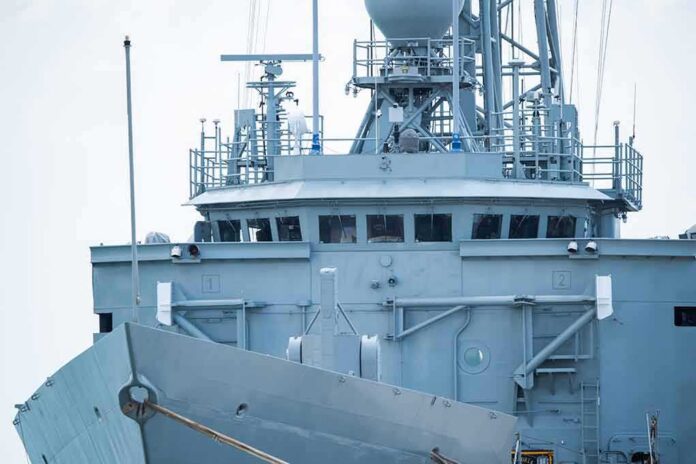
Jon Stewart opened his segment by mocking President Trump’s comments about the USS Abraham Lincoln, a Navy aircraft carrier that just wrapped a grueling 286-day deployment. Trump had said sailors aboard told him the ship was “beautifully maintained and beautifully taken care of.” Stewart flatly disagreed on air, pointing to visible rust and corrosion on the vessel’s hull as proof the president was ignoring plain facts.
Stewart called Trump’s comment part of a “relentless denial of reality” that he said is “eating away at the foundational load-bearing structures that hold this country together.” It’s a punchy line for a comedy show, but it’s also the same broad brush late-night hosts have used against Trump since 2016. A ship showing wear after nearly ten months at sea isn’t shocking; sailors calling a well-run ship well-maintained isn’t either.
The Lake Ontario Renaming Adds Fuel to the Fire
Stewart’s segment didn’t stop at the carrier. He also seized on Trump’s order renaming Lake Ontario “Lake America,” signed as tensions with Canada escalated over tariffs on tens of billions of dollars in cross-border trade. Trump said the change was “effective immediately” and framed it as a jab at Canada during the dispute, which also included new duties on Canadian goods.
The stunt didn’t sit well with the public. A Reuters/Ipsos poll released days later found a majority of Americans opposed both the new Canada tariffs and the lake renaming order. That’s a fair data point for conservatives to weigh honestly: symbolic gestures in a trade fight can distract from the substance of the policy, and voters notice the difference between theater and results.
A Familiar Late-Night Playbook
Stewart’s larger point ties into a real, well-documented trend: trust in political institutions has been sliding for decades, long before Trump ever ran for office. Researchers tracking global survey data found declining confidence in elected institutions stretching back to the late 1950s, while trust in courts, police, and civil services has held steadier. That’s a structural problem across parties, not something one president invented.
Framing every Trump statement as a symptom of “denial of reality” flattens a much bigger story about why Americans have grown skeptical of Washington, the media, and now even late-night comedy itself. Conservatives watching Stewart’s monologue should separate the legitimate policy critique, like whether a tariff stunt actually helps American workers, from the recycled personal attacks that have defined anti-Trump comedy for a decade.
The Navy carrier’s condition after nearly a year at sea is a maintenance and budget question worth real scrutiny, not a punchline. Likewise, the Lake Ontario order deserves judgment on whether it strengthens America’s hand with Canada, not on how it plays for a studio audience. Facts matter, but so does keeping the focus on substance over spectacle.
Sources:
mediaite.com, telegraph.co.uk, reuters.com, bbc.com