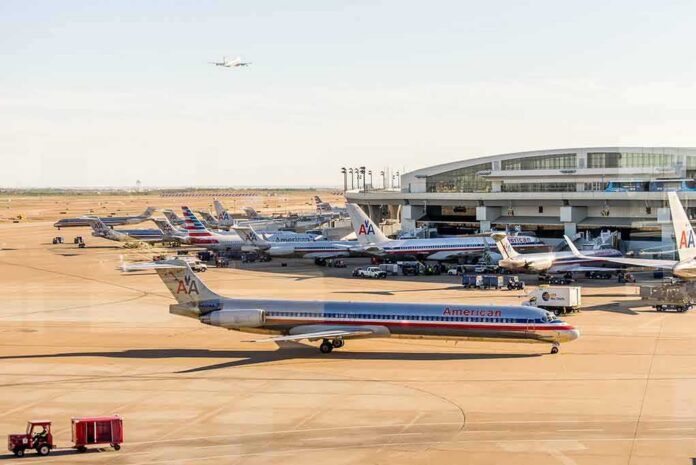
Dallas–Fort Worth International Airport will add Islamic ablution stations inside Terminal D restrooms, raising fresh questions about priorities, transparency, and equal treatment for travelers.
Story Snapshot
- Texas filing shows one men’s and one women’s ablution station planned in Terminal D restrooms.
- Reports say the privately funded project aims to support ritual washing and cut wet-floor hazards.
- DFW already installed two ablution stations near the Terminal D chapel in 2019.
- Officials have not released design details or data proving safety gains to the public.
What DFW Filed With Texas Regulators
Texas records show a registered renovation at Dallas–Fort Worth International Airport to add ablution stations in existing Terminal D restrooms. The filing describes one men’s and one women’s station on the concourse level. This signals a defined scope rather than a terminal-wide buildout. The registration number TABS2026026706 anchors the project to July 31, 2026. Public summaries mirror that scope and timing, keeping the change confined to Terminal D restrooms and not the entire airport.
Reports describe the work as privately funded, not a draw on taxpayer-backed airport bonds. That point matters to travelers who worry about cost and mission creep. Outlets summarizing the filing say the goal is twofold: provide a space for ritual washing and reduce water on restroom floors and counters from people using standard sinks for the same purpose. The filing and summaries do not include full plan sheets, contractor details, or technical safety notes available to the public yet.
How This Fits With DFW’s Existing Chapel Facilities
Airport history shows prior steps toward this accommodation. In 2019, Dallas–Fort Worth International Airport announced that the Terminal D interfaith chapel added two ablution stations next to the chapel, along with other upgrades. That means the airport had wudu-capable access near Terminal D years before this restroom project. Chapel directories continue to list chapels across terminals, including Terminal D after security, which aligns with the airport’s pattern of faith accommodations.
Because ablution options already existed near the chapel, the new restroom stations may function as a convenience upgrade. They bring the practice into main restrooms rather than routing travelers to a chapel-adjacent spot. Supporters might see this as practical. Critics may ask whether duplication is necessary or whether design tradeoffs affect other users. The available record does not cite measured demand, such as user counts or survey data, to justify expansion into restrooms.
The Safety Claim And The Public Evidence Gap
Reports say the new stations aim to cut wet floors and counter damage that can happen when people use regular sinks for foot washing. That is a clear, testable claim. But the public record so far includes no engineering memo, slip-and-fall log, or maintenance report to verify the predicted benefit. Without those materials, the safety case rests on a stated goal rather than hard numbers, leaving room for questions about results and cost-effectiveness in a busy terminal.
Dallas-Fort Worth International Airport is introducing dedicated Wudu stations to Terminal D restrooms. ✈️🕋 Fox News
The privately funded installation aims to provide a dedicated space for ritual cleansing while resolving a long-standing maintenance headache:
standard sinks… pic.twitter.com/uIULlLcMsc
— Mazi okwuoma (@MaziEzike_Nedu) August 13, 2026
Design specifics also remain unclear in public summaries. The filings and reposts do not show drainage plans, anti-slip flooring details, cleaning protocols, or accessibility layouts. Those details decide whether a niche fixture helps safety or creates new risks. Releasing plan sheets and incident data would let the public judge if the project meets basic fairness: serve one group’s needs while keeping restrooms safe, clean, and efficient for everyone who passes through Terminal D.
What Conservative Travelers Should Watch
Travelers should track three things. First, scope: one men’s and one women’s station in Terminal D restrooms is the stated limit; any move to expand should be explained and justified. Second, safety: the airport should publish before-and-after data on wet floors, custodial load, and slip claims once the stations open. Third, transparency: plans and funding details should be available so the public can see how the fixtures affect space, traffic flow, and upkeep, without favor or special treatment.
Sources:
facebook.com, x.com, wanderboat.ai, dfwairport.com