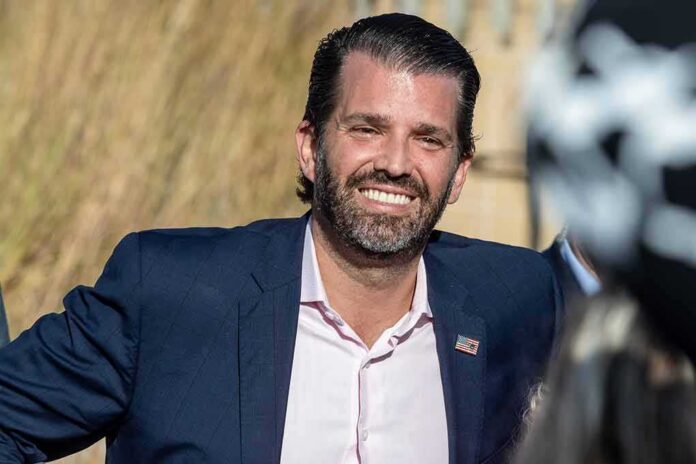
A new report says Donald Trump Jr. opposed the Iran war from day one and told President Trump so in private.
Story Highlights
- The Atlantic reports Donald Trump Jr. privately opposed the Iran war and shared that view with President Trump.
- Publicly, Trump Jr. did not break with his father and at times praised his leadership on Iran.
- The claim relies on unnamed sources; such sourcing is common in sensitive political reporting.
- The report spotlights a larger debate on avoiding open-ended wars while confronting hostile regimes.
What The Report Claims About Trump Jr.’s Private Stance
The Atlantic reported that Donald Trump Jr. “repeatedly voiced his opposition” to the Iran war in private talks, including with President Trump, and that he opposed the war from the outset. Two people who said they spoke directly with him were cited. The piece describes quiet pushback rather than a public split. The report does not quote Trump Jr. on the record. It frames his view as favoring restraint while America confronts Iran’s threats.
News summaries that followed repeated the same core claim. Outlets said Trump Jr. kept his concerns private while the conflict continued, and that he did not publicly criticize President Trump’s decisions. These stories rely on The Atlantic’s account rather than new named sources. They present the picture of a son who voiced concerns behind closed doors while staying loyal in public. That dynamic is common in high stakes national security debates.
Trump Jr.’s Public Messages On Iran During The Conflict
The Atlantic reproduced an April 2024 post where Trump Jr. praised President Trump’s strength after critics warned he would spark a full war with Iran. That message underscored the Trump brand of peace through strength. Later coverage said Trump Jr. still did not break publicly with his father once fighting escalated. Another outlet reported he defended President Trump’s approach when critics attacked a proposed settlement with Tehran in June 2026.
These public signals point to a steady theme. Trump Jr. backed tough deterrence and sought to avoid a wide war. That balance mirrors long-standing conservative goals: end forever wars, crush terror sponsors, and protect American troops. Public praise for strength and private caution can both fit that lane. The reported private talks suggest a push to keep objectives tight and costs low, while still checking Iran’s aggression.
How To Read Anonymous Sourcing In Sensitive Foreign Policy Stories
The Atlantic’s report depends on unnamed sources who claim first-hand talks with Trump Jr. Anonymous sourcing is common in national security and family matters where access is sensitive and retaliation is possible. Ethics guides urge clear explanations of why a source is unnamed and how they know the facts, so readers can judge credibility. That does not prove the claim, but it explains why the account may lack on-the-record quotes.
Research on anonymous sources shows a tradeoff. Unnamed voices can open a window into closed rooms, but they limit outside verification. Readers tend to trust named sources more than anonymous ones, especially on high-stakes topics. For that reason, the strongest use of such reporting is to add context, not to overrun clear facts in public view. Here, the public record shows loyalty and support; the private record, if accurate, shows caution on war costs.
Why This Matters For Conservatives Focused On Peace Through Strength
Conservatives want strong borders, strong families, and a strong military that fights only when needed. The reported Trump Jr. stance tracks those goals. Many on the right remember past elites who rushed into open-ended wars. They want victory defined, missions limited, and an exit that protects American interests. If Trump Jr. urged restraint, that aligns with a core priority: avoid another endless conflict while still deterring Iran’s terror networks and missile threats.
According to The Atlantic, Donald Trump Jr. privately voiced his opposition to the Iran war on multiple occasions and is unhappy about the conflict.
Follow: @AFpost pic.twitter.com/a5vjq2QZCE
— AF Post (@AFpost) October 22, 2026
The split between public unity and reported private caution is not a crisis. It is how serious teams pressure-test major calls. Presidents hear competing views, then decide. President Trump campaigned on no new endless wars and on restoring deterrence. That balance is hard but necessary. The country is safer when leaders debate costs, demand clear goals, and keep America out of nation-building traps. That is the lesson many readers have wanted Washington to relearn since the early 2000s.
Sources:
zerohedge.com, theatlantic.com, independent.co.uk, aol.co.uk, cjr.org, files.eric.ed.gov