After years of “hands-off” excuses, federal agents just moved to take back a Los Angeles park that locals say became a public drug bazaar—yet even this crackdown shows how hard it is to restore order once government lets chaos harden into routine.
Quick Take
- Federal agents and LAPD carried out “Operation Free MacArthur Park,” arresting 18 people tied to a fentanyl and meth network in Los Angeles’ Westlake neighborhood.
- Prosecutors charged 25 defendants in total, with seven still listed as fugitives as of May 6, 2026.
- Officials framed the sweep as an effort to reclaim a park long plagued by open-air drug sales allegedly linked to the 18th Street Gang.
- Despite viral claims about a “40 pounds of fentanyl” seizure, the available reporting summarized in the research does not confirm a specific quantity taken in this operation.
What Happened in “Operation Free MacArthur Park”
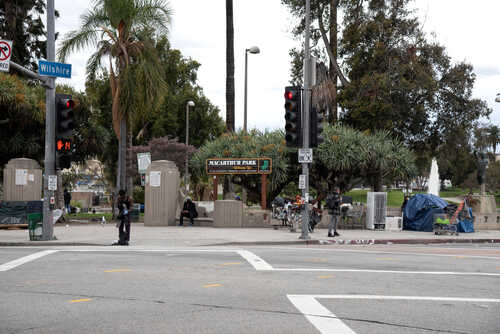
Federal agents working with LAPD swept into MacArthur Park in Los Angeles this week, targeting what authorities described as an entrenched open-air market for fentanyl and methamphetamine. The operation resulted in 18 arrests tied to a broader case charging 25 defendants, with seven suspects still at large. Investigators focused on alleged suppliers and coordinators rather than only low-level street sellers, aiming to disrupt how drugs were fed into the Alvarado Corridor.
Authorities identified alleged key suppliers connected to the distribution chain. The research summary names Mallaly Moreno-Lopez, 31, and Jackson Tarfur, 28, as alleged main suppliers linked to the 18th Street Gang, accused of providing drugs for street-level distribution in the area. Additional suppliers named include Yolanda Iriarte-Avila, 40, of Calabasas, and Jesus Morales-Landel, 33, of South Los Angeles. Agents also served warrants at six corridor businesses, underscoring how storefronts can become logistics hubs.
The “40 Pounds” Claim vs. What’s Verified So Far
Online posts described the sweep as a “blitz” that seized “40 pounds of fentanyl,” a detail that instantly drew attention because it implies a dramatic physical interdiction. The research methodology, however, flags a key limitation: no evidence was found confirming that specific quantity in connection with the MacArthur Park operation as reported. The more solidly supported facts center on arrests, indictments, and the alleged supply network, not an itemized fentanyl weight announced to the public.
That distinction matters because Americans are drowning in headline whiplash—big numbers get shared, then quietly walk back. For conservatives and many independents, credibility is part of public safety: the public deserves clear, verifiable details when officials claim major wins. The research notes that reporting emphasized disruption of the supply chain and the use of tents and businesses for concealment, which points to a sustained criminal ecosystem rather than a one-time “record seizure” narrative.
Why MacArthur Park Became a Flashpoint
MacArthur Park’s problems are not new. The research describes the area as an open-air drug market dating back to the 1980s, with gang influence recurring over decades and fentanyl’s post-2020 surge worsening the stakes. High homelessness in the surrounding Westlake area has also complicated enforcement, because encampments can be exploited to hide drugs while ordinary residents lose safe access to shared public space. The result is a familiar pattern: disorder spreads, then taxpayers fund cleanup.
Officials portrayed the sweep as part of a broader federal push against open-air markets and transnational-linked gangs during Trump’s second term. The research also notes prior March 2026 federal arrests of 18th Street members for violent and trafficking-related crimes, suggesting investigators were building cases over time rather than improvising. If the government’s core duty is to secure basic order, then reclaiming parks and corridors is not “over-policing”—it is restoring the baseline conditions families need to live, work, and move freely.
What Comes Next: Disruption vs. Displacement
The next test is whether enforcement is sustained long enough to prevent the market from simply relocating. A DOJ COPS analysis cited in the research argues arrests alone often fail unless authorities also constrict the operating environment with visible, consistent pressure and practical tools that make dealing harder. The research warns that drug markets can adapt quickly, especially when the underlying demand is high and the social environment provides cover. That is why residents often feel government shows up only for temporary optics.
DOJ Launches Blitz on LA's Open-Air Drug Market, Seizes 40 Pounds of Fentanyl https://t.co/wHP6G21jl1
— Carol RN *Miss Rush & the Gipper* 👩⚕️🇺🇸 🇮🇱🦈 (@pasqueflower19) May 7, 2026
For communities, the stakes are immediate. The research references more than 1,800 overdose deaths in Los Angeles County in 2025, many linked to fentanyl, which is precisely why open-air markets become political lightning rods. Conservatives tend to focus on the right to safe streets and accountability for criminals, while many liberals emphasize addiction and root causes. Both sides, however, increasingly agree on a blunt reality: when institutions tolerate lawlessness for too long, ordinary people—not elites—pay the price first.
Sources:
Feds sweep into MacArthur Park targeting ‘open-air drug market’
DOJ COPS report on strategies for disrupting drug markets