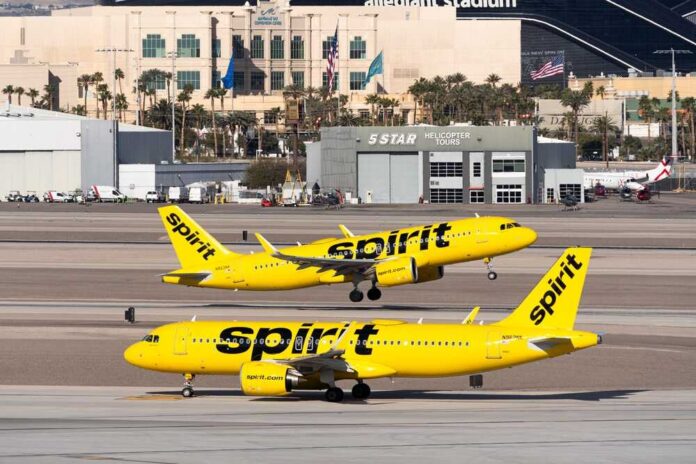
Spirit’s overnight collapse is a hard reminder that when Washington and Wall Street clash, everyday travelers and workers get stranded first.
Story Snapshot
- Spirit Airlines abruptly ceased operations early Saturday, May 2, 2026, canceling all flights and ending customer service as an “orderly wind-down” began.
- A proposed $500 million federal bailout tied to steep government equity warrants reportedly fell apart amid creditor resistance and internal administration disagreements.
- Thousands of passengers were left scrambling at airports, while roughly 20,000 employees and many contractors faced immediate uncertainty.
- Competitors moved to absorb stranded travelers with capped fares and special accommodations, but analysts warned reduced capacity could push ticket prices higher.
An Overnight Shutdown That Left Travelers With No Options
Spirit Airlines, the Florida-based ultra-low-cost carrier known for its bright yellow planes, ceased operations early Saturday, May 2, 2026, according to multiple reports. The shutdown was immediate: flights were canceled across the system, customer service ended, and passengers reported arriving at airports to learn their itineraries had vanished. Because the airline had been operating under bankruptcy protection, the sudden stop raised immediate questions about refunds and who gets paid first.
The whiplash was intensified by messaging in the final hours. Reports indicated that before the closure, Spirit maintained it was “operating as usual,” only to reverse course with a wind-down statement once last-ditch financing and policy negotiations failed. For families traveling on tight budgets, that kind of overnight failure is more than an inconvenience—it can mean missed work, missed events, and unexpected costs that hit hardest when household finances already feel stretched by inflation.
Why the $500 Million Bailout Collapsed Under Trump’s Watch
Spirit’s fate turned on a proposed $500 million federal lifeline that reportedly included 90% equity warrants for the government—an arrangement designed to protect taxpayers if the airline recovered. According to coverage of the talks, bondholders pushed back on the terms, preferring a path that maximized their recovery rather than accepting dilution and government involvement. Reports also described internal pushback within the administration, underscoring how even a GOP-led Washington can fracture over intervention versus market discipline.
That tension is the core political story. Many conservatives want limited government and resent bailouts that feel like picking winners and losers. At the same time, voters across the spectrum increasingly suspect the system is wired for insiders—where creditors, lobbyists, and connected players navigate the rules while consumers absorb the chaos. The Spirit episode does not prove corruption on its own, but it does highlight a recurring reality: ordinary Americans often sit at the bottom of the priority list when complex financial restructurings collide with public policy.
What Happens to Refunds, Jobs, and a Region That Relied on Spirit
Refunds were immediately uncertain, and reporting emphasized that in a liquidation scenario, consumers are often not the first priority. That matters because Spirit’s business model attracted price-sensitive travelers who may not have used travel insurance or flexible fares. On the labor side, the company’s footprint was significant, with roughly 20,000 employees affected and about half reportedly tied to South Florida, alongside thousands of contractors whose livelihoods can disappear even faster than payroll jobs.
Higher Fares and Fewer Seats: The Hidden Cost of Losing a Discount Carrier
Spirit’s exit also threatens to tighten capacity right as summer travel demand builds. Analysts cited by major outlets warned that when seats disappear, prices usually rise, especially with jet fuel costs already elevated. Cirium data referenced in coverage suggested that when Spirit previously exited routes, average round-trip fares increased about 23% (roughly $60) and passenger volumes fell about 20%. Those numbers won’t map perfectly to every city, but the direction of travel is clear: less competition rarely makes travel cheaper.
BREAKING: Spirit Airlines ceases operations overnight, thousands stranded | Wake Up America Weekendhttps://t.co/EyLceG9Lje
— ConspiracyDailyUpdat (@conspiracydup) May 2, 2026
Other airlines—including American, JetBlue, United, and Frontier—moved quickly with capped fares and special accommodations for stranded passengers, but capacity cannot be replaced instantly. Planes, crews, and airport slots take time to reassign, and peak-season schedules are already tight. Politically, the episode will fuel competing arguments: some will say government should never intervene, while others will argue that market failures punish the public. Either way, the immediate lesson is practical—when a carrier is in distress, travelers may need contingency plans that don’t depend on last-minute Washington deals.
Sources:
https://www.cbsnews.com/news/spirit-airlines-tickets-flghts-shutting-down-impact/
https://www.flightradar24.com/blog/aviation-news/airline-news/spirit-airlines-ceases-operations/