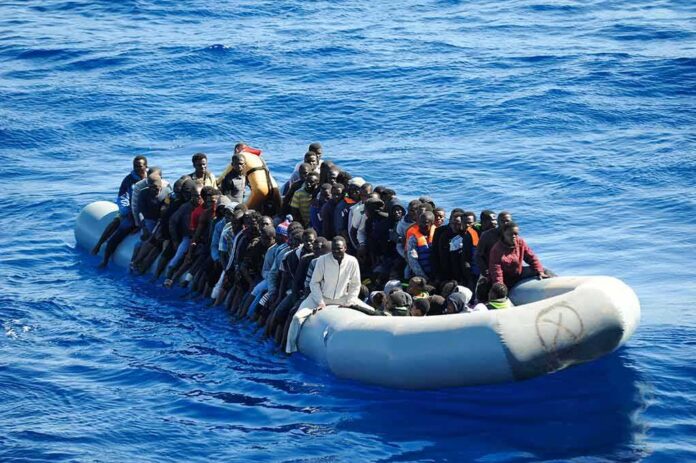
Britain’s Home Secretary just announced she’ll open new legal doors for refugees while small boats keep crossing the English Channel.
Quick Take
- Home Secretary Shabana Mahmood reopened the UK Resettlement Scheme and unveiled three new “safe and legal routes” for refugees.
- Charities, universities, and eventually employers will be allowed to sponsor refugees under the new system.
- Conservative critics say the plan does nothing to stop illegal small-boat crossings across the Channel.
- Reform party leader Nigel Farage says Britain is not obligated to take in more migrants at all.
- About a quarter of new arrivals are expected to be Afghan women or Palestinians, officials say.
Resettlement Scheme Reopens Immediately
The Home Office announced the UK Resettlement Scheme will reopen right away for new referrals. Officials call it a “safe and legal route” for what they describe as “genuine refugees”. The government says this move adds to three brand-new pathways first promised in a border policy statement back in November 2025. Roughly one in four people admitted are expected to be Afghan women or Palestinians, according to reporting on the plan.
Mahmood framed the overhaul as a way to protect the asylum system “for a generation”. But the plan does not cap or stop the boats crossing the Channel. It simply creates more legal paths for people to arrive on top of whatever keeps happening at the border. That distinction matters to anyone who has watched years of promises to “take back control” of Britain’s borders come up short.
Charities and Universities Get New Powers
Starting next month, charities and nonprofit groups can apply to sponsor refugees under a “community sponsorship route”. A “student sponsorship route” tied to universities opens at the same time, with the first arrivals expected in autumn 2027. A work-based sponsorship route, letting employers bring in refugees directly, is set to follow in spring 2027. The Home Office admits the new system will run at “a much higher capacity” than the current scheme, though it has not said how many people will ultimately come through it.
Handing sponsorship power to universities and advocacy groups raises an obvious question: who is actually screening these arrivals, and how fast can the numbers grow once the door is open? The government has set no firm ceiling on this expansion, only promising an annual cap will eventually be set based on “community capacity”.
Critics Say the Boats Will Keep Coming
Conservative shadow home secretary Chris Philp pushed back hard on the plan. He said people turned away from any legal scheme “would still try to enter the UK by small boat anyway,” making the whole announcement pointless for border security. Philp’s point cuts to the heart of the matter: new legal routes do not replace illegal crossings, they just add another layer on top of a border that still is not secured.
Farage went further, arguing Britain has no obligation to accept more migrants at all. He said anyone arriving under Labour’s new schemes would not be allowed to stay if his party took power. That’s a direct challenge to the entire premise behind Mahmood’s announcement, and it reflects a frustration shared by many who feel the government keeps rebranding open borders as “managed migration” instead of actually controlling them.
🇬🇧 SHABANA MAHMOOD EXPANDS SAFE REFUGEE ROUTES
The Home Secretary has reopened the UK Resettlement Scheme and announced new capped legal routes for refugees.
Around 25% of referrals are expected to be Afghan women and girls and Palestinians, with arrivals initially in the…
— Rabindra. 🚩 (@rabindraX238) October 7, 2026
A published critique of the speech argued Mahmood’s plan effectively “keeps Britain’s borders wide open for the foreseeable future,” warning that new routes for refugees from Afghanistan and Palestine would be impossible to keep limited in practice once they’re running. Whether that prediction holds, the core fact is clear: Britain’s government chose to expand legal immigration pathways rather than tighten the border itself, even as boat crossings continue unresolved.
What This Means for Border Control
Supporters call this a humane alternative to dangerous Channel crossings that have cost lives. Critics call it a distraction from the failure to actually secure the border. Both things can be true at once, and that is exactly why this policy is drawing fire from the right. Legal routes without enforcement at the border simply mean more arrivals overall, not fewer.
For American conservatives watching from across the Atlantic, Britain’s approach looks familiar. Years of promises to “fix” immigration through managed programs, while the underlying border problem goes unaddressed, rarely produce the control voters actually demanded. Britain’s experiment with expanded safe routes will be worth watching as a preview of what happens when governments choose more paperwork over more fences.
Sources:
theamericanconservative.com, gov.uk, aa.com.tr, metro.co.uk, sundayguardianlive.com, lbc.co.uk, easterneye.biz