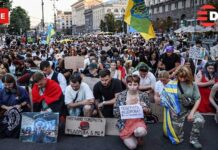

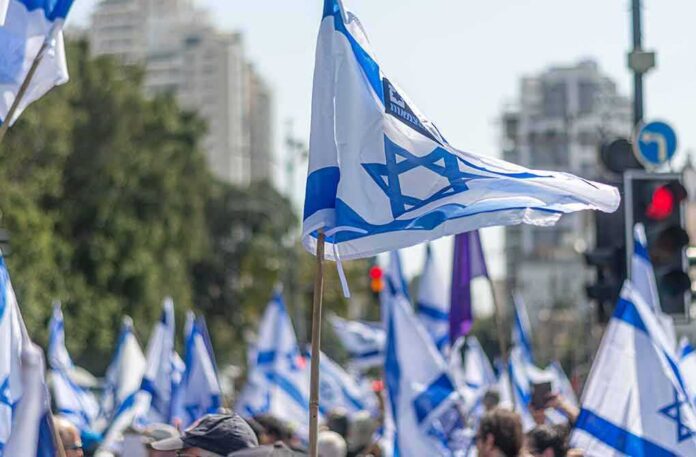
With elections months away, Tel Aviv filled with anti-government protesters who say current policies have failed on security, peace, and social cohesion.
Story Highlights
- Protesters in Tel Aviv accuse the government of backing and funding settler violence.
- Demonstrations demand early elections, a cease-fire deal for hostages, and policy change.
- Organizers say two mosques in the West Bank were set on fire, fueling outrage.
- Prime Minister Benjamin Netanyahu defends stronger policing while calling protest a “sacred right”.
Protest Claims Tie Government To Rising Settler Violence
Associated Press video from the scene shows organizers charging that the government is “backing, funding, supporting” settler violence in the West Bank. A student organizer with the group Standing Together made the claim on camera, linking the Tel Aviv rally to recent mosque arsons in the territory. Separate footage shows police blocking protesters and signs reading “Together against the settlers’ terrorism,” underscoring a march focused on security and rule of law, not just politics.
Protesters say the violence threatens Israel’s long-term security and moral standing. They argue that coercive policies deepen conflict and endanger civilians on both sides. That message, while coming from Israel’s left, reflects a basic principle conservatives recognize: when a government looks the other way on lawlessness, instability grows. Here, the push is for enforcement against criminal acts by any group and for leaders to stop policies that appear to excuse it.
Election Pressure And Demands For Accountability
Media reports describe large and frequent rallies in Tel Aviv over the past two years, with demands ranging from a hostage release deal to early elections. Protesters say leadership failed on the October 7 aftermath and on restoring security. Demonstrators blocked major roads in prior waves and called for a cease-fire tied to freeing hostages, pressing for accountability as voting nears. The movement blends war fatigue with anger at perceived government drift.
Families of victims and hostages have joined the pressure. In one case, parents of a slain hostage urged voters to back only parties that pledge a state commission to investigate the October 7 failures. That mirrors a core conservative value: government must answer for breakdowns that cost lives. Calls for clear benchmarks, secure borders, and decisive action fit the belief that peace comes through strength and competence, not through confused policy or selective enforcement.
Government Response: Security First, But Policing Must Be Even-Handed
Prime Minister Benjamin Netanyahu says Israel cannot allow riots or violence and insists law enforcement must be uniform at all protests. He has called the right to demonstrate within the law “a sacred right,” while warning that selective enforcement would be a “fatal wound” to democracy. The Associated Press has reported that police were directed to allow peaceful demonstrations but to act against vandalism, road blockages, and prohibited flags under set rules.
Netanyahu also argues that protests urging an end to the war without defeating Hamas could harden the terror group’s stance and delay hostage release. He says Israel must “finish the job” against Hamas to prevent another mass-casualty attack and to secure the captives’ return. That framing centers national survival and deterrence. For American readers, this echoes our debates about balancing civil liberties with public safety and about how protests intersect with national security in wartime.
Why This Matters To U.S. Conservatives
These Israeli protests are not just another street drama. They highlight three issues conservatives track closely: border security, equal justice under law, and accountability for failure. Protesters claim state tolerance of lawlessness in the West Bank is spilling into wider instability. The government replies that order matters and policing must be fair and firm. Both sides stress security, but they disagree on what policies deliver it.
Israelis join anti-government protest in Tel Aviv with elections months away #AssociatedPress https://t.co/w4YKHBDgtr
— #TuckFrump (@realTuckFrumper) August 23, 2026
For Americans, the lesson is clear. A free people can protest, but the state must enforce the law evenly. Leaders must protect citizens, secure borders, and tell the truth about mistakes. When policy weakens deterrence or excuses violence, families pay the price. As Israel heads toward elections, voters there will judge competing claims. Our readers can watch for three tests we know well: are streets safe, are laws applied the same to everyone, and are leaders worthy of trust?
Sources:
youtube.com, pbs.org, facebook.com, pressenza.com, wsws.org, timesofisrael.com