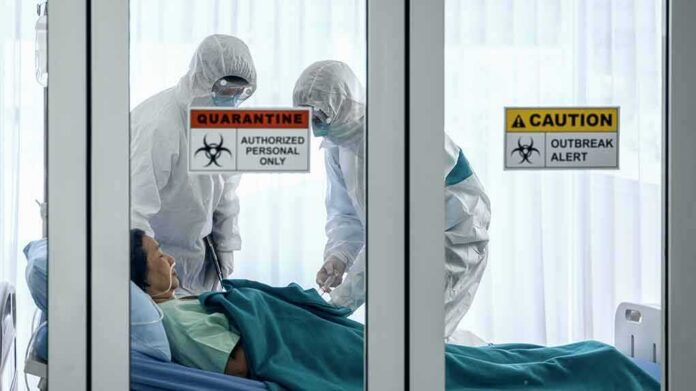
Kenya confirmed its first imported Ebola Bundibugyo case after a traveler from the Democratic Republic of the Congo died in Nairobi, underscoring how fast deadly diseases can cross borders when screening misses early illness.
Story Highlights
- Kenya’s Health Ministry confirmed its first imported Ebola Bundibugyo case; the patient later died.
- The Kenyan citizen had lived in the Democratic Republic of the Congo for seven years and traveled through Uganda.
- Officials said lab tests in two separate facilities confirmed the infection.
- Kenya reported it had raised surveillance and border readiness since May 2026.
Kenya Confirms First Imported Ebola Case And Death
Kenya’s Ministry of Health announced that laboratory testing confirmed its first imported case of Ebola disease caused by the Bundibugyo strain. Officials said the patient, a Kenyan citizen, died in Nairobi shortly after arrival. Health Cabinet Secretary Aden Duale reported that confirmatory tests were run at the National Virology Reference Laboratory and the Kenya Medical Research Institute, and both returned positive results for Ebola Bundibugyo virus disease. The ministry called the case imported, not locally acquired.
Officials identified the patient as a Kenyan national who had lived in the Democratic Republic of the Congo for seven years. Reporting based on ministry statements said the traveler moved from the Democratic Republic of the Congo through Uganda and then entered Kenya. Some outlets described a road trip to Kampala followed by a flight to Nairobi. All reports agree the patient reached Nairobi and died within days, even as minor route details vary across outlets.
Timeline: Illness Before Travel, Routine Airport Screening
Kenya’s health chief said the individual became sick about a month earlier while in the Democratic Republic of the Congo and sought care at several facilities there before traveling. After reaching Nairobi’s main airport, the person cleared routine public health checks and was taken to a hospital by a family member. The patient died soon after, with public updates noting the death occurred late Monday following arrival the prior weekend. At this stage, authorities have emphasized the case was detected and confirmed post-arrival.
Kenya said it had already raised alert levels before this case. The Ministry of Health stated that surveillance, border checks, and response plans were scaled up since May 2026 due to the regional Ebola Bundibugyo outbreak. Officials framed this as part of a standing posture to protect the public and support quick contact tracing. The ministry also highlighted airport protocols and hospital readiness steps designed to isolate and investigate suspect cases as fast as possible.
Regional Pattern: Cross-Border Importations Require Fast Tracing
World Health Organization updates describe a fast-moving Bundibugyo outbreak in the Democratic Republic of the Congo, with cross-border spread to neighboring countries, including Uganda. This pattern reflects how travel across porous borders can bring isolated cases into major hubs, where early triage and tracing decide the outcome. The World Health Organization counts thousands of confirmed cases in the region, reinforcing why countries keep screening at airports and land crossings despite practical limits.
Kenya has confirmed its first imported Ebola case, caused by the Bundibugyo virus. The Kenyan patient fell ill in DR Congo, travelled through Uganda and was isolated after arriving in Nairobi.
The patient has since died while receiving treatment. Health authorities are tracing…
— Chemingoes (@Koecheruiyot) October 6, 2026
Kenya’s confirmation fits this known importation-and-containment cycle. Border checks can reduce risk, but they do not catch every case, especially when symptoms start earlier or appear mild while traveling. The Centers for Disease Control and Prevention has warned that early detection, strong lab capacity, and tight contact tracing are the tools that stop spread once a traveler is already inside a country. Kenya’s dual-lab confirmation and ongoing surveillance reflect that playbook.
What Matters Now: Containment, Transparency, And Travel Vigilance
Health officials are now focused on contact tracing, hospital infection control, and clear public messaging. That means finding close contacts fast, monitoring symptoms, and isolating anyone who becomes ill. Kenya’s preparedness posture, built up since May, should help. The ministry’s next steps could include publishing a contact-tracing brief and a fuller timeline to keep public trust high while protecting patient privacy. Officials have urged calm, stressing that this is a single imported case, not proof of widespread local transmission.
Sources:
bbc.com, bbc.co.uk, english.news.cn, saudigazette.com.sa, standardmedia.co.ke, allafrica.com, chinadailyasia.com, moneyweb.co.za, kenyanews.go.ke, who.int