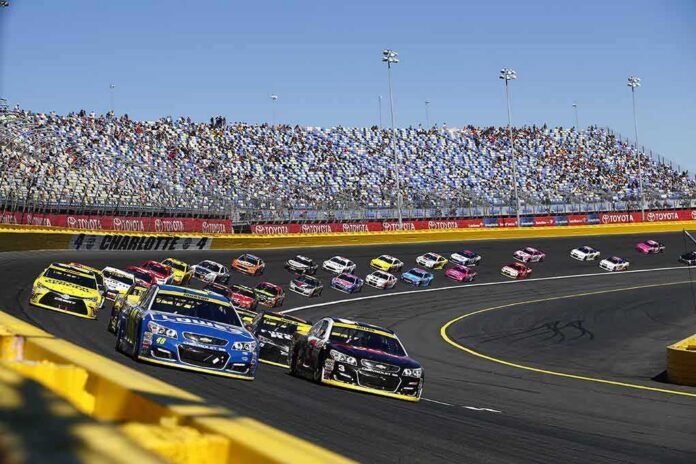
On a night when stock cars roared and grandstands shook, the loudest sound at Charlotte Motor Speedway was the silence left by Kyle Busch’s empty seat.
Story Snapshot
- Fans and drivers turned Charlotte Motor Speedway’s Memorial Day weekend opener into a rolling tribute to the late Kyle Busch, one of NASCAR’s defining modern drivers.[1][3]
- Ross Chastain’s emotional victory and Busch-style celebration showed how deeply Busch’s competitive persona shaped a younger generation of racers.[2]
- Busch’s 234 national-series wins and two NASCAR Cup Series championships now function as both record book and mythology for the sport.[1][3]
- The raw grief in the garage echoed a broader national frustration that powerful institutions only seem to honor people fully after they are gone.
A Memorial Day Weekend That Turned Into A Wake For A Sport’s Giant
Charlotte Motor Speedway has always treated Memorial Day weekend as racing’s unofficial homecoming, but this year the mood shifted from festival to vigil as fans and competitors gathered to honor Kyle Busch’s legacy on and off the track.[3] Track tributes, crowd displays, and broadcast segments framed Busch not just as a winner, but as one of stock-car racing’s “towering, bright lights,” whose absence already felt enormous at the sport’s home court.[1] Every pre-race ceremony carried an undercurrent of shock and disbelief.
Organizers and commentators repeatedly returned to Busch’s career numbers, emphasizing 234 national-series victories and two NASCAR Cup Series championships as achievements that now read less like statistics and more like folklore.[1][3] Writers and former competitors described that win total as the kind of unbreakable mark that moves from box scores into legend, placing Busch in the same rarefied company as the sport’s all-time greats.[1] That framing mattered, because it helped a grieving community translate raw loss into a story about permanence, influence, and memory.
Emotional Drivers, Emotional Fans: How The Garage Processed The Loss
Veteran driver and analyst Hermie Sadler called Busch “one of the last throwbacks,” describing a man who was brash, unapologetic, and often a sore loser, yet whose edge fueled his success.[3] Sadler explained that Busch embraced rivalries and intensity in ways that could divide opinion but undeniably raised the sport’s competitive bar, challenging younger drivers to toughen their approach.[3] That honesty about Busch’s polarizing personality gave the tributes a layered tone, blending admiration with acknowledgement of conflict rather than pretending everyone always agreed about him.
Current drivers echoed that mixture of awe and tension as they shared memories of battling Busch on track and learning from him away from cameras.[7] Multiple competitors described how his relentless approach forced entire teams to improve engineering, pit strategy, and driver preparation just to keep pace, crediting him with reshaping their understanding of what “professional” meant in modern NASCAR.[7] Some spoke about heated rivalries and bruised egos, but the common thread was respect for a standard that made everyone better, even when they resented him in the moment.
From Victory Lane To Philanthropy: A Legacy Bigger Than Lap Charts
One of the night’s most powerful images came when Ross Chastain won the Charbroil 300 and chose to celebrate not with his own trademark move, but by replicating Busch’s signature Victory Lane routine before anything else.[2] Chastain then stood on the podium alongside teammates wearing Busch hats, turning a standard post-race ceremony into an improvised memorial service that signaled how deeply the late champion’s rituals and swagger had imprinted on the next generation.[2] Fans in the stands responded with both cheers and tears.
Remembering Kyle Busch: Hermie Sadler reflects on the loss of a NASCAR legend | America Right Nowhttps://t.co/rNWqKpU4S0
— ConspiracyDailyUpdat (@conspiracydup) May 23, 2026
Commentators also highlighted a side of Busch many casual viewers knew less about: the family man and philanthropist who created the Bundle of Joy Foundation with his wife Samantha to help couples facing fertility challenges.[3] Coverage emphasized how Busch juggled his own packed schedule with cross-country flights to attend his son Brexton’s youth races, arguing that his commitment to family, charity, and fans extended his impact beyond trophies.[3] That broader portrait reinforced why so many people across political and cultural lines felt the loss personally, not just as a sports headline.
Why This Night Resonated Far Beyond The Track
NASCAR’s tributes unfolded against a national backdrop where many Americans, left and right, believe powerful institutions only deliver authenticity in moments of tragedy, not in public policy or everyday life. Fans who have watched Washington bureaucracy fail on immigration, inflation, and basic economic fairness saw a rare example of a major institution opening its heart instead of its talking points. The contrast made the raw, unscripted emotion at Charlotte feel almost shocking in its sincerity, and therefore deeply healing for a cynical public.
Yet the way Busch’s story is already being shaped also reveals how quickly powerful leagues and media outlets can package grief into a tidy narrative. Tribute coverage tends to smooth over controversy, emphasizing “legend” and “icon” while sidestepping the harder questions about how a polarizing figure changed a sport’s business, culture, and audience.[1][3] For citizens who already distrust elites and suspect that big organizations are always managing perception, that tension is familiar: even when the emotion is real, the framing is curated, and both truths coexist uncomfortably.
What Fans Are Really Mourning
Listening to the crowd at Charlotte, it was clear people were mourning more than one driver. They were grieving a piece of an older America where effort, risk, and courage still seemed to matter more than branding and algorithms. Busch’s rise from raw talent to statistical juggernaut fit that older story line: work hard, compete fiercely, refuse to apologize.[1][3] In a time when many feel locked out by rigged systems and unaccountable elites, that story feels endangered, and his loss makes the fear more tangible.
As the engines cooled and fans filed out, the night left behind an uncomfortable question that applies far beyond NASCAR: Why do our major institutions seem capable of genuine unity and honesty only around funerals and flag-draped moments, but not around the everyday economic and cultural crises squeezing ordinary people? The emotional memorial for Kyle Busch showed that Americans still crave shared meaning and straight talk. The challenge now is demanding that same authenticity while the people we admire are still alive.
Sources:
[1] Web – Kyle Busch leaves legacy as racing world’s towering, bright light
[2] YouTube – Kyle Busch’s legacy will live on forever #nascar #racing #kylebusch
[3] Web – Tributes Pour In After Sudden Death of NASCAR Great …
[7] YouTube – NASCAR drivers share memories about Kyle Busch and reflect on …