

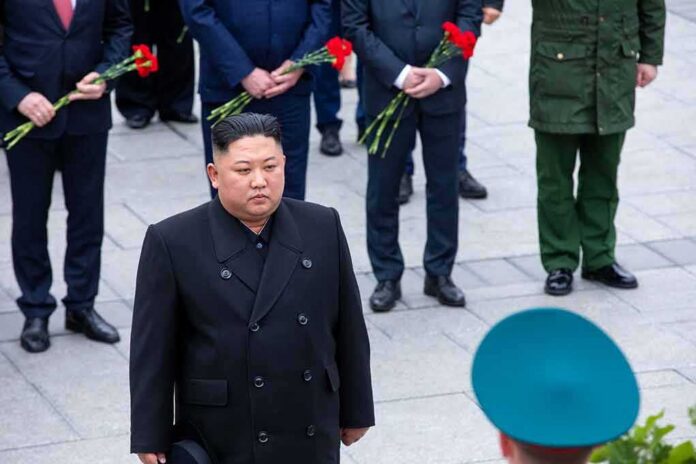
North Korea fired another ballistic missile into the sea just days before American and South Korean troops kick off major joint war games, keeping alive Kim Jong Un’s yearslong pattern of saber-rattling.
Quick Take
- North Korea launched a ballistic missile on August 12 that flew roughly 700 kilometers toward the East Sea.
- The launch came days before the United States and South Korea start the annual Ulchi Freedom Shield exercise.
- It marks North Korea’s second missile test in less than a week and one of many launches in 2026.
- Allied militaries tracked the missile and reported no immediate threat to American troops or territory.
Missile Flies Toward East Sea Days Before War Games
South Korea’s military said North Korea launched the missile from the Wonsan area, sending it about 700 kilometers into the East Sea. The timing was no accident. It came just five days before the United States and South Korea begin their annual Ulchi Freedom Shield drills, a large-scale exercise Pyongyang has long branded an “invasion rehearsal.” South Korea’s Joint Chiefs of Staff confirmed the launch and said they are watching closely for follow-up activity.
This launch followed another short-range ballistic missile test just six days earlier, the first such North Korean test in more than 40 days after an earlier string of weapons demonstrations. Reuters reported that launch also came ahead of joint drills between South Korea and the United States, reinforcing the idea that Kim’s regime uses these exercises as an excuse to flex military muscle on a predictable schedule.
Pattern of Provocation Continues Under Kim Jong Un
This year alone, North Korea has test-fired ballistic missiles at least a dozen times, according to tracking by South Korea and Japan. In April, North Korea launched what was reported as its seventh ballistic missile test of the year, with a fourth in that month alone, fired near the port city of Sinpo. Kim Jong Un personally oversaw one of those tests, which state media said involved warheads carrying cluster bombs and fragmentation mines, according to North Korean state media reporting relayed by Reuters.
The Hindu newspaper described the August tests as a likely protest of the upcoming allied drills, a framing Pyongyang has used for decades to justify its weapons programs. Whatever North Korea calls it, the outcome is the same: a nuclear-armed regime with a record of hostility toward the United States and its allies keeps building and showing off missiles capable of striking its neighbors and, eventually, farther targets.
Historical tracking data compiled by security researchers shows North Korea has conducted missile launches tied to nearly every major joint military exercise cycle for years running. That pattern did not start under President Trump’s watch, but it remains a live threat his administration inherited, and one that demands steady American resolve rather than the empty promises of past nuclear diplomacy that failed to slow Pyongyang down.
Allies Say No Immediate Threat, But Concerns Persist
United States Indo-Pacific Command has said in past incidents that launches like these posed no immediate threat to American personnel, territory, or allies. That assessment matters, because it shows the missile did not strike anywhere near American assets and was tracked start to finish by allied radar and satellite systems. Still, no immediate threat does not mean no threat at all.
North Korea on Wednesday performed its second ballistic missile test in less than a week, its neighbors said, a likely protest of the upcoming South Korea-U.S. military drills that North Korea views as an invasion rehearsal.
Read more: https://t.co/oijIJghDVh pic.twitter.com/fT1PzlfIXM
— WGN TV News (@WGNNews) August 12, 2026
South Korea, Japan, and the United States are reportedly coordinating intelligence sharing after the launch, a sign the three allies are not taking Kim’s provocations lightly. Reuters reported the two nations plan to proceed with their scheduled drills despite the tests, a signal that Washington and Seoul refuse to let North Korean threats dictate the timing of legitimate defensive training.
Conservatives have long argued that weakness invites aggression, and North Korea’s launch calendar backs that up. Every time joint drills approach, Pyongyang fires another missile to test the boundaries of American and allied patience. The correct response is not retreat but continued deterrence, strong alliances, and a missile defense posture that keeps Americans and our allies safe no matter what Kim Jong Un decides to launch next.
Sources:
nbcnews.com, aljazeera.com, reuters.com, x.com, turkiyetoday.com, thehindu.com