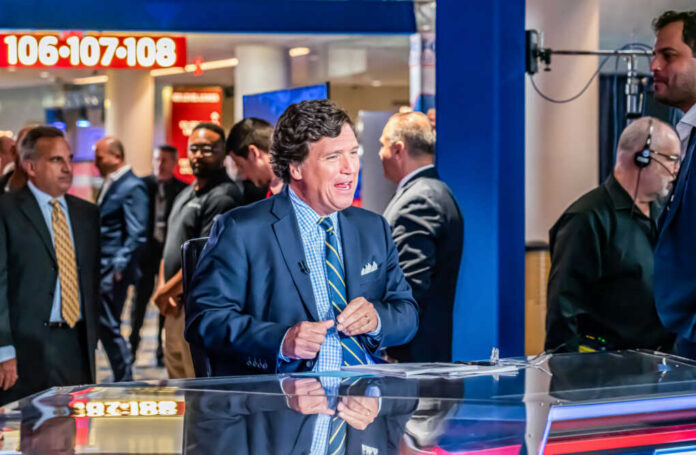
A leading conservative media figure is being confronted with his own audio after denying he suggested President Trump could be the “Antichrist.”
Quick Take
- Scott Jennings blasted Tucker Carlson for denying on a New York Times podcast that he floated “Antichrist” language about Trump.
- Lulu Garcia-Navarro played clips during the interview, forcing Carlson to pivot from denial to a narrower “lack of precision” defense.
- The dispute highlights how influencer politics can reward provocation while punishing accountability when receipts surface.
- For many voters already distrustful of institutions, the episode reinforces a broader sense that political narratives are often marketing, not truth.
Jennings Replays the Tape, Turning a Denial Into a Story
Scott Jennings used his radio platform to rebut Tucker Carlson after a New York Times interview put Carlson on the spot about remarks implying Donald Trump could be the Antichrist. Jennings’ core move was simple: replay Carlson’s own audio and argue the denial collapsed under direct evidence. The clips referenced language about a leader “mocking the God of gods” and asking, “Could this be the Antichrist?”
Jennings framed the moment as a credibility test, not a theological debate. His critique was that Carlson promoted a shocking insinuation to attract attention, then attempted to disown it when confronted by a mainstream interviewer with the record in hand. The conflict matters because it is less about one comment and more about whether high-profile voices will stand by their words when the audience changes.
The NYT Interview Strategy: Evidence First, Then the Follow-Up
Lulu Garcia-Navarro’s interview approach centered on documentation rather than commentary, pressing Carlson with clips from his own show. According to coverage, Carlson first denied making the “Antichrist” remark in that form and then shifted to an “if the video shows it” posture, offering an apology while arguing the line lacked “precision.” That sequencing—deny, then narrow the claim—became the hinge of the controversy.
The documented tension underscores a reality in modern politics: viral rhetoric travels faster than clarifications. When public figures use spiritual or apocalyptic language to describe elected leaders, the impact can spill beyond ordinary policy disagreement into moral panic. Even if meant rhetorically, accusations framed in religious end-times terms can deepen suspicion and tribalism—especially inside coalition politics where unity often determines turnout and fundraising.
Why the “Antichrist” Label Hits a Nerve in the Trump Era
Carlson’s remarks referenced symbolism around Trump’s inauguration, including commentary about Trump not placing his hand on a Bible during swearing-in and what that might signal. In a nation where many voters still take faith seriously, that kind of insinuation can be interpreted as an attack not just on a president but on supporters who see their politics as tied to cultural stability, religious liberty, and resistance to elite scorn.
At the same time, Carlson has positioned his break with Trump partly around the U.S.-Iran conflict and related foreign policy arguments highlighted in reporting. That context matters because it suggests this is not random internet drama; it is a high-profile disagreement over war, alliances, and America’s role abroad. The problem is that intense policy disputes can get flattened into personal or spiritual smears that produce more heat than light.
What This Episode Reveals About Media Incentives and Public Distrust
The strongest fact pattern in the reporting is that clips existed and were played during the interview, making the dispute less about hearsay and more about verifiable content. When that happens, audiences can judge for themselves, and accountability becomes possible. The weakness is that the public still lacks full context beyond excerpts; without full transcripts, viewers are often left to interpret tone and intent secondhand.
For conservatives and liberals who already believe the system is broken, the episode can feel like another reminder that elite media ecosystems—corporate and independent alike—often reward outrage, factionalism, and “gotcha” moments. Limited government and civic trust both suffer when politics becomes a content treadmill. When leaders and influencers treat words as disposable, citizens reasonably ask who is level with them about war, money, and power.
Scott Jennings Demolishes Tucker Carlson’s ‘Trump Is the Antichrist’ Denialhttps://t.co/qWqEw6IP49
— Mediaite (@Mediaite) May 4, 2026
Politically, the immediate effect is more fragmentation on the right at a time when unified messaging typically matters for governing priorities and midterm strategy. The longer-term consequence may be cultural: Americans across the spectrum are tired of institutions that lecture about “misinformation” while tolerating loose rhetoric from influential personalities. The public appetite is shifting toward receipts, clarity, and accountability—no matter which side is speaking.
Sources:
Scott Jennings Demolishes Tucker Carlson’s ‘Trump Is the Antichrist’ Denial
Tucker Carlson Cornered After Denying Donald Trump ‘Antichrist’ Comment